Add AD Mortgage as your preferred source on Google
Why is it important to understand the link between credit scores and mortgage insurance? For mortgage brokers, it is another way to build stronger relationships with their clients and earn their loyalty.
Let’s break down the credit factors that drive insurance costs and leverage that knowledge to structure stronger, 2more affordable loans for your borrowers.
Why Credit Score Drives Mortgage Insurance Costs
A credit score plays one of the most crucial roles when determining how much borrowers pay for mortgage insurance. Lenders use this FICO score to measure risk: the higher the score, the lower the risk of default. Simply put, stronger credit means lower monthly insurance premiums and more affordable homeownership.
Let’s have a look at an example with Private Mortgage Insurance (PMI). A borrower with a FICO score above 760 might pay significantly less, often under 0.5% of the loan amount annually, compared to someone with a score in the 620–639 range, who might pay over 1.5%. FHA loans also adjust MIP costs based on creditworthiness and loan details, though less drastically than conventional PMI.
Understanding how your client’s credit tier affects these costs can help you save thousands over the life of your client’s loan.
Credit Score Basics: FICO 2/4/5 vs VantageScore
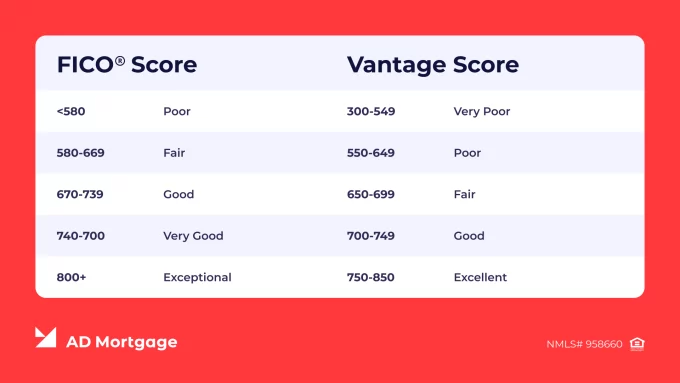
Not all credit scores are treated equally. While many consumers are familiar with VantageScore, lenders typically rely on FICO mortgage scores, specifically versions of FICO 2, 4, and 5, known as “classic” or “mortgage-only” models.
They are used because they’re more conservative and tailored to predict mortgage risk. Each version corresponds to one of the three credit agencies:
Lenders usually pull a tri-merge credit reportwithcombined data from all three agencies. To define your client’s qualifying credit score, you need to use the middle score, not the average.
For example, if your scores are 680, 700, and 720, the lender will use 700 as your official score for underwriting.
The VantageScore might be helpful, but it’s not used in mortgage lending. When working with borrowers, it’s essential to understand the differences between scoring models and which one your lender will use. This helps to set realistic expectations for your clients.
How PMI is Calculated
Private Mortgage Insuranceoccurs when borrowers put down less than 20% of the overall cost of the house. It protects lenders if your client fails to pay for their mortgage.
PMI is calculated based on several key factors:
Loan-to-Value Ratio (LTV) Tiers High LTV means that the loan is riskier for lenders, so the PMI rate is higher. Let’s have a look at the example, PMI at 97% LTV can be nearly double the rate charged at 85% LTV.
Credit Score Multipliers Credit scores also matter. PMI providers use tiered pricing, with FICO scores above 740 qualifying for the best rates. If your client has a FICO of 620, they could pay over 3x more than someone with a 760+ score.
Loan Amount High loan amounts may increase PMI pricing slightly due to increased exposure, especially on loans exceeding $766,550 in 2025. In contrast, low-balance loans may qualify for reduced coverage levels.
FICO Range
Annual PMI Rate (% of loan amount)
760+
0.46 %
740–759
0.58 %
720–739
0.70 %
700–719
0.79 %
680–699
0.98 %
660–679
1.23 %
640–659
1.31 %
620–639
1.50 %
You can also calculate your client’s PMI using a special U.S. Mortgage calculator.
Credit Score Thresholds for Major Loan Types
When advising a borrower on loan eligibility and pricing, it’s essential to know minimum credit score requirements. Here’s a breakdown by loan type:
Conventional Loans (Fannie Mae/Freddie Mac)
Minimum score: 620
Best pricing typically starts at 740+
Scores under 680 may lead to higher interest rates and mortgage insurance premiums
FHA Loans (Federal Housing Administration)
Minimum score for 3.5% down: 580
500–579: Allowed with 10% down, but few lenders approve
Credit scores don’t directly impact MIP cost, but may affect lender overlays
VA Loans (Department of Veterans Affairs)
No official minimum credit score, but most lenders require 580–620
Credit score doesn’t change the VA funding fee, but can affect loan approval and terms
No PMI required, regardless of score
USDA Loans (U.S. Department of Agriculture)
Recommended minimum: 640
Lower scores may still qualify with manual underwriting and strong compensating factors
Like VA loans, USDA does not require PMI, but does charge a ‘guarantee fee’
Top 6 Broker Strategies to Lower Clients’ PMI
As a broker, you can help your clients reduce their PMI costs and significantly improve loan affordability and satisfaction. Here are five practical strategies brokers can use to reduce or eliminate PMI:
Rapid-rescore before closing
If a borrower is just a few points away from a better FICO score, a rapid rescore can level up their score in a few days. Paying down credit cards or correcting reporting errors before closing can move PMI pricing to a lower tier. Potentially, your client can save thousands over the life of the loan.
Split-premium vs BPMI math
Instead of standard Borrower-Paid Mortgage Insurance (BPMI), some borrowers may benefit from a split-premium structure, where a portion of the PMI is paid in advance and the rest on a monthly basis. Brokers should assess the numbers carefully, especially for borrowers with borderline credit or higher LTVs to find the most cost-effective structure.
LPMI trade-off explanation
With LPMI, the lender covers the insurance cost in exchange for a slightly higher interest rate. While this eliminates monthly PMI, it raises long-term interest expenses. Brokers should explain the pros and cons so borrowers can decide whether avoiding PMI now is worth the rate to increase over time.
Piggyback HELOC to hit 80% LTV
For clients with strong credit and enough equity, a “piggyback loan” strategy can help them avoid PMI. This is typically an 80/10/10, which involves a first mortgage at 80% LTV, 10% down, and a second mortgage (HELOC) for the remaining 10%, reducing the primary loan’s LTV and bypassing PMI requirements.
Re-appraise after renovation for PMI cancellation
If the borrower has improved the home’s value through renovations, a new appraisal may push the LTV below 80%. Brokers can advise clients to request PMI cancellation based on the updated value, speeding up removal without waiting for amortization milestones.
Consider Lender-Paid PMI
Some lenders offer lender-paid PMI (LPMI). It means that the lender agrees to pay the PMI. The only thing is that a borrower in exchange pays a slightly higher interest rate on their mortgage.
These strategies give brokers a value-added opportunity to deliver clients the best service and close more cost-effective loans.
Credit Improvement Checklist for Your Borrowers
Payment History
Make sure you’ve explained to your client the importance of paying all bills on time, because missed payments have the most negative impact on their score.
It might be helpful to set up an autopay or reminders to avoid slipping.
Utilization
It is crucial to keep balances below 30% of your credit limits. The ideal scenario is under 10%.
Advise to pay down high balances. Especially on open-ended ones, like credit cards.
Thin-file building
If your client has a short credit history, they can open a secured credit card or become an authorized user on someone else’s account.
Remind your clients that it’s critical to have a positive history.
Eliminate errors
Encourage your clients to review their credit reports from all three bureaus: Equifax, Experian, and TransUnion.
Advise them to dispute any inaccuracies and clean up their report.
Is a Mortgage Possible with a Bad Credit Score?
There’s a possibility of receiving a mortgage even with poor credit history. The main issue here is that even a small increase in your client’s interest rate can cost them thousands of dollars over the life of a mortgage. It’s highly recommended that people take time to improve their credit history before applying for a mortgage.
If your client doesn’t want to wait and is eager to buy a home soon, while still having bad credit, here are a few tips that can help them get a decent interest rate:
Take a look at an FHA loan. With 10% or more down, a borrower could get approved with a score as low as 500.
Minimize possible risks. A borrower can make a larger down payment, pay down credit card balances to reduce their credit utilization rate, or pay off other debts to lower their DTI.
Don’t be in a hurry. Remind your clients that it’s always better to take some time to get preapproved with multiple lenders to get an idea of what’s available based on your credit situation.
Find a cosigner. Your clients may consider asking someone with good credit to apply as a cosigner.
However, there’s no guarantee that these actions will help you qualify for a mortgage on good terms, but they can improve your odds.
FAQs
What credit score cancels PMI?
Credit score alone doesn’t cancel PMI. PMI can be removed when your loan-to-value (LTV) ratio reaches 80%, either through payments or home appreciation. However, a higher credit score (typically 700+) can help you refinance a loan without PMI more easily.
How does a borrower’s credit score impact mortgage insurance premiums?
Credit score is a key factor in determining the cost of PMI. The lower the credit score, the higher the perceived risk to the lender—and the higher the insurance premium. Borrowers with excellent credit scores (typically 760+) receive the lowest PMI rates, while those with scores under 620 may see significantly higher premiums or reduced loan options.
What range of FICO scores typically trigger lower or higher PMI rates?
PMI pricing is tiered by FICO score bands, usually in 20-point increments. For example:
760+: Lowest PMI rates
740–759: Very low
720–739: Moderate
700–719: Higher
Below 700: Substantial increases
Each drop in score tier can add basis points to the premium, especially on loans with high loan-to-value (LTV) ratios.
Can improving a client’s credit score significantly reduce their monthly mortgage insurance costs?
Yes. Even a small improvement in a borrower’s FICO score can push them into a better pricing tier. For example, raising a score from 719 to 720 could lower the PMI by 10–25 basis points, depending on LTV. Over the life of the loan, this can translate into thousands of dollars in savings.
What’s the difference between PMI and MIP, and how does credit score factor into each?
PMI (Private Mortgage Insurance) is used for conventional loans, while MIP (Mortgage Insurance Premium) applies to FHA loans. PMI is credit-score-sensitive where borrowers with higher credit pay less. MIP, on the other hand, has fixed rates regardless of credit score, though recent FHA changes offer slightly reduced MIP for certain credit brackets and loan terms.
How can brokers help clients qualify for better mortgage insurance pricing tiers?
Brokers can guide clients towards improving their credit before locking-in a loan. Strategies include reducing credit card utilization, correcting errors on credit reports, and avoiding new credit inquiries. Running a “what-if” simulator using credit tools can also help brokers forecast the credit score improvement needed to reach a lower PMI tier.
Conclusion
In today’s mortgage market, brokers must understand the relationship between credit scores and mortgage insurance. This knowledge can help deliver competitive, tailored financing solutions.
From navigating PMI pricing tiers to advising on credit improvements or alternative loan structures, brokers who master these dynamics can help clients save on upfront costs and over the life of the loan.
By staying informed and proactive, you achieve two goals: secure better loans and strengthen client trust. Both of these will often lead to long-term business success.
Become an A&D Mortgage Partner Today
Ready to grow your business with competitive loan programs, expert support, and cutting-edge broker tools?
Click here to become an A&D Mortgage partner and strive for success together!
Thank you, you're successfully subscribed! Please confirm your subscription in your email.