DSCR Second Mortgage: How It Works, Requirements, and Use Cases
·14 min read
Participate in 'The State of US Mortgage Professionals 2027' Survey by AD Mortgage
Share Your Voice
Take Our Year-End Survey to Get 500 Loyalty Points and Exclusive Summary TAKE SURVEY
Let’s say your investor borrower wants to access equity they’ve built in a rental property but does not want to refinance the existing first mortgage.
The reasons can vary. Maybe they’re locked into a low interest rate on the first lien, need funds for income-boosting renovations, or want a down payment to acquire more properties. Whatever the scenario, a DSCR Second Mortgage is most likely the solution your borrower is looking for. It lets them qualify based on property cash flow rather than personal income, while the first loan at a low rate stays in place.
DSCR Second Lien at AD Mortgage: Quick Overview
Maximum HCLTV
Minimum DSCR Ratio
Minimum FICO
Loan Amount
75%
1.00 (Gross income / Proposed PITIA)
680
$50,000-$500,000
You have a scenario that matches this description? Let’s discuss it in detail: SUBMIT A SCENARIO
Key Takeaways
Read this guide to learn:
How does a DSCR Second Lien work?
How do you benefit from this program as an MLO?
How to qualify for a DSCR Second at AD Mortgage?
What to choose: DSCR Second Mortgage or Cash-Out Refinance?
How to pitch DSCR Second Mortgage to real estate investors? (A free PDF)
What Is a DSCR Second Mortgage?
A Second Mortgage (or Second Lien) is an additional loan against a property that already carries a first mortgage. It’s a subordinate lien, meaning it gets paid after the first mortgage in the event of foreclosure. See how Second Mortgage works for the basics.
A DSCR Second Mortgage (also called a DSCR HELOAN or Closed-End Second) applies that structure to investment properties. Instead of verifying borrower’s income, lenders qualify based on the debt service coverage ratio.
Second mortgage rates tend to run higher because it’s a second lien, or second in line to get that payment. HELOAN is seen as a lump sum and can be used to pay larger expenses, and HELOC is a revolving line of credit, so you can spend it on smaller expenses.
Anna VeselenakAccount Executive at AD Mortgage
How Does a DSCR Second Mortgage Work?
The investor keeps the existing first mortgage, and the lender records a new second lien behind it, funding a lump sum from part of the property’s equity. Two numbers drive the deal:
CLTV = (First mortgage balance + Second mortgage amount) ÷ property value. The combined loan-to-value (CLTV) limit caps how much equity the investor can pull.
DSCR = Gross Rental Income ÷ PITIA, as defined in AD’s DSCR underwriting requirements. With a second lien, PITIA includes both mortgage payments plus taxes, insurance and association dues. DSCR measures a property’s cash flow against its total debt obligations.
For example, a $600,000 rental has a $330,000 first mortgage and $4,200 in monthly rent. At an illustrative 75% CLTV, the investor could borrow up to $120,000.
If the first-lien PITIA is $2,400 and the second adds $1,050, combined debt service reaches $3,450 and DSCR drops from 1.75 to about 1.22.
The added leverage means stricter underwriting, and lenders may deny a second mortgage if the combined ratio falls below their threshold. See DSCR vs. LTV for how the two metrics interact.
Different Approaches to DSCR
While researching this topic, you may have come across another formula for DSCR: DSCR = NOI (Net Operating Income) ÷ Total Debt Service
The NOI-based formula measures property income after operating expenses against debt service. NOI is not the same as taxable income: depreciation and mortgage interest are excluded from the NOI calculation, while maintenance expenses generally reduce NOI.
In contrast, AD Mortgage utilizes an asset-based approach:
DSCR = Gross Rental Income ÷ PITIA (Principal, Interest, Taxes, Insurance, and association dues)
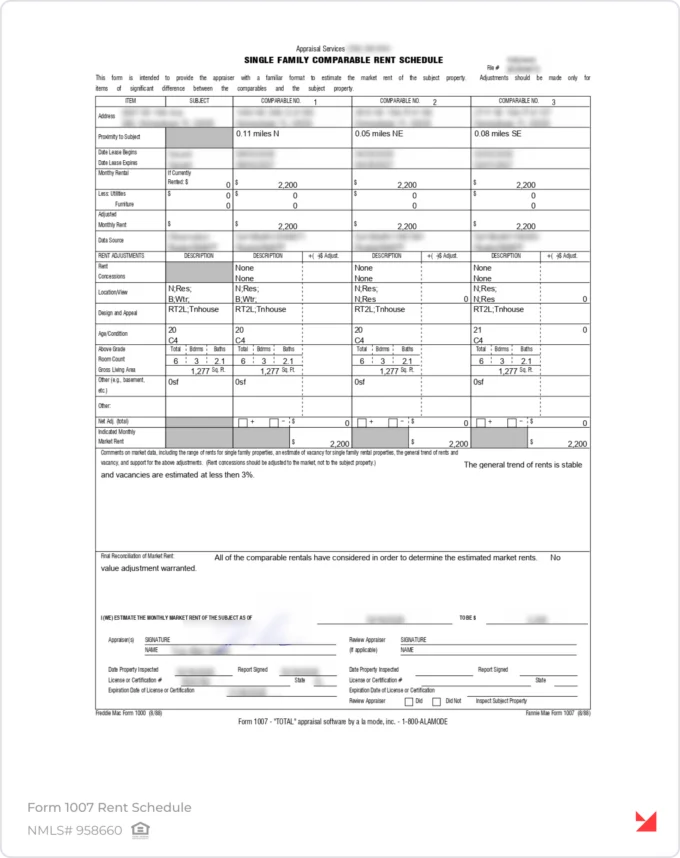
By relying on the appraiser’s 1007 Rent Schedule to determine fair market rent rather than historical tax documentation, this formula allows ‘paper-poor’ but cash-rich investors to bypass personal income verification and DTI calculations entirely.
What are the Benefits of DSCR Second Mortgage?
There are plenty of ways DSCR Second Liens deliver value – for both real estate investors and the brokers who serve them.
Your Advantages as a Broker
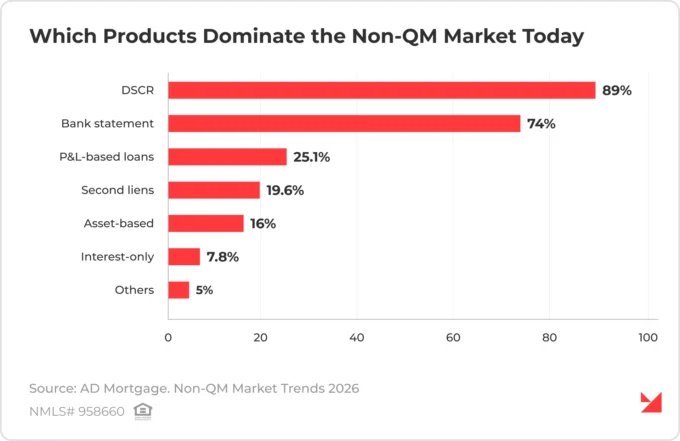
With first-home affordability tightening and investor activity climbing, having DSCR loans in your portfolio is quickly becoming a competitive advantage. Our 2026 Non-QM Market Trends Report backs this up: partners shared that DSCR loans are the central product shaping the Non-QM market, leading at 89.0%.
From a brokerage’s business and profitability standpoint, there are massive benefits to selling DSCR Second Mortgages:
Property-Based Income Qualification: DSCR qualification uses the property’s qualifying rental income and housing payments rather than the borrower’s personal income. Credit, combined leverage, mortgage history, property eligibility and other program requirements still apply.
Database Reactivation (The Lock-In Effect): DSCR Second Mortgages are perfect for waking up your ‘zombie’ CRM of past clients locked into 3% rates, offering them cash-out liquidity without resetting their primary mortgage.
The Portfolio Flywheel: Investors don’t just buy one property – they scale. When you help an investor pull $100k out of Property A using a DSCR second lien, they’re almost always using that cash for the down payment on Property B. By funding the second mortgage, you effectively secure the origination rights for their next loan. You become the financier of their growth, creating an endless flywheel of referrals and repeat business.
Want to partner with a lender that can support you in DSCR portfolio growth?
Here’s how getting a second mortgage for investment property benefits real estate investors.
Keep the Existing First Mortgage
About half of all U.S. mortgages still carry rates of 4% or lower, Federal Reserve Governor Michael S. Barr noted in a September 23, 2026 speech. With the 30-year fixed average at 7.03% for the week of September 24, 2026, according to Freddie Mac, refinancing a low-rate first lien to pull cash can raise the cost of the whole balance. A second mortgage on investment property leaves those terms untouched.
Access Equity Without a Full Refinance
Existing equity does nothing for an investor until they put it to work. A second mortgage turns part of it into additional capital for the next move – without repricing the first lien.
Qualify Around the Investment Property
Many rental property investors write off enough expenses that their tax returns understate their real cash flow. Unlike traditional loans where lenders rely on DTI, a DSCR Second qualifies on the property’s rental income rather than personal income, so complex borrower income documentation stays out of the file.
What are the Typical Use Cases for a DSCR Second Mortgage?
Investors typically put a second mortgage on rental property to work in several ways:
Portfolio expansion: Pulling equity to purchase another property or acquire funds for a down payment on another rental – without selling or refinancing an existing one.
Renovations and value-add property improvements: Proper financial strategy involves funding renovations that raise rent and improve future DSCR, as long as the added income exceeds the new debt service.
Liquidity and reserves: A cushion for repairs, reserve requirements for the next purchase, or quick capital when the right deal hits the market.
When Does DSCR Second Mortgage Make Sense?
Getting a second mortgage for investment property works best with a clear purpose and numbers that hold up. For example, proper financial strategy involves ensuring that the income increase from renovations exceeds new debt service. Before recommending DSCR Second Mortgage, brokers should check the fit:
Potential Fit:
Meaningful available equity
Rental cash flow supports the financing
The borrower wants to preserve the first mortgage
The capital has a clear investment purpose and the property type is eligible.
Potentially Weaker Fit:
Insufficient equity or CLTV room
Rental income doesn’t support qualification
Replacing the first mortgage produces better economics
Two liens cost more than they’re worth, or the investor can’t comfortably carry both payments (missing either one risks foreclosure).
How to Qualify for a DSCR Second Lien at AD Mortgage
Below you’ll find the requirements to qualify for a DSCR Second Lien at AD Mortgage.
Important note: you’ll see that in our matrix we refer to HCLTV instead of CLTV. What is the difference?
Home Equity Combined-Loan-to-Value Ratio (HCLTV) is a ratio that is used when a mortgage financing package includes home equity lines that are potential liens; a ratio that is developed by dividing the sum of the original loan amount of the first mortgage, the amount of the HELOC (whether or not there have been any draws), and the unpaid principal balance of all other subordinate financing by the lower of the property’s sales price or appraised value.
HCLTV is used because a second lien must be evaluated with all debt secured by the property, not on the second lien alone. CLTV generally combines the outstanding first and subordinate-lien balances divided by the property value. HCLTV also includes the full credit limit of an existing HELOC, including its undrawn portion.
For a closed-end second lien, the calculation generally includes the first-lien balance, existing subordinate liens, and proposed second-lien amount. If a HELOC is present, its full line may also be included. This provides a more conservative measure of total potential debt secured by the property.
Let’s Look at a Real-Life Example:
Scenario
A real estate investor already has a HELOC and wants to get a second mortgage to fund renovations.
The Numbers
Appraised Value: $500,000
Existing First Mortgage: $250,000 balance
Existing HELOC: $100,000 approved credit limit
New DSCR Second Mortgage (Closed-end): $50,000 proposed loan amount
Context: The investor currently has a $40,000 drawn balance on the existing HELOC to pay a contractor, leaving a $60,000 undrawn portion.
The Calculations
CLTV (Actual & Proposed Debt): Combines the outstanding first and subordinate-lien balances, plus the proposed second-lien amount.
$250k (first) + $40k (drawn HELOC balance) + $50k (new second mortgage) = $340,000.
$340,000 ÷ $500,000 = 68% CLTV
HCLTV (Potential Debt ÷ ‘Potential Liens’): Includes the first-lien balance, the proposed second-lien amount, and the full credit limit of the existing HELOC (including its undrawn portion).
$250k (first) + $50k (new second mortgage) + $100k (full HELOC limit) = $400,000.
$400,000 ÷ $500,000 = 80% HCLTV
DSCR Second Mortgage: Underwriting Requirements at AD Mortgage
Requirement
AD Mortgage Guidelines
Loan amount
$50,000-$500,000
Max combined loan amount (1st + 2nd)
$4,000,000
Max HCLTV
75%
Minimum credit score
FICO 680 (no-score option for Foreign Nationals)
Qualification
DSCR
DSCR
Borrower income not required for DSCR structure; DSCR must be ≥ 1.00 (Gross income / Proposed PITIA)
In the table below you can see a side-by-side comparison of DSCR Second Mortgage vs. Cash-Out Refinance:
DSCR Second Mortgage vs Cash-Out Refinance
Factor
DSCR Second Mortgage
DSCR Cash-Out Refinance
Existing first mortgage
Remains
Replaced
Amount being repriced
New second-lien balance
Entire refinanced balance
Equity access
Yes
Yes
Number of liens afterward
Two
One
Best considered when
Preserving the first mortgage matters
Replacing the first mortgage makes financial sense
The second-lien rate alone doesn’t tell the whole story, so brokers should compare the blended cost of a second mortgage on investment property against a full refinance of the investment property.
In the first example, the second lien leaves $330,000 at the old rate and prices only $120,000 at the new one, while a cash-out refinance reprices all $450,000. Weigh interest rate, term, and closing costs for each. Replacing the first mortgage can still win when the existing loan carries a high or adjustable rate.
A second mortgage is a cashout. The entire loan amount is cash to borrower. The closing costs come out of the loan amount, so you get less cash than the loan amount technically is.
Ruben NunezBusiness Development Manager at AD Mortgage
Pitching a DSCR Second Mortgage to a real estate investor requires shifting the conversation from ‘getting a loan’ to ‘strategic capital allocation’. Investors don’t just get mortgages – property acquisition allows them to buy leverage, speed, and yield.
To pitch this product effectively, you need to position it as a wealth-building tool that solves the specific pain points investors face in today’s market: high rates, strict DTI limits, and trapped equity.
Here are key points from a comprehensive sales strategy for DSCR Second Mortgage that we prepared for you, including target audience, pitch angles, mathematical rebuttals, and compliance guardrails.
Identify the Right Audience
Focus on those who bought or refinanced between 2020–2022 with a first mortgage rate between 2.5% and 4%.
Choose the Right Pitching Angle
Here is a pitch to choose if you focus on rate retention: ‘Mr. Investor, you are sitting on $150k of trapped equity, but your first mortgage is locked in at 3.5%. If you do a traditional cash-out refi today, you are resetting your entire balance at 7.5%. Let’s keep your cheap first mortgage exactly where it is and just grab a second lien to fund your next deal.’
Handle Prepayment Penalty Objection
Highlighting AD’s ‘20% rule’ can help address this concern. The rule allows investors to pay down up to 20% of the principal annually penalty-free. If a full early payoff triggers a penalty, help the investor weigh that cost against the benefit of accessing fast, non-income-verified capital right now to secure the next deal. For full information, check our Closed-End Second Lien Eligibility Guideline, section 2.6.
Tips for Your Marketing
Target investors who bought properties in 2020-2021 that have since appreciated (lots of equity). Use in your emails subjects like: ‘Keep your 3% interest rate. Unlock your rental’s equity without refinancing.’ Offer a free ‘Blended Rate Analysis’ comparing a full cash-out refi vs. a DSCR second lien.
Top States to Buy Investment Property
If your borrowers ask, what is the best state to buy rental property, there is no ‘one-size-fits-all’ answer: the right choice depends on investment strategy. To help brokers guide investors through the market, we conducted research on top states for property acquisition depending on what borrowers prioritize – growth, rental income, or long-term stability. This ranking can be used to open a focused conversation, not as an investment advice.
Key Insights
To summarize, DSCR Second Mortgage is a great choice for your borrower to expand their portfolio in case they have a first mortgage at a low rate and don’t want to give it up. Now you know that:
DSCR loans are the main driver of the Non-QM market.
A DSCR second mortgage uses rental income and property cash flow to qualify – not tax returns.
The existing first mortgage, and its rate, stays in place.
Available capital depends on the property’s equity and the combined LTV (CLTV) limit. These funds can be used for renovations or acquiring more properties.
Brokers should compare total financing cost against a cash-out refinance, not the second-lien rate alone.
There is no best state to buy rental property. It depends on the investment strategy of your borrower.
Want to expand your portfolio with DSCR Second Mortgages?
When clients ask, ‘Can I get a Second Mortgage on an investment property?’, the answer is often yes – if the property has enough equity, the rent supports both payments, and the first lien allows subordinate financing.
Does the first mortgage have to be a DSCR loan?
Generally, no. The first lien can be a conventional, DSCR, or other loan, subject to the first-lien requirements in AD’s guidelines.
How much equity is needed for a DSCR Second Mortgage?
Enough to keep both liens within the CLTV limit. For example, on a $500,000 property at 75% CLTV, total liens can’t exceed $375,000.
Does a second mortgage affect the property's DSCR?
Yes. The second payment adds to debt service, which lowers DSCR. Underwriting looks at the combined payment.
Thank you, you're successfully subscribed! Please confirm your subscription in your email.