
Alabama Housing Market Q3 2026: Data for MLOs to Finish the Year Strong
| Share Your Voice |
|---|
| Take Our Year-End Survey to Get 500 Loyalty Points and Exclusive Summary TAKE SURVEY |
Thanks to its economic and housing market stability, Alabama’s housing market is a great choice for investors. In our recent ‘U.S. Real Estate Investment Opportunities by State’ report, the state ranks second among the top markets for fundamental investors.
During Q3 2026, Alabama’s market showed a mix of trends: a stable economic backdrop, longer marketing times, and a decline in the number of new listings.
To help Alabama MLOs prepare for Q4, we analyze the Q3 housing and economic data and offer our interpretations.
Alabama Economic Backdrop: Steady Growth Keeps Affordability in Focus
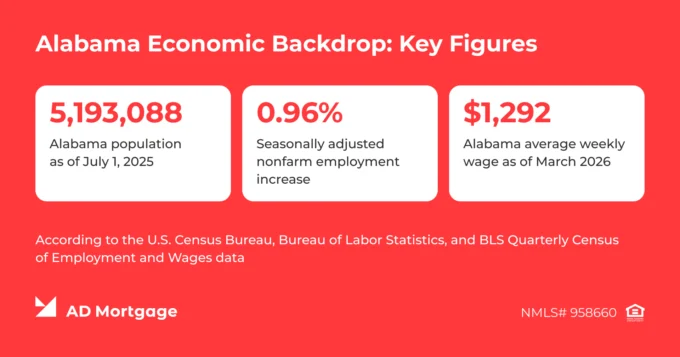
The latest U.S. Census Bureau state estimates indicate moderate year-over-year population growth in Alabama. The state’s population reached 5,193,088 in 2025, up 0.58% from 5,163,055 in 2024. Alabama had 4,075,161 residents age 18 and older, representing 78.5% of the total population.
Employment also increased, according to Bureau of Labor Statistics data. Average nonfarm employment rose from approximately 2,197,000 in Q3 2025 to 2,218,100 in Q3 2026, almost a 1% growth.
Year over year, average weekly wages grew slightly – from $1,247 in March 2025 to $1,292 in March 2026.
Broker Takeaway: Modest growth in population, employment, and wages is evident in most states in Q3 2026. These trends alone do not indicate a sharp increase in housing demand, so affordability remains a key consideration for brokers.
Market trends can provide useful context, but every transaction ultimately comes down to the borrower’s individual financial situation. If you have a scenario that may require a different financing approach, AD Mortgage can help you explore the available options.
Alabama Real Estate Market Slows: More Days on Market, Fewer New Listings
Since reaching a pandemic-era low, the number of active listings in Alabama has been steadily increasing. In September, active listings totaled 22,525 – a level last seen in 2018.
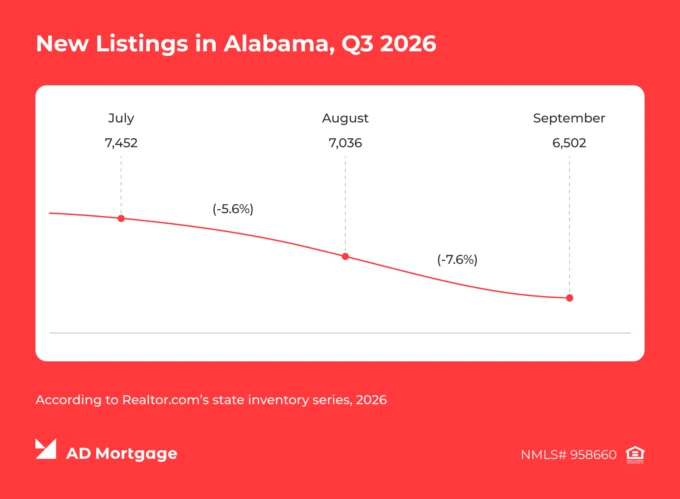
However, according to Realtor.com state inventory series, the number of new listings declined throughout the quarter – falling from 7,452 in July to 7,036 in August and 6,502 in September. Overall, 20,990 new listings entered the market in Q3 2026.
In Q3 2026, Alabama properties spent progressively more time on the market, with median days on market rising from 67 in July to 68 in August and 71 in September. Based on seasonal patterns in previous years, median days on market typically peak in January, suggesting that marketing times could continue to lengthen in Q4.
Broker Takeaway: As buyers take more time to shop and negotiate terms, brokers should prepare for longer timelines from preapproval to closing. Evaluate affordability carefully and discuss whether seller concessions or temporary rate buydowns could help reduce buyers’ upfront costs or initial monthly payments.
Alabama Home Prices: Listing Prices Decline While Sale Prices Rise
Following the national trend, Alabama’s average listing price declined during the third quarter, reaching $438,252 in September. This represents a 1.05% decrease from $442,932 in September 2025. However, the median sale price rose sharply to $275,333, a 17% year-over-year increase, according to the Association of Alabama REALTORS report.
Beyond purchase prices, brokers also need to consider ongoing ownership costs. Alabama ranks among the states with the lowest property taxes in the country, according to Tax-Rates.org. The median annual property tax is $398, while the average annual cost of homeowners insurance is $3,716.
Broker Takeaway: Despite low property taxes, Alabama has the 12th-highest average homeowners insurance premium among states, according to Insurance.com. While declining listing prices can be a useful conversation starter, brokers should consider the full cost of homeownership when evaluating each client’s financing scenario.
High Alabama Homeownership Rate Opens the Door to Second Mortgages
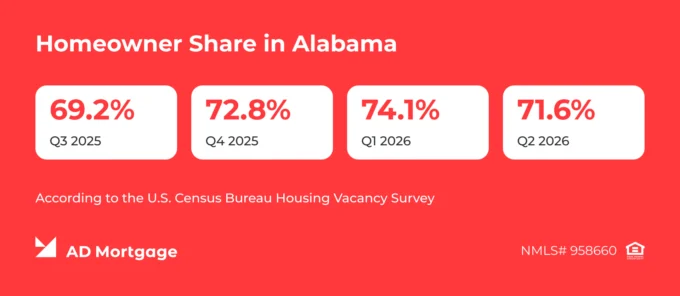
Alabama’s homeownership rate stood at 71.6% in Q2 2026, a slight decrease compared with 74.1% earlier in Q1 2026, according to the Census Bureau’s latest Housing Vacancy Survey.
Of all owner-occupied housing units, 54.1% have a mortgage, according to the latest U.S. Census Bureau data. Of those units, 676,566 have neither a second mortgage nor a home equity loan.
Broker Takeaway: The substantial share of homeowners with an existing mortgage may present opportunities for refinancing or – more popular in the current economy – second-mortgage lending.
Alabama Housing Market Forecast: What to Watch in Q4 2026
With rapid changes in the market, it is challenging to track the full range of indicators, both local and nationwide. We suggest three indicators for you to keep an eye on and a framework to guide your communication with clients:
- New Listings: Fewer listings do not automatically mean reduced affordability. However, if new listings continue to decline, that might be a signal for brokers to explore opportunities in second mortgages and refinancing alongside purchases.
- Days on Market: Longer timelines combined with listing price reductions may indicate stronger negotiating power for buyers. Discuss with your client which homeownership hurdles are the most challenging – upfront costs, a high monthly payment, or the purchase price in general – and explore potential seller concessions that address the borrower’s specific constraint.
- Sales and Prices: Price changes can be a conversation starter. However, regardless of how prices change in Q4, structure the scenario around the overall cost of homeownership – rather than the purchase price alone.
Broker Takeaway: Market changes are a strong reason to contact your client and start discussing financing options. AD Mortgage partners can compare several scenarios using Quick Pricer Pro, available in AIM, and match the borrower with the best-fit solution.
Not a Partner yet? Complete the Broker Package and get access to innovative tools for an efficient loan workflow.