

Conventional lending may be standardized, but how brokers navigate it is not. Qualification challenges and agency execution shape how Conventional loans get done.
AD Mortgage surveyed more than 250 mortgage professionals from September 1-30, 2026 about their Conventional business, borrowers, qualification challenges, and workflows. For this survey, Conventional means Fannie Mae- or Freddie Mac-eligible lending, including standard conforming and high-balance loans.
The survey was conducted during a period of market volatility.
The market may feel uncertain, but people are still looking for a place to call home. We want to give brokers practical options they can bring to those conversations.

1. Conventional Lending Trends and Outlook for 2027
How conventional loan volume has changed since 2023
Conventional has moved in both directions. 30.5% report a larger share of their business than in 2023, exactly matching the 30.5% who report a decline. Another 39.1% have seen little change.
Conventional lending expectations for 2027
46.4% expect Conventional’s share of their business to stay about the same over the next 12–24 months. Growth expectations (34.5%) outweigh decline expectations (19.1%), continuing the broader pattern of mixed experiences and expectations.
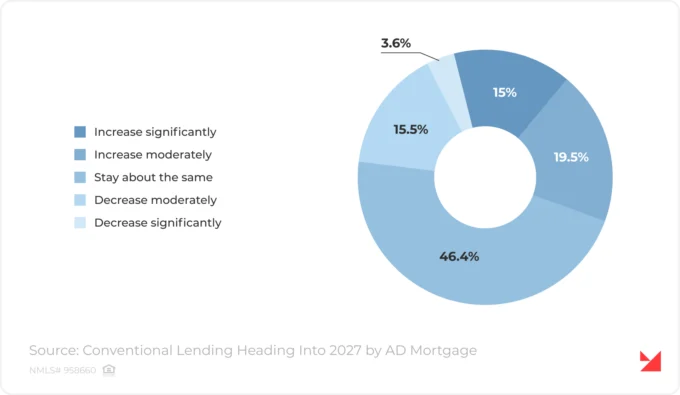
How mortgage professionals see the future of Conventional lending
We asked respondents to choose the statement that best describes where Conventional lending is headed. Views of Conventional’s direction are divided.
“Still the foundation of the mortgage market” is the most common view, at 36.8%
but nearly as many respondents (28.6%) believe Conventional is “losing ground to Non-QM”.
- Still the foundation of the mortgage market – 36.8%
- Losing ground to Non-QM – 28.6%
- More technology-driven than ever – 15.9%
- Defined as much by the property as the borrower – 10%
- Evolving beyond traditional prime lending – 6.8%
- A broader tool for affordability – 1.8%
Responses were collected September 1-30, 2026, during a period of market volatility.
2. Transactions and Borrowers: What Defines the Pipeline
Most common Conventional loan transactions
Standard conforming purchases dominate at 85%, more than twice the rate of any other transaction type. Cash-out refinances (38.6%) and investment-property purchases (38.2%) are nearly tied for second.
Other common transactions include:
- Rate-and-term refinances – 30%
- HomeReady / Home Possible purchases – 25.5%
- High-balance purchases – 13.2%
- Second-home purchases – 12.7%
*Respondents could select multiple options.
Most common Conventional loan borrowers
First-time homebuyers are the clear leader at 40%. No other borrower profile reaches 20%.
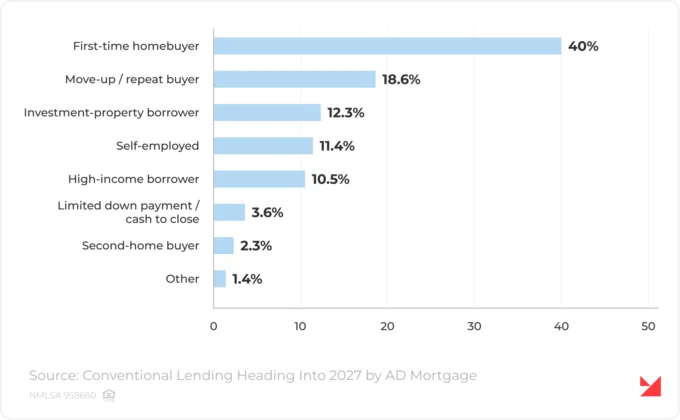
Other profiles include:
- Move-up / repeat buyers – 18.6%
- Investment-property borrowers – 12.3%
- Self-employed borrowers – 11.4%
- High-income borrowers – 10.5%
- Limited down payment / cash to close – 3.6%
- Second-home buyers – 2.3%
3. Conventional Loan Benefits and Qualification Challenges
Why choose Conventional?
Cost stands apart. Better pricing / total cost is selected by 57.7% of respondents, well ahead of lower mortgage insurance / fees (32.3%) and AUS approval / underwriting path (29.1%).
Other frequently selected reasons include:
- Low-down-payment / affordable-lending options – 25.5%
- Faster, more predictable decision-making – 22.7%
- Documentation requirements – 14.5%
- Property / appraisal fit –12.7%
- Higher conforming / high-balance limits – 5.9%
*Respondents could select multiple options.
Biggest Conventional loan qualification challenges
Income / DTI qualification is the clear No. 1 obstacle, selected by 55.0% of respondents. Credit / pricing ranks second at 40.5%, followed by cash to close / reserves (27.3%) and monthly payment (26.8%).
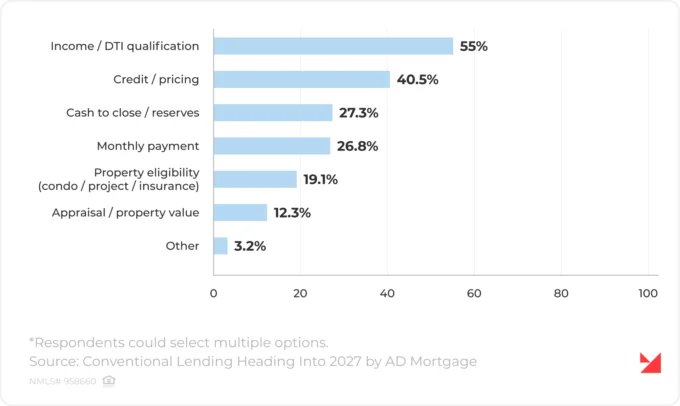
*Respondents could select multiple options.
Property-related issues rank lower: property eligibility is selected by 19.1%, and appraisal / property value by 12.3%.
5. Technology and Automation in Conventional Mortgage Lending
How automated are Conventional mortgage workflows?
Conventional workflows receive a moderate technology and automation rating, trailing the benchmarks from AD Mortgage’s other 2026 surveys.
- 5.6/10 Conventional tech level
- 6.4/10 Non-QM tech level
- 7.2/10 Industry tech level
The benchmarks come from separate AD Mortgage surveys and are provided for descriptive context.