
Post content:
Best Places to Buy a Home in Arizona in 2026

Add AD Mortgage as your preferred source on Google
Arizona offers a wide range of opportunities for homebuyers, and there is no single ‘best’ place to buy a home in the state. From large metropolitan areas to quiet rural communities, Arizona features housing markets that can appeal to first-time buyers, retirees, remote workers, and growing families alike.
Expanding suburbs of Phoenix, mountain landscapes of Flagstaff, and the affordable desert communities of Kingman – Arizona provides a diverse mix of lifestyles and price points. AD Mortgage took a deep dive into the Arizona housing market, reviewed available data, and examined some of the most attractive locations for buyers across the state in 2026.
For buyers interested in mountain living and outdoor recreation, take a look at our report on Flagstaff, or explore our Top Neighborhoods guide for Kingman to learn more about one of Arizona’s more affordable housing markets. We encourage readers to review our findings and work with a local realtor and mortgage professional when evaluating the best place to buy a home in Arizona.
Arizona Real Estate Market Overview
We examined multiple factors when compiling this report to provide a broad overview of the advantages and challenges facing homebuyers, realtors, and mortgage professionals throughout Arizona.
The complete range of research and supporting data is available in the downloadable PDF guide. However, below is an overview of the primary categories we explored and considered while evaluating housing opportunities across the state:
- Median Home Prices
- Homebuying Entry Costs
- Taxes and Insurance
- Median Incomes
- Cost of Living
- Location
- Down Payment Assistance (DPA) Programs
For Arizona, we focused on a combination of major metropolitan areas, growing suburban communities, and smaller rural markets that we believe present unique opportunities for different types of buyers. While cities such as Phoenix and Tucson continue to attract buyers seeking employment opportunities and urban amenities, locations like Prescott, Globe, and St. Johns may appeal to those prioritizing affordability, outdoor recreation, or a quieter lifestyle.
This report is designed to provide readers with a practical starting point when comparing housing markets across Arizona. The downloadable guide includes additional charts, market data, and affordability comparisons to help buyers better understand both the upfront and long-term costs associated with homeownership in different regions of the state.
It is important to note that our selections and rankings are based on currently available 2025 housing and economic data, along with local market insights and affordability trends. The information provided should serve as a general guide for those researching housing opportunities in Arizona rather than a definitive ranking of the ‘best’ places to buy a home.
For readers looking to better understand Arizona’s housing landscape, the charts and market breakdowns below offer a closer look at the costs, lifestyle factors, and regional differences that continue to shape the state’s real estate market.
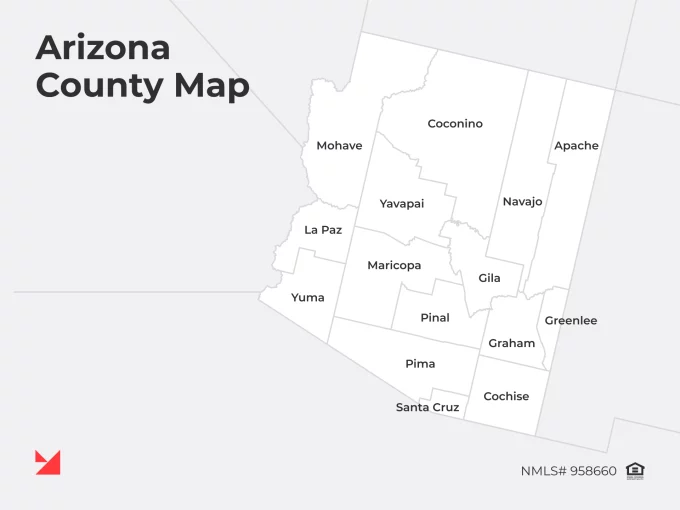
The Price of Buying and Owning a Home in Arizona
For most homebuyers, the first major consideration is the cost of purchasing a home. Because of this, we chose to begin our evaluation with the entry cost of housing across Arizona. The table below outlines the estimated down payment needed for a typically priced home in various Arizona markets. We also divided each location into tiers based on affordability and overall entry costs.
Price to Enter: Cost of Buying a Home in Arizona
| County | Typical Home Value | Est. DP 3% | Est. DP 5% | Entry Cost Tier |
|---|---|---|---|---|
| Coconino | $627,000 | ~$18,800 | ~$31,350 | Very High |
| Yavapai | $504,000 | ~$15,100 | ~$25,200 | High |
| Maricopa | $463,000 | ~$13,900 | ~$23,100 | Mid |
| Navajo | $394,000 | ~$11,800 | ~$19,700 | Mid |
| Gila | $386,000 | ~$11,500 | ~$19,300 | Mid |
| Pinal | $365,000 | ~$11,000 | ~$18,200 | Mid |
| Mohave | $352,000 | ~$10,600 | ~$17,600 | Mid |
| Pima | $343,000 | ~$10,300 | ~$ 17,100 | Mid |
| Apache | $314,000 | ~$9,400 | ~$15,700 | Lower |
| Graham | $306,000 | ~$9,200 | ~$15,300 | Lower |
| Santa Cruz | $282,537 | ~$8,500 | ~$14,100 | Low |
| Yuma | $281,000 | ~$8,400 | ~$14,000 | Low |
| La Paz | $268,000 | ~$8,000 | ~$13,400 | Low |
| Cochise | $264,000 | ~$7,900 | ~$13,200 | Low |
| Greenlee | $166,000 | ~$5,000 | ~$8,300 | Very Low |
Lower home prices do not always result in lower monthly ownership costs. In Arizona, property taxes, insurance rates, utility expenses, and regional cost of living differences can significantly impact long-term affordability. As a result, some mid-priced markets may provide more predictable ownership expenses than certain lower-cost rural areas.
To provide a clearer picture for borrowers, we examined typical home values alongside estimated property taxes and homeowners insurance costs. This allows buyers to better understand the core expenses associated with homeownership, including principal, interest, taxes, and insurance (PITI).
Cost to Hold: Ongoing Ownership Costs by County
| County | Median Property Tax | Est. Insurance | Annual Cost | Monthly Cost | Cost % of Value |
|---|---|---|---|---|---|
| Pima | $1,614 | ~$2,200 | ~$3,814 | ~$318 | ~1.11% |
| Maricopa | $1,418 | ~$2,450 | ~$3,868 | ~$322 | ~0.84% |
| Pinal | $1,383 | ~$2,300 | ~$3,683 | ~$307 | ~1.01% |
| Coconino | $1,290 | ~$2,620 | ~$3,910 | ~$326 | ~0.62% |
| Yavapai | $1,246 | ~$2,300 | ~$3,546 | ~$296 | ~0.70% |
| Santa Cruz | $1,131 | ~$2,200 | ~$3,331 | ~$278 | ~1.18% |
| Cochise | $977 | ~$2,400 | ~$3,377 | ~$281 | ~1.28% |
| Gila | $942 | ~$2,500 | ~$3,442 | ~$287 | ~0.89% |
| Mohave | $916 | ~$2,090 | ~$3,006 | ~$251 | ~0.85% |
| Yuma | $895 | ~$1,960 | ~$2,855 | ~$238 | ~1.02% |
| Navajo | $842 | ~$2,360 | ~$3,202 | ~$267 | ~0.81% |
| La Paz | $831 | ~$2,000 | ~$2,831 | ~$236 | ~1.06% |
| Graham | $627 | ~$2,400 | ~$3,027 | ~$252 | ~0.99% |
| Apache | $598 | ~$2,300 | ~$2,898 | ~$242 | ~0.92% |
| Greenlee | $303 | ~$2,550 | ~$2,853 | ~$238 | ~1.72% |
Location, Location, Location
While home prices and ownership costs have a significant impact on housing choices, they are not the only factors. Location and the related cost of living in an area are crucial, as they greatly influence everyday lifestyle.
Although more people tend to work remotely and many services are available online – such as food delivery and shopping – nothing can replace visiting favorite restaurants, going to the cinema with family, or having quick access to healthcare and education.
However, ‘location’ is challenging to evaluate and translate into an objective metric. Additionally, Arizona’s geography is diverse, spanning deserts, mountains, and rural plains. Therefore, we consulted local experts to select the most prominent locations in the state.
Initial Results
While the tables above don’t paint a complete picture of where to buy in Arizona, they do present a great starting point in understanding the costs associated with various counties in the state.
Like most states, property values in Arizona vary dramatically by county, with less populated rural locations generally being the least costly. Of course, rural living in Arizona’s more remote areas isn’t ideal for everyone, despite the affordability of counties like Greenlee and La Paz.
Interestingly, property tax rates in Arizona don’t always correlate directly to urban vs. rural counties. Greenlee County, for example, carries one of the lowest median property tax figures in the state despite having a notably higher cost-to-value ratio, meaning ongoing ownership costs remain relatively high compared to the home price.
One area where Arizona stands out compared to many other states is homeowners’ insurance. Premiums across Arizona counties are meaningfully higher than national averages, driven by wildfire risk, heavy rains, and extreme heat. Buyers should factor insurance costs carefully into their long-term budgeting, particularly in counties like Coconino and Gila.
Taking all the collected data into account, Maricopa County presents the strongest overall balance for most Arizona homebuyers, combining moderate entry costs, a broad range of DPA programs, strong employment opportunities, and established infrastructure. That said, continue reading about our other selections and why each location is worth a closer look.
Phoenix
Phoenix is the largest city in Arizona and one of the fastest-growing metropolitan areas in the entire country. It tops our list for the same reasons it dominates the state’s economy: job diversity, infrastructure, a broad range of housing options, and one of the most robust ecosystems of down payment assistance programs available to Arizona buyers.
The city has long outgrown its reputation as a purely sun-and-retirement destination. Today, Phoenix is home to a thriving tech sector, major healthcare systems, professional sports franchises, and a restaurant and entertainment scene that continues to expand. For buyers who want long-term upside and the ability to trade up without relocating, Phoenix remains the strongest overall market in the state.

Tucson
Tucson is Arizona’s second-largest city and offers a compelling mix of affordability, culture, and lifestyle that sets it apart from the Phoenix metro. Home to the University of Arizona, the city has a younger, more eclectic feel, with a strong arts community, diverse dining, and easy access to some of the state’s best hiking and outdoor recreation.
From a homebuying standpoint, Tucson’s typical home values sit below the state average, and Pima County’s City of Tucson-Pima County HOME DPA program offers some of the most generous assistance in Arizona – up to $50,000 for qualifying buyers. For first-time buyers especially, Tucson deserves a serious look.

Flagstaff
Flagstaff stands out as one of Arizona’s most unique housing markets. Situated at over 7,000 feet elevation in the Coconino National Forest, it offers a four-season mountain lifestyle that is rare in the Southwest – and buyers pay a premium for it. Coconino County carries the highest typical home values in our entire dataset.
That said, Flagstaff has a great deal to offer the right buyer. The city is home to Northern Arizona University, a strong outdoor recreation economy, and the Community Homebuyer Assistance Program (CHAP), which provides up to $50,000 in matching assistance for qualifying low- and moderate-income buyers. For those drawn to mountain living and a genuine sense of community, Flagstaff is worth the investment.
Take a look at our guide to the top 5 neighborhoods in Flagstaff for a more detailed look at the city.

Prescott
Prescott is one of Arizona’s most consistently appealing markets for buyers seeking a slower pace without sacrificing amenities. Known for its historic downtown, mild four-season climate, and strong retiree and remote worker community, Prescott sits in Yavapai County – the second-highest entry cost tier in our data, but one that many buyers consider well-justified.
The city offers a genuine small-town atmosphere with reliable access to healthcare, dining, and services, plus easy highway connections to Phoenix for those who need them. For buyers transitioning out of larger cities and looking for something more manageable without going fully rural, Prescott consistently earns its place on the shortlist.

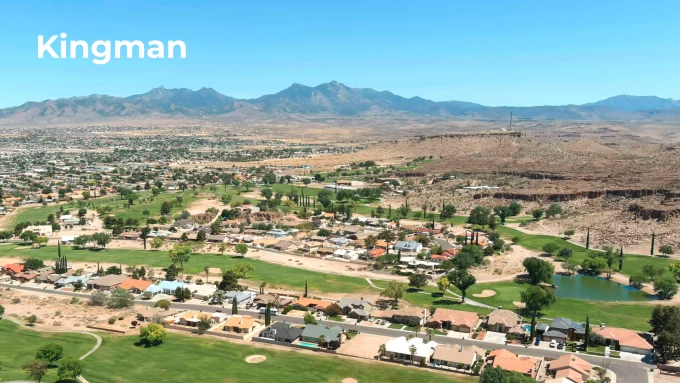
Kingman
Kingman is one of the more accessible entry points into Arizona homeownership, and it tends to fly under the radar compared to the state’s better-known markets. Located in Mohave County along historic Route 66, the city offers reasonable home prices, a tight-knit community, and straightforward access to both Nevada and California via Interstate 40.
It won’t appeal to everyone – Kingman is a working town rather than a resort destination – but for buyers prioritizing affordability and a stable, unpretentious community, it delivers real value. Explore our top neighborhoods guide for Kingman to learn more about what the city has to offer.
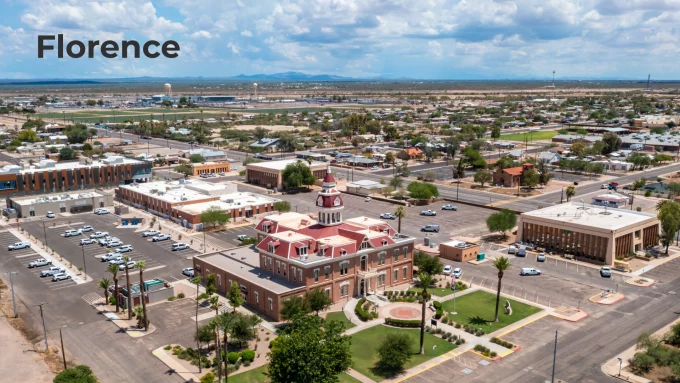
Florence
Florence sits in Pinal County, one of Arizona’s fastest-growing corridors, positioned between Phoenix and Tucson along the I-10. For buyers who need reasonable proximity to a major metro but can’t stretch to Maricopa County prices, Florence offers a practical middle ground with newer housing stock and a steadily expanding local infrastructure.
The town has a long history as one of Arizona’s oldest communities, and that character still shows in its walkable historic downtown. As the surrounding region continues to develop, Florence represents a solid option for buyers looking to get ahead of growth without overextending their budget.
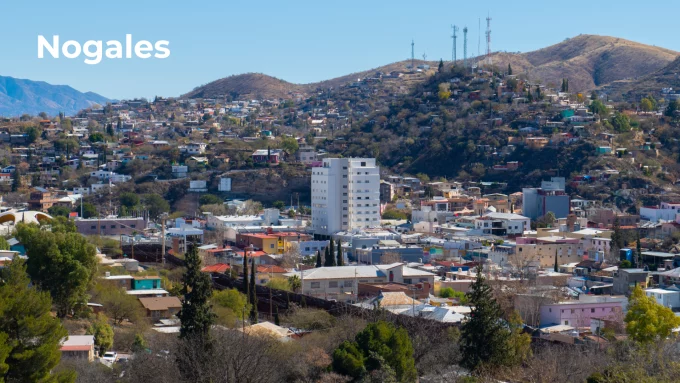
Nogales
Nogales occupies a genuinely unique position in the Arizona housing market. Situated directly on the US-Mexico border in Santa Cruz County, it is a bicultural community with deep ties to cross-border trade, family networks, and a lifestyle that reflects the best of both sides of the border.
Home prices in Santa Cruz County sit in the lower tier of our data, making Nogales one of the more accessible markets in the state from an entry cost standpoint. For buyers with roots in the region or those drawn to the border community lifestyle, Nogales offers affordability that larger Arizona markets simply can’t match.
Holbrook
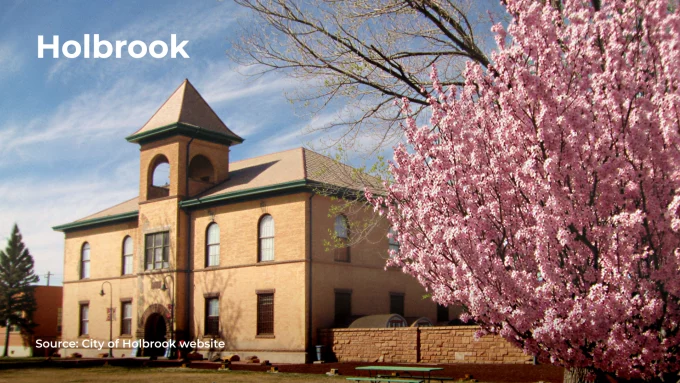
Holbrook is a small high-desert town in Navajo County that most buyers pass through on their way to somewhere else – and that’s exactly what makes it worth a second look. Situated along I-40 near the Petrified Forest National Park and the Painted Desert, it offers some of the most affordable housing in the state alongside a landscape that is genuinely striking.
For remote workers, retirees, or buyers simply looking to maximize purchasing power without relocating out of state, Holbrook is the kind of market that quietly checks a lot of boxes. Low prices, low density, and a community that hasn’t been discovered yet.
Globe
Globe is a former copper mining town in Gila County that has held onto its character better than most small Arizona communities. The historic downtown is intact, the surrounding Tonto National Forest provides exceptional outdoor access, and home prices remain well below the state average.
What makes Globe worth attention is the combination of genuine affordability and a location that isn’t as isolated as it might appear on a map. It sits roughly 90 miles from Phoenix, close enough for occasional trips to the city while offering a daily pace of life that is hard to find at this price point. For buyers who have written off rural Arizona, Globe is the kind of place that changes minds.

St. Johns
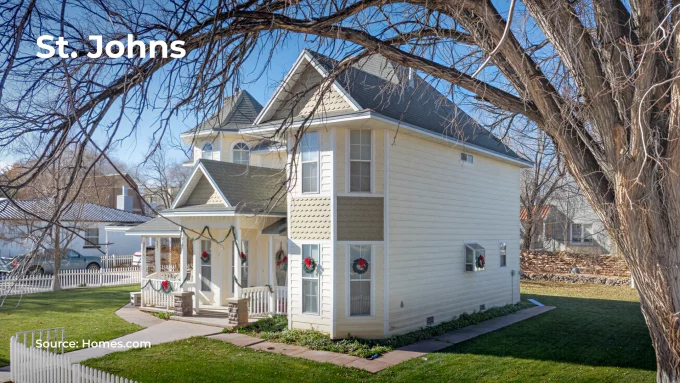
St. Johns is about as far off the beaten path as Arizona gets, and for the right buyer, that is the entire appeal. The small county seat of Apache County sits in the White Mountains region near the New Mexico border, offering wide open landscapes, a quiet community, and some of the lowest home prices in the state.
Apache County also participates in the Arizona is Home assistance program, which can provide meaningful support for qualifying first-time buyers. For those seeking maximum affordability and a genuinely rural lifestyle – hunters, outdoor enthusiasts, retirees on a fixed income – St. Johns represents a corner of Arizona that rarely makes the lists but consistently delivers value.
Trusted Brokers in Arizona
AD Mortgage operates from coast to coast, including Arizona. Here are some of our trusted partners operating throughout the state:
- Rich Simon and Scott Roberts from AZ Lending Experts


Finding Your Place in Arizona
Arizona’s housing market is as diverse as its landscape. From the urban energy of Phoenix to the mountain communities of Flagstaff and Prescott, and from the border culture of Nogales to the quiet high-desert towns of Holbrook and St. Johns, the state offers something for nearly every type of buyer and every budget.
The data makes clear that there is no single ‘best’ place to buy a home in Arizona. The right choice depends on your financial situation, lifestyle priorities, and long-term goals. What this guide can do is give you a solid starting point.
For the complete picture – including the full dataset, affordability comparisons, and regional market breakdowns – download the Arizona Homebuyers Guide. Whether you are a first-time buyer, a growing family, or someone looking to make a fresh start in a new community, the guide is designed to help you make a more informed decision.