
Michigan’s economy is telling a story of stability rather than acceleration in the second quarter of 2026. Population growth remains steady, the labor market has flattened out, and the housing market is showing the kind of balance that has not been common in recent years.
AD Mortgage analysts reviewed the key trends from Q2 and what they could signal for MLOs and their clients as Michigan moves into Q3.
Market trends can provide useful context, but every transaction ultimately comes down to the borrower’s individual financial situation. If you have a scenario that may require a different financing approach, AD Mortgage can help you explore the available options.
Michigan’s Economic Backdrop: Strong and Stable Market
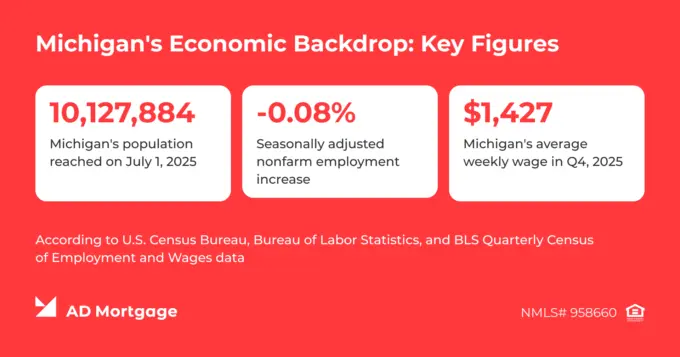
Michigan’s resident population grew +0.28% between 2024 and 2025, bringing the state to a total of 10.1 million residents, of whom 8 million are 18 and older, according to U. S. Census state estimates. That is modest but growth – not a boom state, but not losing residents either.
Employment tells a different story. Data from Bureau of Labor Statistics shows that total nonfarm payrolls in Michigan declined 0.08% from Q2 2025 to Q2 2026 – essentially flat, with a slight negative tilt. This mirrors the national ‘cooling, not collapsing’ labor trend rather than signaling a Michigan-specific downturn.
Despite the soft job numbers, wages kept climbing. Average weekly wages rose 4.2% year-over-year (December 2024 to December 2025) – comfortably ahead of national inflation.
Broker Takeaway. The market shows enough demographic and income support to sustain purchase demand, but not enough job growth to expect broad, easy volume growth. Wage growth that outpaces inflation is a meaningful tailwind for borrowers’ purchasing power. It is a useful talking point with buyers who feel priced out but whose earnings – and potentially their qualifying income – have improved.
More Listings Drive Faster Market Pace
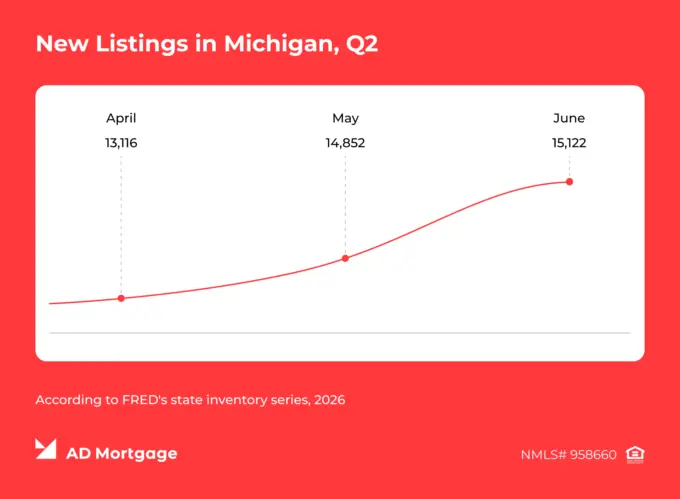
New listings totaled 43,090 for the quarter, according to FRED. This solid supply figure suggests sellers are reasonably active, and inventory is not critically tight.
Homes in Michigan spent a median of 40 days on market in Q2 2026, down from 64 days in Q1 2026. That faster pace indicates that buyer demand strengthened relative to available listings as the spring market progressed. Buyers may have more room to negotiate than in a hyper-competitive market, but they should not expect open-ended timelines for well-priced, desirable properties.
Broker Takeaway. Buyers have more selection and potentially more negotiating leverage than in a severe inventory shortage, but preparation still matters. Encourage clients to obtain a fully reviewed prequalification, understand their monthly-payment range, and be ready to act when the right, properly priced home becomes available.
Affordability is a Conversation Starter
Michigan recorded 30,703 existing home sales in Q2 2026. Compared with nearly 45,000 new listings, that ratio points to a market with more supply than is currently clearing – a sign of gradually loosening conditions rather than a seller’s squeeze.
For buyers, this may be an appropriate time to focus on realistic, well-supported offers instead of automatically over-escalating. Negotiating leverage will still vary by location, price point, condition, and how accurately a home is priced.
The average median sale price for Q2 2026 came in at $280,150. That is materially below the national median single-family existing-home price of $434,900 reported by NAR for the quarter, reinforcing Michigan’s relative value proposition.
Broker Takeaway. Relative affordability is a major Michigan advantage, particularly for buyers relocating from higher-cost coastal and Sun Belt markets. Frame the conversation around actual monthly payment, property taxes, insurance, commuting and employment considerations – not purchase price alone.
Homeownership is Higher than National Average
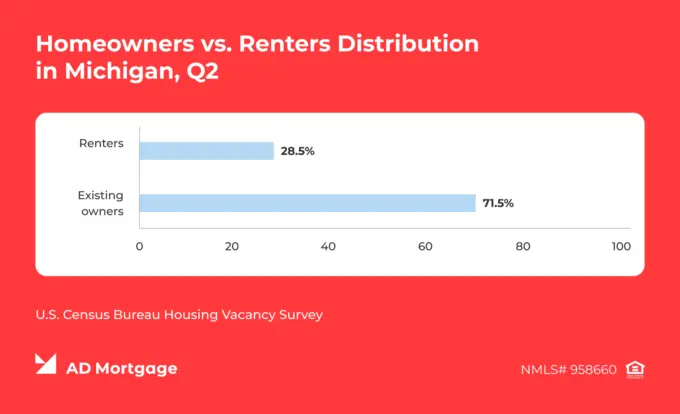
Michigan’s homeownership rate stood at 71.5% in Q2 2026, with a 28.5% rental share, according to the Census Bureau’s Housing Vacancy Survey. Being well above the national average, the numbers reflect Michigan’s lower cost of living and larger stock of single-family housing relative to coastal markets.
Broker Takeaway. Michigan housing market trends along with a high homeownership rate signal a mature, owner-occupied market – a strong environment for refinance conversations and move-up buyers, not just first-time purchases.
What to Look for in Q3: Shortlist for Brokers
Q2 ended with several signs of a more balanced Michigan market: sellers added a steady flow of new listings, homes moved faster as the spring market progressed, and statewide prices remained relatively accessible compared with the national market. At the same time, flat employment growth means buyer confidence and transaction volume may remain uneven rather than accelerating broadly.
Three indicators will be particularly useful to watch in Q3:
- New Listings. Watch whether the upward seasonal pattern continues through Q3 or begins to level off. Continued listing growth could give buyers more choice; a slowdown could tighten conditions again in certain markets.
- Days on Market. If marketing times remain low or decline further, it would suggest that demand is keeping pace with new supply. If they begin to rise, buyers may gain additional flexibility to compare homes, negotiate price, request concessions, or structure seller-paid buydowns.
- Sales and Prices. Existing-home sales and the statewide median sale price will show whether buyer activity is keeping pace with the higher flow of listings. In Q3, watch whether prices remain stable, continue rising, or begin responding to more buyer choice and slower employment growth.
Local conditions will remain especially important. Statewide data can set the context, but market conditions may vary significantly between Detroit-area suburbs, Grand Rapids and West Michigan, Ann Arbor and Washtenaw County, Lansing, northern recreational markets, and more rural communities. Inventory, property taxes, insurance costs, local employers, price points, and the availability of comparable homes can all change a borrower’s effective purchasing power.
Broker Takeaway. Use the statewide report as a starting point, then bring the conversation back to the borrower’s target neighborhood, monthly-payment comfort level, employment profile, and cash-to-close position. In a more balanced – but still active – market, you can add value by helping clients compare financing scenarios, evaluate seller concessions or buydown options, and arrive with a well-reviewed prequalification before the right home becomes available.
When a borrower profile calls for a different financing approach, explore AD Mortgage’s loan programs and review the full scenario with your Account Executive.