
One of the most important lessons I have learned as a mortgage loan officer is that an initial ‘no’ does not necessarily mean the transaction is dead.
Some of the most challenging files I have worked on looked straightforward when the application was first taken. Then underwriting revealed an issue: debt-to-income ratios were too high, a student loan payment had to be calculated differently, an unexpected lien appeared, documentation created another condition, or the original loan program simply did not fit the borrower as well as expected.
That is where an experienced loan officer can add significant value.
A loan officer’s job is not simply to collect documents, quote a rate, and submit a file. We also have to understand the guidelines well enough to identify legitimate alternatives when the original structure does not work.
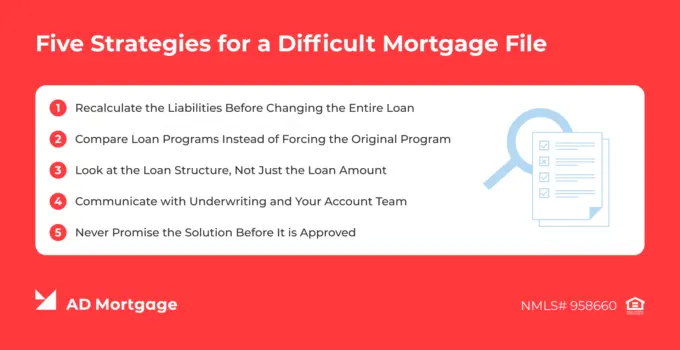
Here are five strategies I use when evaluating whether a difficult mortgage file can be restructured.
1. Recalculate the Liabilities Before Changing the Entire Loan
Before assuming the borrower no longer qualifies, I review every liability being included in the debt-to-income ratio.
Student loans are a good example. The payment shown on a credit report may not always be the payment that underwriting guidelines require. Deferred loans, income-driven repayment plans, and Parent PLUS loans can all require additional analysis depending on the loan program and documentation available.
The same applies to mortgages on departing residences, HELOCs, installment debts, solar obligations, and debts that may be eligible for payoff at closing.
A relatively small change in qualifying monthly debt can make a significant difference in DTI.
The lesson is simple: understand why every liability is being counted before trying to restructure the entire transaction.
2. Compare Loan Programs Instead of Forcing the Original Program
Loan officers sometimes become overly committed to the program they originally presented. That can be a mistake.
Conventional, FHA, VA, Non-QM and other programs do not always treat income, debt, and credit characteristics the same way. A borrower who is slightly outside the qualifying parameters of one program may fit comfortably within another.
The goal should not be to force the borrower into a particular product. The goal should be to identify the financing structure that best fits the borrower while still meeting applicable guidelines.
Whenever a file becomes difficult, I ask myself: If I were seeing this borrower for the first time today, knowing everything I know now, would I still choose the same loan program?
Sometimes the answer is yes. Sometimes that question saves the transaction.
3. Look at the Loan Structure, Not Just the Loan Amount
Another powerful tool is restructuring. If the borrower is completing a cash-out refinance, for example, reducing the requested cash-out may lower the payment enough to bring the DTI back within acceptable limits.
In other situations, paying off selected debts through closing may create a stronger qualifying profile than giving the borrower additional cash.
Purchase transactions can have similar opportunities involving seller credits, down payment structure, pricing decisions, or changes to the financing strategy.
The important part is understanding the relationship between:
- Loan amount
- Interest rate
- Mortgage insurance
- Monthly liabilities
- Cash to close
- Cash received by the borrower
- Debt-to-income ratio
Instead of changing one number randomly, evaluate how each adjustment affects the complete transaction.
AD Mortgage provides a Quick Pricer tool for instant loan scenario pricing, helping brokers match each borrower’s situation with the right mortgage solution.
4. Communicate with Underwriting and Your Account Team
Some difficult files cannot be solved simply by reading a guideline – they require communication.
When I encounter an unusual scenario, I try to present the issue clearly to underwriting or my lender account team rather than asking a vague question such as, ‘Can we make this work?’
A better approach is:
- Here is the borrower’s situation.
- Here is how the liability is currently being calculated.
- Here is the documentation available.
- Here is the guideline or alternative I believe may apply.
- Can this structure be accepted?
That makes it much easier for everyone involved to evaluate the scenario.
Your underwriter, account executive, and lender support team can be some of your most valuable resources. Experienced loan officers learn how to use those relationships effectively.
5. Never Promise the Solution Before It is Approved
Creativity is important in mortgage lending, but compliance and accuracy matter more.
There is a major difference between identifying a potential solution and telling a borrower the issue has been resolved. Until underwriting or the appropriate lender authority confirms the treatment, I present alternatives as possibilities. That protects both the borrower and the loan officer. It also builds credibility.
Borrowers can handle hearing, ‘I found an option that may solve this, and I’m confirming it with underwriting.’ What damages trust is telling them everything is resolved and then having to reverse that statement later.
Difficult Files are Where Expertise Matters Most
Easy mortgage transactions rarely demonstrate the full value of a knowledgeable loan officer – the challenging files do.
A borrower may never know how many calculations, guideline reviews, conversations, and restructuring scenarios occurred behind the scenes. They simply know that someone continued looking for a solution instead of immediately concluding that the loan could not be done.
Not every mortgage can – or should – be saved. Guidelines exist for a reason, and responsible lending always comes first.
But before declaring a transaction dead, I believe loan officers should understand exactly why it does not work and determine whether another legitimate path exists.
Sometimes one guideline, one calculation, or one restructuring decision is the difference between a declined file and a successful closing. And that ability to find the right path is one of the most valuable skills a loan officer can develop.
AD Mortgage serves brokers with complex or out-of-the-box borrower scenarios. Submit a Scenario Request, and our experts will contact you in 30 minutes with a tailored loan solution.
The article is written by Frank Vasquez is a California mortgage loan officer with E Mortgage Capital, INC. NMLS #1036028.