
New York Housing Market in Q3 2026: The Details Loan Officers Need to Know
| Share Your Voice |
|---|
| Take Our Year-End Survey to Get 500 Loyalty Points and Exclusive Summary TAKE SURVEY |
The third quarter of 2026 saw several trends in the New York housing market. Sale prices rose by more than 5%, and the number of active listings increased, while the number of new listings declined.
In this report, we explore the key indicators of the New York housing and mortgage market. We also discuss what these trends could mean for the future.
New York Economy: Fastest Wage Growth Among States as Jobs Hold Steady
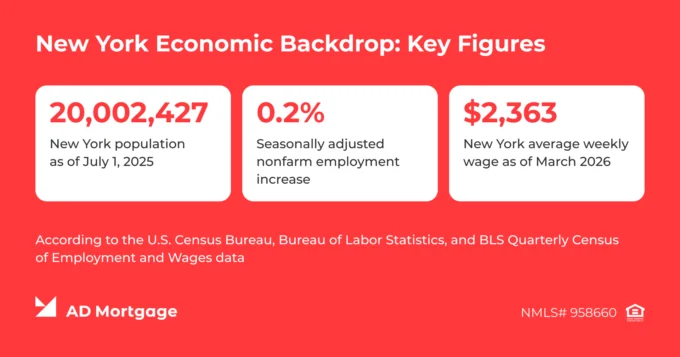
New York’s population remained largely stable, increasing by less than 0.01% between 2024 and 2025. In 2025, it reached 20,002,427 residents, according to the latest U.S. Census Bureau state estimates. Adults 18 and older accounted for 80.5% of New York’s population, or approximately 16.1 million residents.
Employment also remained stable. According to Bureau of Labor Statistics data, seasonally adjusted nonfarm employment averaged 9,963,600 jobs in Q3 2026, an increase of 0.2% compared with 9,946,100 jobs in Q3 2025.
New York recorded the fastest wage growth among U.S. states. From March 2025 to March 2026, average weekly wages grew by 6.5%, reaching $2,363. This represents a $144 increase – the largest dollar increase among states over that period – according to BLS data.
Broker Takeaway: Stable population and employment, combined with wage growth outpacing national inflation, suggest stronger purchasing power. However, rising home prices, discussed later in this report, keep affordability central. Brokers can make affordability discussions more practical by helping buyers compare property tax costs and check their eligibility for New York’s STAR benefit.
Market trends can provide useful context, but every transaction ultimately comes down to the borrower’s individual financial situation. If you have a scenario that may require a different financing approach, AD Mortgage can help you explore the available options.
New York Housing Inventory: Active Listings Up, New Listings Down
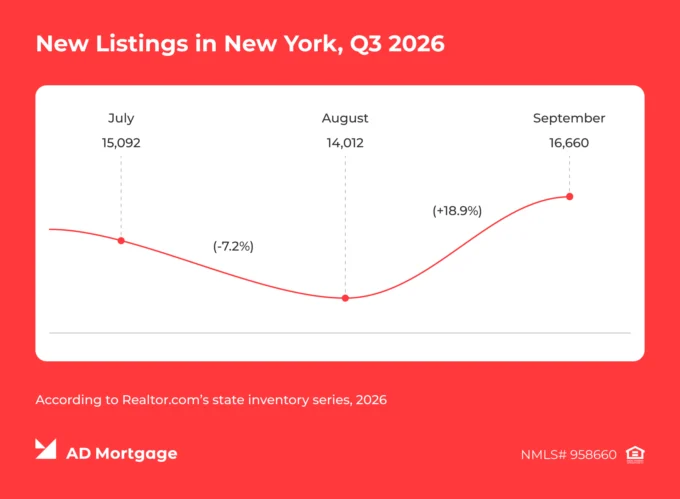
According to the Realtor.com state inventory series, the average number of active listings reached 39,644 in Q3 2026, representing growth of 2.58% from 38,646 in Q3 2025.
In contrast, the number of new listings declined. While 47,468 properties entered the market in Q3 2025, that number fell to 45,764 in Q3 2026 – a decrease of 3.6%. Additionally, homes spent fewer days on the market – 59.7 days in Q3 2026, compared with 62.3 days in Q3 2025.
Broker Takeaway: Higher inventory does not necessarily mean greater buyer leverage: fewer new listings and shorter marketing times suggest that more choice has not translated into a slower market.
New York Home Prices and Home Sales Rose in Q3
The average of regional median sale prices reached $377,769, an increase of 5.6% from $357,672 in Q3 2025, based on Zillow data.
Similarly, the number of homes sold increased by 3.1% – from 57,148 in Q3 2025 to 58,969 in Q3 2026.
Beyond purchase prices, ongoing homeownership costs are also an important consideration. In New York, the median annual property tax is $3,755, which is about 1.23% of assessed fair market value per year. The average annual homeowners insurance premium is $2,418 for $300,000 in dwelling coverage.
Broker Takeaway: As home prices rise, loan limits play an important role. AD Mortgage increased the Conventional loan limits for 1-4-unit properties, giving partners greater flexibility and helping more borrowers stay within Conventional programs.
New York Homeownership Rate Remains Among the Lowest in the U.S.
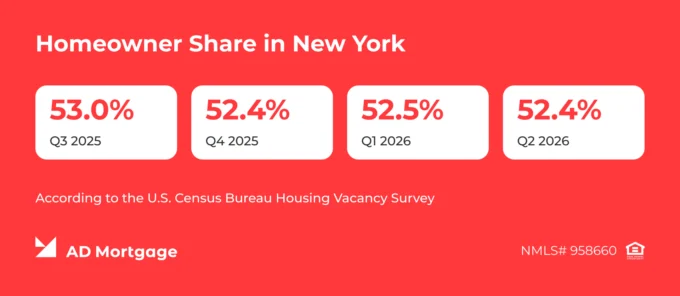
New York has one of the lowest homeownership rates in the country, ranging between 51% and 54% in recent years. In the third quarter of 2026, the U.S. Census Bureau’s Housing Vacancy Survey reported that owner-occupied homes accounted for 52.9% of properties. Additionally, about 56.8% of owner-occupied properties had a mortgage in 2024, according to U.S. Census Bureau data.
Broker Takeaway: A high share of renter households may signal a sizable potential first-time buyer audience. If you’re working with a first-time homebuyer deciding whether to buy now or postpone a purchase, our Should I Buy a House Now or Wait? study may provide useful historical context.
New York Housing Market Outlook: What Brokers Should Watch in Q4 2026
While the New York market entered Q4 with more homes available, there was not a clear shift toward a more buyer-friendly environment because sale prices increased and homes sold faster. Will additional inventory give buyers more negotiating room, or will competition keep conditions tight? Watch these three indicators through the end of the year:
- New Listings and Active Inventory. Track whether new listings recover from their Q3 year-over-year decline of 3.6%, alongside changes in the number of homes available. However, more inventory alone does not establish that buyers have greater leverage.
- Days on the Market. Watch whether time on the market continues to shorten after averaging 59.7 days in Q3, compared with 62.3 days a year earlier. Review this measure alongside inventory: a larger selection combined with longer selling times would suggest a different negotiating environment than more listings that continue to move quickly.
- Sale Prices and Sales Volume. Monitor whether price growth moderates and whether completed sales continue to increase. Following both measures can help brokers evaluate whether additional supply is being absorbed without easing price pressure.
Broker Takeaway: Statewide trends are a useful starting point, but it is important to focus the conversation on the borrower’s target location and price range. Local market conditions vary considerably, so connect observations about prices and negotiating terms to the borrower’s budget.
The Quick Pricer will help you quickly review estimated loan terms for a client scenario, compare options from AD Mortgage’s program portfolio, and identify a potential best-fit solution.