

Ask an Arlington renter and a lifelong Buchanan County resident where to buy a home in Virginia, and you probably will not hear the same answer twice. That is not indecision – it’s a fair reflection of how differently this state’s housing map behaves from one region to the next.
A buyer chasing a Beltway paycheck in Fairfax is playing an entirely different game than a family shopping for acreage near the Blue Ridge, and neither has much in common with someone comparing waterfront towns along Hampton Roads. Virginia’s real estate landscape refuses to collapse into a single storyline, and this guide is not trying to force one.
What we found instead is range: a Washington-adjacent corridor where prices climb fast, a Piedmont and Shenandoah Valley stretch where a mid-size budget still goes a long way, and a southwestern corner where typical home values remain below $100,000. AD Mortgage dug through the numbers behind each of these markets to surface the ones most worth a Virginia buyer’s attention in 2026.
For Mortgage Professionals: Use the Virginia Homebuyers Guide to help clients compare entry costs, ongoing ownership expenses, regional affordability, and potential assistance opportunities.
AD Mortgage is a wholesale mortgage lender that has spent more than two decades building programs and technology for broker partners, backed by support that never clocks out. Become a Partner to work with a lender built to help you close.
Virginia Real Estate Market Overview
This section pulls together the factors that matter most to buyers, agents, and loan officers working across the Commonwealth.
The full research sits inside the downloadable Virginia Homebuyers Guide PDF. Below is a quick look at the categories we dug into along the way:
- Median Home Prices
- Homebuying Entry Costs
- Taxes and Insurance
- Median Incomes
- Cost of Living
- Location
- Down Payment Assistance (DPA) Programs
Our research spans Virginia’s biggest employment centers, its fast-growing suburbs, and a handful of smaller cities that stood out for reasons that go beyond price. Northern Virginia mainstays like Arlington and Fairfax pull buyers chasing federal and private-sector paychecks, while places such as Newport News, Charlottesville, and Winchester draw people looking for lower costs, a tighter-knit community, or simply a different pace of life.
This overview is meant to give you a practical jumping-off point for sizing up housing markets around Virginia. The full guide goes further, with additional charts, regional cost breakdowns, and side-by-side affordability comparisons to help buyers weigh both the sticker price and the long-term cost of owning in different parts of the state.

Unless otherwise noted, the housing and household-income comparisons in this article use 2025 data. Down payment assistance program information was reviewed in July 2026 and remains subject to funding, eligibility requirements, and program changes. Treat these rankings as a starting point for your own research rather than a final verdict on Virginia’s ‘best’ places to live.
To dig deeper into Virginia’s housing patterns, the sections ahead cover entry costs, ongoing ownership expenses, and the regional differences that shape what buying a home actually looks like across the state.
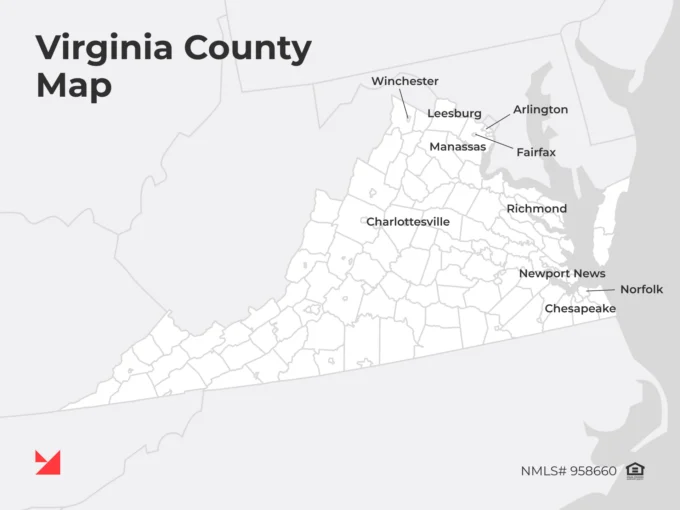
The Price of Buying and Owning a Home in Virginia
Entry cost is usually the first real obstacle a buyer runs into, which makes it the natural place to start. The table below shows the estimated down payment on a typically priced home across a range of Virginia counties, grouped into tiers by how expensive it is to get in the door.
These counties were selected to illustrate Virginia’s broad range of higher-cost, moderate-cost, and more accessible housing markets. They are representative examples rather than a complete ranking of every county in the Commonwealth.
Price to Enter: Cost of Buying a Home in Virginia
| County | Typical Home Value | Est. DP 3% | Est. DP 5% | What This Market Feels Like |
|---|---|---|---|---|
| Arlington | $825,578 | $24,767 | $41,279 | Premium urban market with high demand |
| Loudoun | $806,960 | $24,209 | $40,348 | Affluent suburban market showing strong growth |
| Fairfax | $776,707 | $23,301 | $38,835 | Established high-value market with steady competition |
| Fauquier | $656,732 | $19,702 | $32,837 | Higher-priced rural market offering more space and privacy |
| County | Typical Home Value | Est. DP 3% | Est. DP 5% | What This Market Feels Like |
|---|---|---|---|---|
| Caroline | $363,916 | $10,917 | $18,196 | Affordable market attracting value-focused buyers |
| Rockingham | $362,461 | $10,874 | $18,123 | Balanced market near growing communities |
| Franklin | $360,311 | $10,809 | $18,016 | Lower-cost market with more buying flexibility |
| Prince George | $359,527 | $10,786 | $17,976 | Stable suburban market near employment centers |
| King William | $355,967 | $10,679 | $17,798 | Small-town market offering relative affordability |
| County | Typical Home Value | Est. DP 3% | Est. DP 5% | What This Market Feels Like |
|---|---|---|---|---|
| Russell | $139,207 | $4,176 | $6,960 | Most affordable market for budget-conscious buyers |
| Wise | $133,317 | $4,000 | $6,666 | Lower-cost market offering attainable homeownership |
| Dickenson | $116,970 | $3,509 | $5,849 | Rural market centered on affordability |
| Lee | $116,391 | $3,492 | $5,820 | Entry-level market appealing to cost-focused buyers |
| Buchanan | $77,773 | $2,333 | $3,889 | Lowest-cost market for maximum affordability |
Sticker price is just the entry fee, though. Once buyers are in, Virginia homeowners still have to budget for property taxes, insurance, utilities, and a cost-of-living picture that shifts noticeably by region.
The spread here is dramatic: Arlington and Loudoun sit near the top of the state’s price ladder, while Buchanan and Lee anchor the other end – proof that Virginia’s housing stretches from luxury-adjacent to genuinely budget-friendly, often within a few hours’ drive of each other.
Cost to Hold: Ongoing Ownership Costs by County
A cheaper home doesn’t automatically mean cheaper homeownership. Across Virginia, property tax rates, insurance premiums, and local cost-of-living swings can move the affordability needle just as much as the purchase price itself. Buchanan and Lee counties, for example, post some of the lowest typical home values in this guide – yet they also carry some of the steepest ongoing cost burdens relative to home value. Buyers eyeing these markets should run the full math on taxes and insurance rather than assume a smaller price tag guarantees a smaller monthly bill.
To help with that math, we compared typical home values with estimated property taxes and homeowners insurance – the final two components of principal, interest, taxes, and insurance, commonly known as PITI. You can find the comparison table in the Guide PDF.
Working with a borrower who doesn’t fit a standard box? AD Mortgage offers a full range of loan programs, and our team can match your client’s scenario with a tailored program in as little as 30 minutes.
Location Still Shapes the Decision
Price and ongoing costs carry a lot of weight in a homebuying decision, but they are not the whole story. Where a home sits – and what it costs to live nearby – still shapes daily life in ways a spreadsheet cannot fully capture.
Remote work and same-day delivery have loosened some of the old ties to geography, but plenty of everyday moments still depend on proximity: a short drive to a favorite trail, quick access to a pediatrician, or simply knowing your neighbors. Location matters.
It is also genuinely hard to measure. Virginia’s geography swings from the Tidewater coast through the rolling Piedmont to the Blue Ridge and Appalachian highlands in the far southwest, and no single metric captures what that variety means for daily life. So alongside the numbers, we brought in perspective from people who know these markets firsthand to round out our list of standout places to live.
Broker Tip: Use these comparisons as a starting point, then evaluate the borrower’s income, credit, available funds, property type, location, and program eligibility before recommending a financing strategy.
What the Numbers Suggest
The tables above will not hand you a single answer, but they are a solid jumping-off point for understanding how Virginia’s housing costs shift from one corner of the state to another.
As is true almost everywhere, home values vary sharply by county, with the state’s more rural stretches generally posting the lowest prices. That said, the remote counties in the far southwest are not the right fit for every buyer, even with places like Buchanan and Lee offering some of Virginia’s most attainable price tags.
Purchase prices and long-term affordability are not the same conversation, either. Buchanan and Lee counties post the lowest typical home values in this guide, yet they also rank among the highest for ongoing costs as a share of home value – proof that the cheapest home to buy is not always the cheapest home to keep.
Down payment assistance adds another layer, and Virginia has an unusually deep bench of it – statewide grants, a Hampton Roads regional program, and a handful of city- and county-specific options stacked on top. We break all of it down in the PDF guide.
Weighing all of this together, Newport News emerges as one of the strongest affordability-focused options in this comparison: it posts the shortest down payment savings timeline of any city in this guide, sits inside a region with several local, regional, and statewide assistance opportunities for qualifying buyers, and keeps ongoing costs from spiraling. Below, we take a closer look at Newport News and the other cities that stood out.
The cities below are presented in order of their estimated down payment savings timelines, beginning with the shortest timeline in this comparison.
Newport News
Newport News quietly posts the best numbers in this entire guide: a typical home price under $300,000, a median household income above $68,000, and an estimated down payment timeline of approximately eight years – faster than anywhere else on this list.

Shipbuilding still drives a meaningful share of local jobs through Newport News Shipbuilding, one of the largest single-site employers in Virginia, while the broader Hampton Roads economy layers in military, logistics, and healthcare work.
Eligible buyers may receive up to $10,000 through Newport News’ First-Time Homebuyer Assistance program. They may also qualify for assistance through the Hampton Roads ‘You’re HOME’ Program, subject to current funding, eligibility, and program compatibility requirements.
Norfolk
Norfolk lands just behind Newport News on the numbers, with a savings timeline under nine years and one of the broadest buyer-support networks anywhere in the state.

The world’s largest naval base gives Norfolk’s economy a foundation that barely wavers with the broader market, while a downtown built around the Elizabeth River waterfront, an active arts scene, and Old Dominion University adds more than a one-industry feel to the city.
Norfolk does not have a city-specific program of its own in our research, but eligible buyers may be able to access the Hampton Roads ‘You’re HOME’ Program or statewide options such as the Virginia Pilot Down Payment Assistance Program, worth up to $50,000 for income-qualified first-time buyers.
Chesapeake
Chesapeake rounds out Hampton Roads’ strong showing, with a savings timeline barely a month behind Norfolk’s and a home price that still sits comfortably under half a million dollars.
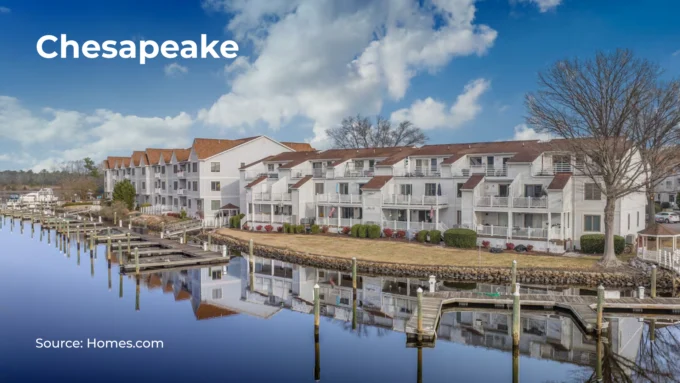
Its economy leans on a mix of agriculture, military contracting, and retail, and its geography stretches from suburban neighborhoods in the north to the Great Dismal Swamp in the south – a range that gives buyers real choice in setting.
The city’s own HOME Down Payment & Closing Cost Assistance program offers up to $13,000, and in some cases as much as $25,000. Buyers may also qualify for regional or statewide assistance, although program compatibility must be confirmed.
Manassas
Manassas breaks from the Hampton Roads cluster at the top of this list, trading a lower price tag for proximity to Washington, D.C. – and buyers here still land a savings timeline under ten years thanks to a median household income above $113,000.
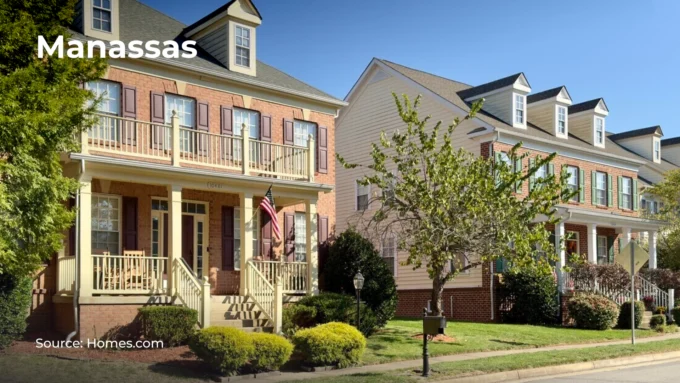
Best known for the Civil War battlefields just outside city limits, Manassas has grown into a genuine commuter hub along the Prince William County corridor, pulling in residents who want Northern Virginia access without Northern Virginia prices.
Prince William County’s First-Time Homebuyer Program may provide down payment assistance equal to 20% to 30% of the approved sales price, with additional closing cost assistance potentially available. Eligibility generally includes income, residency or employment, property, lender, and financing requirements. This is a meaningful boost on top of an already favorable starting position.
Richmond
Virginia’s capital lands right in the middle of the pack on savings timeline, but its lower typical home price – under $380,000 – keeps the math approachable even against a median income well below that of the Northern Virginia suburbs.

State government is the obvious economic anchor, but Richmond’s job base extends into finance, higher education through VCU, and a food and arts scene that has earned the city a reputation well beyond its size.
Richmond does not appear on the local DPA list here. Eligible buyers may receive assistance equal to as much as 10-15% of the sales price, plus up to $2,500 in closing cost assistance, subject to a combined maximum of $40,000.
Is your client buying in Virginia, or looking at options somewhere else entirely? AD Mortgage supports brokers working through complex or nontraditional borrower scenarios, helping you find the right fit fast.
Leesburg
Leesburg sits deep in Loudoun County’s orbit, and it shows: a typical home price near $868,000 is the second-highest on this list, offset only partly by a median household income above $145,000.
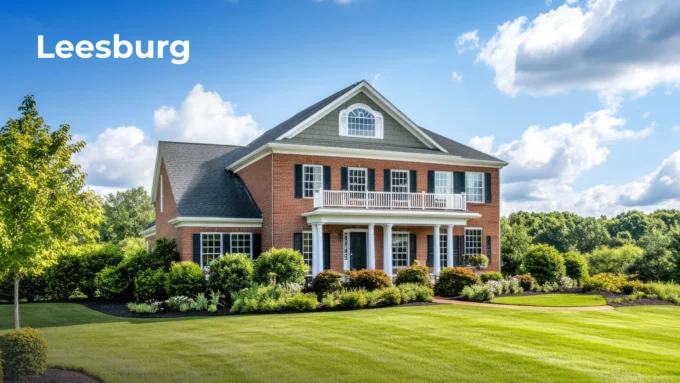
Historic downtown streets, a growing wine-country tourism scene, and easy access to Dulles-area tech and government jobs give Leesburg a split identity – small-town charm layered over serious earning power.
Loudoun County’s Homebuyer Assistance Program is the headline option here, offering a forgivable loan of up to 10% of the purchase price or $70,000, whichever is less – built for exactly the kind of price gap Leesburg presents.
Fairfax
Fairfax carries a price tag nearly identical to Leesburg’s, but a slightly higher median income keeps its savings timeline a shade shorter at just over eleven years.
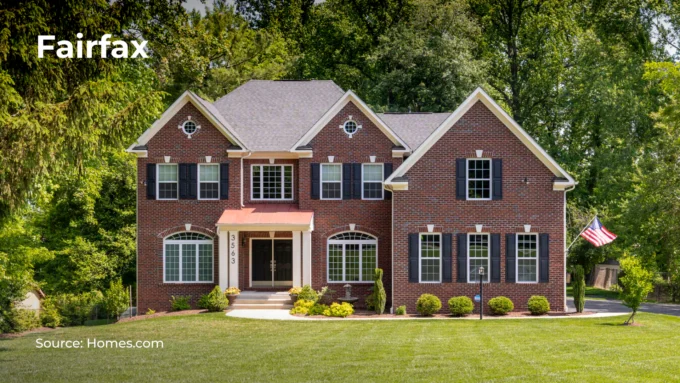
Federal agencies, government contractors, and a dense concentration of corporate offices make Fairfax one of the steadiest job markets in the state, with George Mason University adding another layer to the local economy.
Fairfax County’s Down Payment Loan Program may provide eligible first-time buyers with a loan of up to $50,000. The program is aimed squarely at closing the gap in one of Virginia’s priciest markets.
Charlottesville
Charlottesville’s numbers tell a familiar college-town story: a median household income under $75,000 stretched against a typical home price above $525,000, pushing its savings timeline past thirteen years.

The University of Virginia shapes nearly everything about the local economy and culture, from the job market to the rental market to the crowds that show up every football Saturday, while a growing healthcare and biotech presence adds ballast beyond the university itself.
Our research did not identify a city-specific program for Charlottesville, although eligible buyers may be able to use statewide assistance. The Virginia Housing Down Payment Assistance Grant may be available through eligible Virginia Housing conventional and FHA loans, subject to borrower, income, sales-price, property, and loan requirements.
Arlington
Arlington posts the highest typical home price of any city on this list at nearly $825,000, and even a median household income above $113,000 isn’t quite enough to keep its savings timeline under thirteen and a half years.

Its location directly across the Potomac from Washington, D.C. is the whole economic story – federal agencies, the Pentagon, and a dense cluster of policy and consulting firms keep housing demand here about as steady as it gets anywhere in the country.
Arlington’s own Moderate Income Purchase Assistance Program (MIPAP) is one of the richest local DPA offerings in this guide: a deferred-payment, zero-interest second mortgage of up to 25% of the purchase price or $112,500, whichever is less. The program uses a shared-appreciation model and currently limits the purchase price to $500,000.
Winchester
Winchester closes out this list with the longest savings timeline of any city here, at just over fifteen years – a function of a median household income around $50,120 set against a typical home price above $400,000.
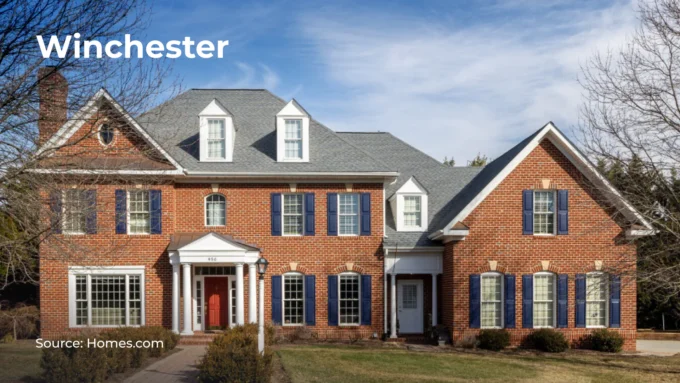
Apple orchards once defined this Shenandoah Valley city, and while agriculture still matters locally, healthcare, logistics, and a historic downtown built around a pedestrian walking mall now carry more of the economic weight.
Winchester doesn’t have a dedicated local program in our research, but buyers here can still draw on statewide help like the Virginia Individual Development Accounts (VIDA) Program, which may provide matched savings assistance for eligible homebuyers, subject to current program requirements and funding availability. This is an excellent option for buyers working with a longer runway.
Finding Your Place in Virginia
Virginia’s housing market covers an enormous range – from federal-job-fueled suburbs outside Washington to naval hubs along the coast, college towns anchored by centuries-old universities, and small cities tucked into the Shenandoah Valley and Appalachian foothills. There’s a home here for nearly any budget or lifestyle, provided you know where to look.
The numbers make one thing clear: there’s no single ‘best’ place to buy in Virginia. The right fit comes down to your income, your priorities, and how much runway you’re willing to give your savings timeline. Some buyers will gravitate toward the job density and amenities of Northern Virginia; others will find better value – and a slower pace – in the state’s smaller cities and rural counties.
For the full research behind this guide – detailed cost breakdowns, program eligibility details, and city-by-city comparisons – download the Virginia Homebuyers Guide. Whether you’re a first-time buyer, relocating for work, or searching for a better fit elsewhere in the state, this guide is built to help you move forward with more confidence.