
Post content:
Is Homeowners Insurance Included in Your Mortgage Payment?

Add AD Mortgage as your preferred source on Google
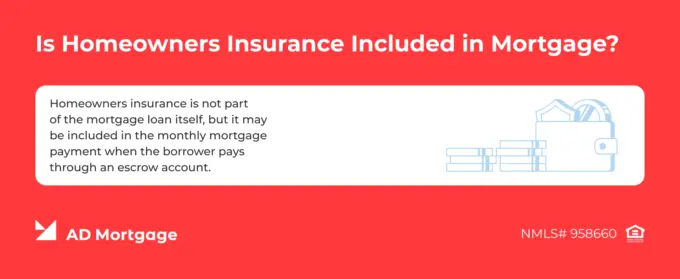
Homeowners insurance is not part of the mortgage loan itself, but it may be included in the monthly mortgage payment when the borrower pays through an escrow account. An escrow account bundles the homeowners insurance premium into the monthly mortgage payment, and the mortgage servicer pays the insurance company when the premium is due.
Homeowners insurance is separate from the mortgage loan, but the confusion often arises because borrowers make one monthly payment that may include principal, interest, property taxes, and homeowners insurance. Brokers should explain these costs to their clients, helping them better manage their budget and avoid payment surprises.
Key Takeaways
- Homeowners insurance is separate from the mortgage loan.
- An escrow account may collect homeowners insurance premiums and property taxes with a monthly mortgage payment.
- Homeowners insurance differs from Private mortgage insurance (PMI) and FHA MIP. Homeowners insurance protects a home and belongings, while PMI and MIP protect the lender.
- A lapse in homeowners insurance coverage can trigger force-placed insurance, which is often more expensive and provides limited protection.
- Paying off mortgage usually ends the lender’s insurance requirement, but maintaining coverage remains financially wise.
- If the lender is listed under the mortgage clause, it may also appear on insurance claim checks after major property damage.
Is Homeowners Insurance Included in a Mortgage?
Many first-time homebuyers assume homeowners insurance is automatically built into their mortgage loan. While the monthly payment may feel like one bill, homeowners insurance is not part of the mortgage loan.
Homeowners insurance is a policy issued by an insurance company that protects a home against covered losses such as fire, windstorms, theft, or certain types of water damage. According to Insurance.com, the average annual home insurance cost is $2,543 in 2026, with rates varying significantly from state to state.
The monthly mortgage payment can include homeowners insurance via escrow, as well as principal, interest, and property taxes. These four components are commonly referred to as PITI.
The mortgage servicer manages escrow account disbursements and collects a portion of the annual homeowners insurance premium each month. When the insurance premium becomes due, the servicer pays the insurance company using the funds held in escrow.
Some borrowers, however, pay homeowners insurance directly to their insurer instead of through an escrow account. Whether this option is available depends on the loan type, lender requirements, equity, and other factors.
AD Mortgage is positioned as the Lender of Choice that helps brokers win. Brokers ranked us as a Top-5 wholesale lender. From Non-QM and Conventional to FHA and VA, partners get the flexibility to serve every borrower.
How Escrow Collects Insurance and Property Taxes
One of the biggest reasons borrowers ask, ‘Does my mortgage payment include homeowners insurance?’ is because of escrow.
An escrow account holds funds for homeowners insurance and property taxes, as well as other housing-related expenses, and this separate account is managed by a mortgage servicer. The mortgage servicer collects the monthly escrow payment with each mortgage payment and pays the insurance premium to the insurer when it is due.
The process typically works like this:
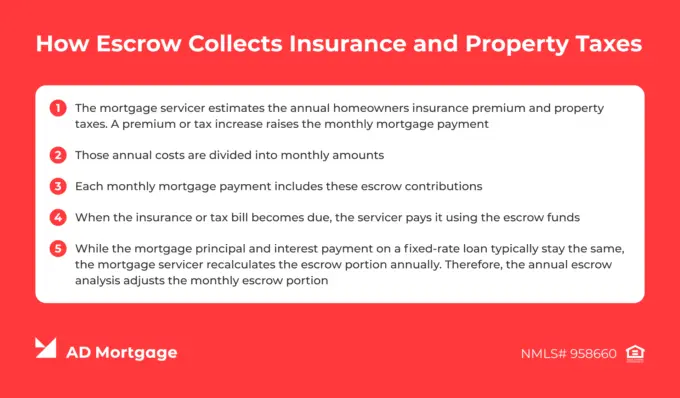
- The mortgage servicer estimates the annual homeowners insurance premium and property taxes. A premium or tax increase raises the monthly mortgage payment.
- Those annual costs are divided into monthly amounts.
- Each monthly mortgage payment includes these escrow contributions.
- When the insurance or tax bill becomes due, the servicer pays it using the escrow funds.
- While the mortgage principal and interest payment on a fixed-rate loan typically stay the same, the mortgage servicer recalculates the escrow portion annually. Therefore, the annual escrow analysis adjusts the monthly escrow portion.
To better understand how the monthly homeowners insurance escrow amount is calculated, let’s look at an example. If the borrower’s annual premium is $1,800, the monthly escrow portion for insurance is $150 before any cushion or escrow adjustment. An escrow cushion increases the monthly escrow collection above the annual premium divided by 12.
Homeowners Insurance vs Mortgage Insurance: What’s the Difference?
Another common source of confusion is the difference between homeowners insurance and mortgage insurance. Although both may appear within your monthly payment, they serve completely different purposes.
Homeowners insurance protects the homeowner and the property from covered perils – and it does not reduce loan default risk for the lender. Mortgage insurance, on the other hand, protects the lender from losses if the borrower defaults.
Because both costs may be collected through escrow, borrowers often assume they are the same thing. They are not, and understanding the difference helps avoid confusion when reviewing a monthly mortgage statement.
Additionally, the type of mortgage insurance depends on the loan type. Private mortgage insurance (PMI) typically applies to conventional loans with down payments below 20%. FHA Mortgage Insurance Premium (MIP) applies to FHA loans.
AD Mortgage offers a full range of loan programs, including Conventional, FHA, VA, Non-QM, and Jumbo loan programs. Visit our Program Page to explore all options.
Homeowners Insurance vs PMI vs MIP
Homeowners insurance, PMI, and FHA MIP can each be collected through an escrow account. Understanding the difference between these payments is crucial for brokers and their clients to accurately estimate monthly housing costs and avoid confusion when reviewing mortgage payments.
| Item | What It Protects | Who Typically Pays | When It May Apply | Can It Be Paid Through Escrow? | Broker Note |
|---|---|---|---|---|---|
| Homeowners Insurance | The home, personal belongings, liability, and additional living expenses for covered losses | Borrower | Required by most lenders while the mortgage is active | Yes | Protects the homeowner and the property, not the lender |
| Private Mortgage Insurance (PMI) | The lender if the borrower defaults | Borrower | PMI is required on some conventional loans with less than 20% down | Sometimes | PMI can be removed at roughly 20% equity (80% loan-to-value) |
| FHA Mortgage Insurance Premium (MIP) | The lender if the borrower defaults | Borrower | FHA MIP persists for the life of the loan or 11 years, depending on the down payment | Yes | Rules differ from PMI and depend on current FHA guidelines |
| Optional Policy Endorsements | Specific risks such as valuable items, sewer backup, or equipment breakdown | Borrower | Optional depending on needs | Usually no | These are additions to homeowners insurance, not mortgage insurance |
Why Lenders Require Homeowners Insurance
A home serves as the collateral for the mortgage loan. If the property suffers significant damage from a covered event such as a fire or severe storm, both a borrower and a lender have a financial interest in protecting that investment. That’s why most lenders require proof of homeowners insurance before or at closing.
The policy generally needs to remain active throughout the life of the loan unless the mortgage is paid off or other lender-specific requirements apply.
Although requirements vary by lender and loan program, lenders commonly expect a policy that provides:
- Adequate dwelling coverage
- Replacement cost protection for the structure
- A valid declarations page showing active coverage
- A mortgage clause listing the lender or mortgage servicer
Depending on the property’s location, additional insurance may also be required. For example, homes located in designated flood-risk areas may require separate flood insurance under applicable federal rules.
If your client is wondering, how much homeowners insurance they need for a mortgage, there is not one universal answer. Coverage requirements can vary based on factors such as loan type, property value, location, and lender guidelines.
Brokers who proactively explain insurance requirements before closing can help clients avoid confusion, reduce unexpected costs, and build long-term trust.
For that reason, brokers should confirm current requirements with their lender, mortgage servicer, and insurance provider rather than relying on a general rule. AD Mortgage provides ADwise, an automated guideline search tool that makes broker research quick and efficient.
What Happens if Homeowners Insurance Lapses?
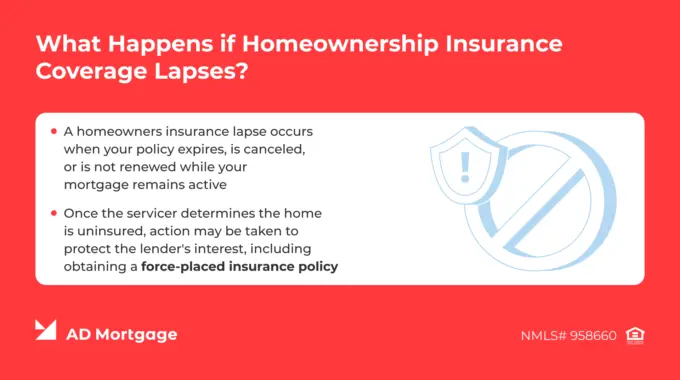
A homeowners insurance lapse occurs when your policy expires, is canceled, or is not renewed while your mortgage remains active.
This is more than an insurance issue. It can also affect your mortgage because maintaining homeowners insurance is usually part of your loan agreement.
If your insurer cancels or does not renew your policy, the mortgage servicer may receive notice because it is listed under the mortgage clause.
Once the servicer determines the home is uninsured, action may be taken to protect the lender’s interest, including obtaining a force-placed insurance policy.
What is Force-Placed Insurance?
If homeowners insurance lapses and replacement coverage is not provided promptly, the mortgage servicer may obtain force-placed insurance, sometimes called lender-placed insurance. This type of policy is purchased to protect the lender’s financial interest in the property.
However, force-placed insurance is often:
- More expensive than a standard homeowners policy
- Limited primarily to the home’s structure
- Less comprehensive than traditional homeowners insurance
- Not designed to protect your personal belongings or personal liability
What Should Brokers Advise Borrowers to Do?
Brokers should explain to their clients what to do in case they receive a lapse or cancellation notice. It is important to take quick action:
- Contact the insurance company immediately
- Arrange replacement coverage if necessary
- Send proof of insurance to the mortgage servicer as soon as possible
- Verify that the escrow account is updated if the lender pays insurance premiums through escrow
Changing, Paying Separately, and Canceling Homeowners Insurance
Borrowers often ask whether they can manage homeowners insurance differently after closing.
The answer depends on their loan setup, lender requirements, and payment history.
Can You Pay Homeowners Insurance Separately from Your Mortgage?
Yes, some borrowers can pay homeowners insurance directly to their insurance company instead of through escrow. This usually happens when the lender approves an escrow waiver. An escrow waiver allows the borrower to manage insurance and property tax payments independently rather than having the mortgage servicer collect them each month.
Eligibility for an escrow waiver may depend on factors such as loan type, payment history, lender policies, and other underwriting requirements.
Keep in mind that paying homeowners insurance separately does not remove the lender’s insurance requirement while the mortgage remains active. The borrower is still responsible for maintaining continuous coverage and providing proof of insurance when requested.
How to Change Homeowners Insurance with a Mortgage
Many homeowners shop for better rates after purchasing their home. Fortunately, switching homeowners insurance providers is generally possible during the life of your mortgage.
Before changing policies, borrowers need to make sure the new policy:
- Meets your lender’s coverage requirements
- Includes the correct mortgage clause
- Lists the proper mortgage servicer when required
- Becomes effective before the old policy expires
It is crucial to avoid any gap between policies. Even a short lapse in coverage could create servicing issues or trigger force-placed insurance.
If homeowners insurance is paid through escrow, a mortgage servicer must be notified about the change.
Can You Cancel Homeowners Insurance After Paying Off Your Mortgage?
Once the mortgage is paid off, the lender’s requirement to maintain homeowners insurance generally ends because the property no longer serves as collateral for an outstanding loan.
However, that doesn’t necessarily mean canceling the policy is a wise financial decision. Even after the mortgage is paid off, a homeowner is still responsible for repairing or rebuilding it if it’s damaged by a covered event or for liability claims if someone is injured on the property.
For these reasons, many homeowners choose to continue carrying homeowners insurance after mortgage payoff.
Claim Checks and the Mortgage Clause
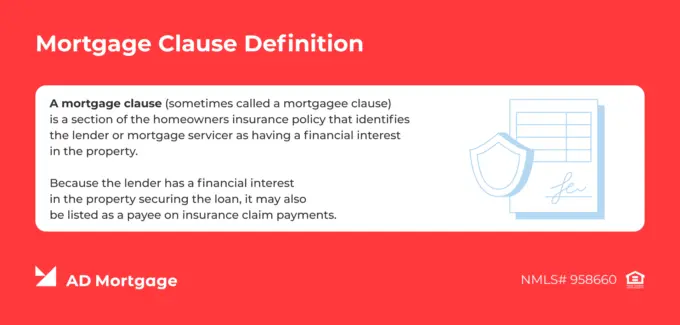
A mortgage clause (sometimes called a mortgagee clause) is a section of the homeowners insurance policy that identifies the lender or mortgage servicer as having a financial interest in the property. Because the lender has an interest in protecting the collateral securing the loan, it may also be listed as a payee on insurance claim payments.
When significant damage occurs, the insurance company may issue a joint claim check payable to both the homeowner and the mortgage lender or mortgage servicer. This helps ensure that insurance proceeds are used to repair the property that secures the mortgage loan.
How Does the Loss Draft Process Work?
For larger claims, many mortgage servicers use what is known as a loss draft process. While procedures vary, the process often includes:
- Reviewing the insurance claim
- Endorsing the insurance check
- Releasing repair funds
- Requesting documentation or inspections as repairs progress
- Issuing funds in stages for major restoration projects
Smaller claims may be handled differently, depending on the servicer’s policies.
What Brokers Should Tell Clients:
- Homeowners insurance is separate from the mortgage loan, even if it’s included in the monthly payment through escrow.
- Escrow accounts commonly collect homeowners insurance premiums and property taxes alongside principal and interest.
- Monthly mortgage payments may increase if homeowners insurance premiums or property taxes rise.
- Homeowners insurance is different from both Private Mortgage Insurance (PMI) and Mortgage Insurance Premium (MIP).
- Maintaining continuous insurance coverage is important because a lapse can trigger force-placed insurance.
- Borrowers can usually change insurance providers during the loan term, provided the new policy satisfies lender requirements and updated proof of insurance is submitted.
- After paying off the mortgage, lender insurance requirements generally end, but continuing homeowners insurance remains an important financial safeguard.
- Insurance claim checks may include the lender because the lender has a financial interest in the property until the mortgage is satisfied.
Conclusion
Homeowners insurance plays an important role in protecting both the homeowner and the lender, but understanding how it interacts with a mortgage is equally important. From escrow accounts and mortgage insurance to force-placed coverage and claim checks, each piece affects the overall homeownership experience.
Mortgage brokers who can clearly explain these topics help clients make informed financial decisions, avoid costly surprises, and navigate the mortgage process with greater confidence.
AD Mortgage has 20 years of experience and partners with more than 9,000 mortgage brokerages nationwide, helping brokers succeed with competitive loan programs, innovative technology, and knowledgeable support. If you’re looking for a wholesale lending partner that helps brokers win, become an AD Mortgage partner today.
Frequently Asked Questions: Homeowners Insurance Requirements for Mortgage
Is Homeowners Insurance Included in Mortgage Payments?
Not automatically. Homeowners insurance is separate from the mortgage loan, but it may be included in monthly mortgage payments if the lender collects insurance premiums through an escrow account.
Is Homeowners Insurance Part of the Mortgage Loan?
No. Homeowners insurance is a separate contract between a homeowner and an insurance company. The mortgage loan finances the purchase of the home, while homeowners insurance protects the property against covered losses.
Does a Mortgage Payment Include Homeowners Insurance and Property Taxes?
Sometimes. If the loan includes escrow, the monthly payment may include principal, interest, property taxes, and homeowners insurance.
Does Escrow Include Homeowners Insurance?
Yes. Many escrow accounts collect funds for homeowners insurance premiums and property taxes before paying those bills on the homeowner’s behalf.
Is Homeowners Insurance the Same as Mortgage Insurance?
No. Homeowners insurance protects the home and homeowner from covered losses, while mortgage insurance protects the lender if the borrower defaults on the loan.
What is the Difference between Homeowners Insurance and PMI?
Homeowners insurance protects borrower’s property, belongings, and liability. PMI protects the lender on certain conventional loans when the borrower has a smaller down payment.
What is the Difference between Homeowners Insurance and MIP?
Homeowners insurance covers property-related risks, while FHA Mortgage Insurance Premium (MIP) is a type of mortgage insurance that applies to FHA loans and protects the lender.
Is Homeowners Insurance Required for a Mortgage?
Most lenders require homeowners insurance before or at closing and expect borrowers to maintain coverage while the mortgage remains active. Specific requirements vary by lender and loan program.
How Much Homeowners Insurance Do I Need for a Mortgage?
Coverage requirements depend on factors such as the lender’s guidelines, the home’s replacement cost, loan type, and location. The lender and insurance provider can help determine appropriate coverage.
What Happens if Homeowners Insurance is Canceled?
If the policy is canceled while the mortgage is active, the mortgage servicer may require proof of replacement coverage. If coverage is not restored, force-placed insurance may be added to protect the lender’s interest.
What Happens if Homeowners Insurance Lapses with a Mortgage?
A lapse can violate the mortgage agreement’s insurance requirement and may result in force-placed insurance, which is often more expensive and offers more limited coverage than a standard homeowners policy.
Can I Pay Homeowners Insurance Separately from My Mortgage?
Yes. Some borrowers qualify for an escrow waiver and pay their insurance company directly. Others are required to pay through escrow based on their lender’s requirements.
Can I Change Homeowners Insurance with a Mortgage?
Yes. Most borrowers can switch insurance providers during the life of the loan. The new policy must meet lender requirements, and your mortgage servicer should receive updated proof of insurance.
Can I Cancel Homeowners Insurance after Paying off my Mortgage?
Once your mortgage is paid off, the lender’s insurance requirement generally ends. However, many homeowners continue carrying insurance to protect themselves against property damage and liability claims.
What is a Mortgage Clause on Homeowners Insurance?
A mortgage clause identifies the lender or mortgage servicer as having a financial interest in the property. It explains how insurance claims involving mortgaged property are handled.
Why is My Mortgage Company Listed on My Insurance Claim Check?
For larger claims, the lender may be listed as a joint payee because it has a financial interest in the property until the mortgage is satisfied. This helps ensure insurance proceeds are used to repair the home.