
Post content:
How to Become a Mortgage Loan Officer in Florida in 2026
Add AD Mortgage as your preferred source on Google
Becoming a licensed mortgage loan officer might seem overwhelming. It takes several months, and a few small mistakes can cost you real money. The process also comes with its own language: NMLS, OFR, SAFE Act, Form MU4, and no one hands you a decoder. There’s a lot to coordinate, but AD Mortgage is here to help. This guide is a complete step-by-step breakdown of everything you need to know.
Why Becoming a Florida MLO is a Good Decision
For mortgage loan officers, Florida is a competitive but accessible environment. In 2026, the timing for new entrants is also favorable.
“People are still flooding into the state and demand for mortgages remains high,” says Michael Pearson, SVP Business Development of AD Mortgage. “Many loan officers who entered during the 2020–2022 refinancing boom have since left, opening up real opportunities for those who are hungry to learn and grow.“
New construction is adding to that demand. “Florida is a growing market with new construction – both single-family homes and condos. It’s a great opportunity for originators,” says Mark Glaser, Wholesale Team Manager.
High Mortgage Market Activity
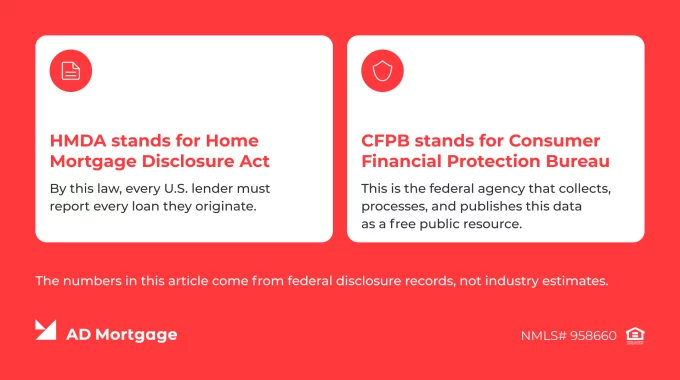
Florida is one of the most active mortgage markets in the United States. According to CFPB HMDA most recent data (2024 report), licensed MLOs in the state closed 396,303 transactions across home purchases, refinances, and cash-out refinances, with a combined loan volume of $157.8 billion.
The average loan size across these transactions comes to approximately $400,000. At a 1% origination fee, that translates to roughly $4,000 in gross commission per closed loan.
Home purchases account for 75% of all transactions. This is the core of any Florida MLO’s business. Refinancing and cash-out refinancing add a meaningful secondary revenue stream that grows significantly when interest rates decline.
Salary of Mortgage Loan Officer in Florida
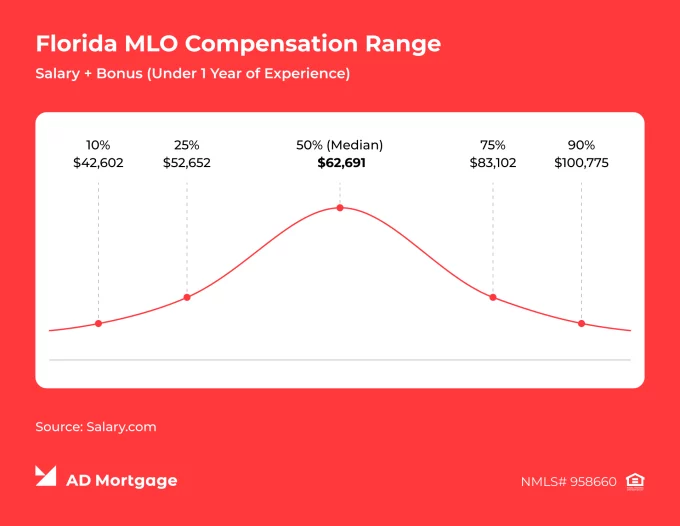
Compensation for Florida mortgage loan officers depends on employment structure. MLOs working within a mortgage company or bank typically earn a base salary plus commission. According to employer-reported data from Salary.com, they receive $63,691 yearly (median), with the top 10% earning above $100,775. These numbers are accurate for professionals with <1 year of experience.
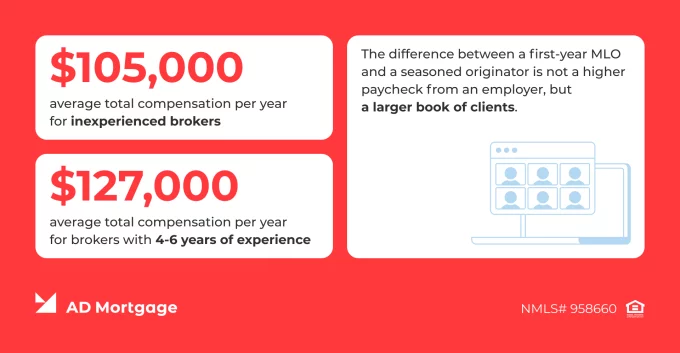
For MLOs operating as independent brokers, income depends on volume. Glassdoor data, based on 830 Florida submissions as of April 2025, shows average total compensation of approximately $105,000 for inexperienced brokers, including base and commission. Experienced originators with 4–6 years of experience average closer to $127,000.
As of September 30, 2025, Florida had 58,212 active state-licensed MLO individuals. This is the highest total of any state in the country, according to the NMLS Mortgage Industry Report. If you are ready to become one, it’s time to learn more about Federal and State-level requirements.
Florida Mortgage Broker License: Quick Facts
| Regulator | Florida Office of Financial Regulation (OFR). The state agency that issues and oversees your license. |
| Licensing system | NMLS (Nationwide Multistate Licensing System). The federal online system where you apply, pay fees, and manage your license. Used in all 50 states. |
| Pre-license education | 20 hours (including 2 hours of Florida-specific content). An in-person course completed before you can sit for the exam. Delivered by private NMLS-approved providers. |
| Exam | SAFE MLO National Test with Uniform State Content, $110. |
| State application fee | $195 if you are licensing as an individual; $425 if you are also opening your own brokerage company. |
| Total estimated cost | $600 – $900 Includes government fees and pre-licensing education. Verify current fees with OFR and NMLS before applying. |
| Renewal deadline | December 31 annually. |
| Governing statute | Chapter 494, Florida Statutes. The Florida law that defines all licensing requirements. It’s the legal foundation for everything in this guide. |
Understanding the Terminology
Before elaborating the steps, let’s clarify two terms that are often used interchangeably but mean different things legally in Florida.
A Mortgage Loan Originator (MLO) is an individual who takes loan applications, negotiates loan terms, or solicits mortgage loans for compensation. This is a case for an individual license. It is what most people are pursuing when they search “how to become a mortgage broker in Florida.”
Alternatively, a Mortgage Broker is a licensed company (business entity) that employs or contracts with one or more MLOs. If you’re looking to run your own independent brokerage and still be able to originate loans yourself, you need both an individual MLO license and a company Mortgage Broker license.
This guide covers both paths. Most people start with an individual MLO license.
How to Get Your MLO License in Florida: Step by Step
Federal Requirements
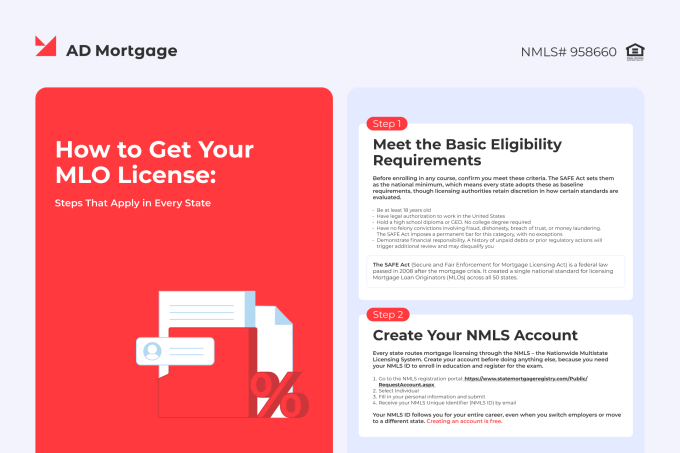
Before getting into Florida’s specific requirements, here are the steps every MLO completes regardless of state. These are set by federal law across all 50 states.
- Create your NMLS account (free)
- Complete 20 hours of pre-license education ($200–$500)
- Pass the SAFE MLO exam ($110)
- Submit Form MU4 + FBI background check ($36.25–$46.25)
- Get employer sponsorship
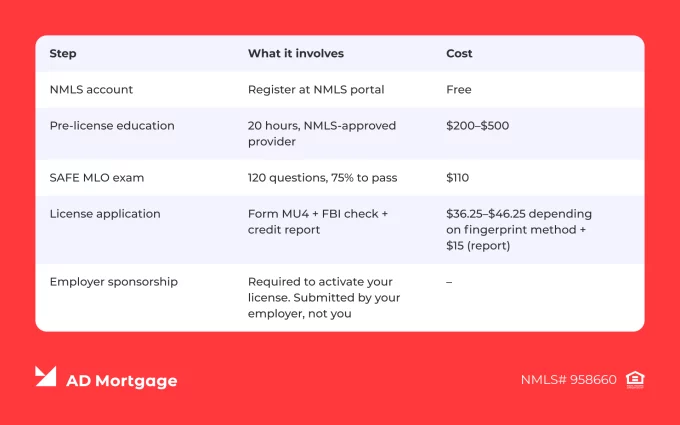
If you are ready to start and want the full, detailed picture of what federal licensing looks like, save the PDF. It lays out every deadline, requirement, and even link in one place so you are not hunting for details across multiple websites.
Florida MLO License Requirements
Florida MLO applicants complete several requirements that don’t apply in most other states.
1. Two separate background checks
Most states require only the federal FBI check. But Florida also requires a separate FDLE state fingerprint scan through an approved vendor. Budget approximately $33 for this and schedule it early, as processing can take several days.
2. Regulator
Florida’s sole licensing authority is the Florida Office of Financial Regulation (OFR). Unlike some states that split oversight between multiple agencies, Florida keeps everything under one roof which simplifies the application process.
3. Florida-specific fees
| Fee | Amount | Paid to |
|---|---|---|
| OFR application fee | $195 | Florida OFR |
| Mortgage Guaranty Trust Fund | $20 | Florida OFR |
| FDLE state fingerprint scan | ~$33 | Approved vendor |
| Florida-specific total | ~$248 |
Federal fees apply in all states and are listed in the PDF checklist.
Need to Renew Your MLO License?
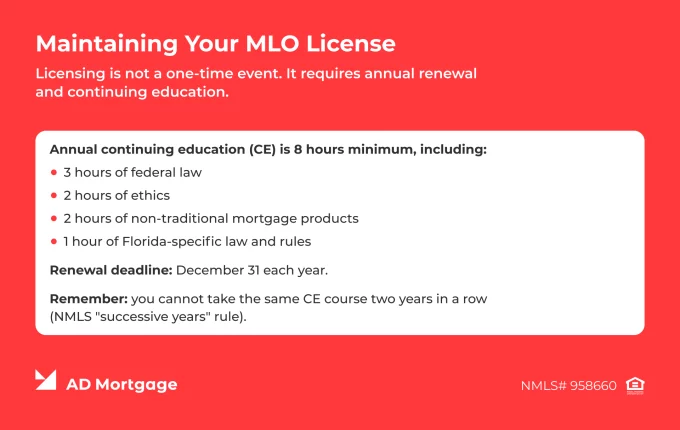
Florida mortgage loan officers can fulfill their annual CE requirement at events organized by major industry organizations:
- FAMP – Florida Association of Mortgage Professionals
- MBAF – Mortgage Bankers Association of Florida
- Originator Connect Network (OCN)
These organizations regularly host one-day sessions where licensed MLOs complete all 8 required CE hours in a single sitting, including:
- Federal law
- Ethics
- Non-traditional mortgage products
- Florida-specific regulations
Events typically include a trade show floor and sessions with industry speakers on market trends, compliance updates, and lending products.
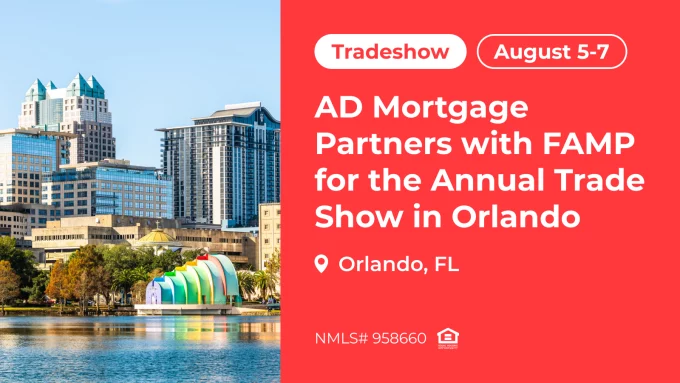
For example, in August 2026, FAMP Annual Mortgage Convention & Tradeshow 2026 will take place in Orlando. At the event, you can complete your continuing education (CE) and renew your license.
AD Mortgage will be supporting this Conference as a Title Sponsor.
How to Receive a Mortgage Brokerage License in Florida
If your goal is to run an independent brokerage (not just work as an individual MLO), you will need a separate Florida Mortgage Broker company license in addition to your individual MLO license.
Key requirements for the company license:
- Register your business with the Florida Division of Corporations
- Submit Form MU1 (company application) through NMLS
- Submit Form MU2 for each control person (officers, directors, partners)
- Pay a $425 OFR application fee + $100 Florida Mortgage Guaranty Trust Fund assessment fee
- Pass background checks and credit reviews for all control persons
- Submit Mortgage Call Reports (MCR) through NMLS
FAQ: Become a Mortgage Loan Officer
How long does it take to get a mortgage broker license in Florida?
Most applicants complete the process in 2–3 months. The pre-licensing course can be finished in as little as 4–5 days online. Exam scheduling, application review, and background check processing account for most of the timeline.
Do I need a college degree to become a mortgage broker in Florida?
No. Florida requires only a high school diploma or GED. No college degree is required.
How much does it cost to become a mortgage broker in Florida?
Government and NMLS fees total approximately $444. Add $200–$500 for pre-licensing education. Total cost typically falls between $600 and $900.
Can I fail the SAFE exam and retake it?
Yes. After the first or second failed attempt, you must wait 30 days before retesting. After a third consecutive failure, you must wait 180 days.
Can I originate loans in Florida without a sponsor?
Florida doesn’t require employer sponsorship to be recorded in NMLS; your license activates upon OFR approval. However, you must be affiliated with a licensed mortgage broker or lender under Chapter 494, Florida Statutes before initiating any loan transaction.
Ready to Get Licensed? What to Do Next
Getting your Florida MLO license is not the finish line. Once licensed, your success depends on the lender relationships and product access you build from day one.
AD Mortgage is a wholesale lender headquartered in Fort Lauderdale, FL, with a dedicated partner support team and access to conventional, Non-QM, Jumbo, and other loan programs. New brokers are welcome.
Last reviewed: May 2026. Not legal advice. Licensing requirements and fees are subject to change. Always verify current requirements directly with the Florida Office of Financial Regulation and the NMLS Resource Center before beginning your application.