
Illinois Housing Market in Q3 2026: What Brokers Need to Know
| Share Your Voice |
|---|
| Take Our Year-End Survey to Get 500 Loyalty Points and Exclusive Summary TAKE SURVEY |
In Q3 2026, Illinois saw an increase in active listings, stabilizing sale prices, and a slight decline in new listings. This report examines those trends from a broker’s perspective and translates the data into practical talking points for client conversations.
Illinois Housing Market at a Glance: Q3 2026
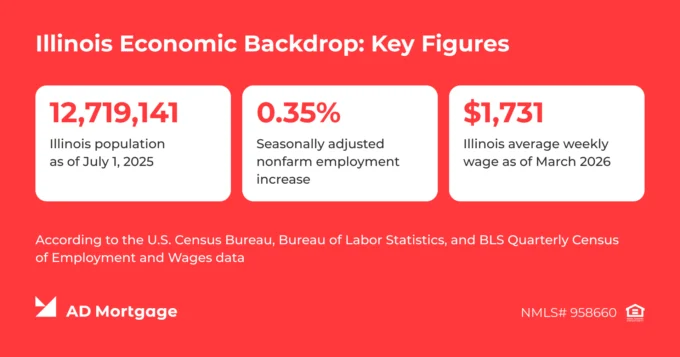
Illinois’ population has grown for three consecutive years, reaching 12,719,141 in 2025, according to U.S. Census Bureau state estimates. Residents age 18 and older accounted for 79.4% of the state population, a bit over 10 million. After population declines in previous years, this renewed growth signals market stabilization rather than a rapid population boom.
Both employment and wages increased modestly. Seasonally adjusted nonfarm employment grew 0.35% year over year, from 6.15 million in September 2025 to 6.17 million in September 2026, according to Bureau of Labor Statistics data. Average weekly wages grew 4.1% year over year, a $68 net change from $1,663 in March 2025 to $1,731 in March 2026, reports BLS.
Additionally, the unemployment rate grew by 0.4 percentage points year over year, reaching 4.7%.
Broker Takeaway: Weekly wage growth outpaced employment growth, indicating that existing workers are earning more rather than a large number of new jobs are being created. Because wage growth exceeded the national inflation rate of 3.4%, Illinois worker purchasing power improved – potentially supporting housing affordability and buyer demand.
While market data provides valuable context, every transaction depends on the borrower’s individual situation. If you have a scenario in mind, submit a request, and our experts will help you explore available financing options and tailor a mortgage solution to your client’s needs.
Illinois Housing Inventory Grows as Homes Stay on the Market Longer
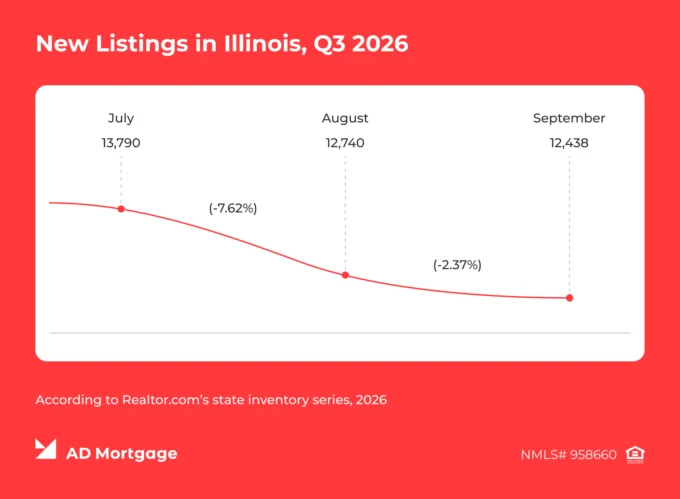
After reaching an annual peak of 13,790 new listings in July, the number of new listings declined through the rest of the third quarter. In September, new listings fell to 12,438, the lowest monthly total of the year, according to Realtor.com’s state inventory series.
Meanwhile, total active listings reached a year-to-date high of 22,584 properties in September, up 0.2% from 22,540 in September 2025. Although the annual increase was minor, the combination of fewer new listings and a larger active inventory suggests that homes are remaining on the market longer.
The properties spent an average of 38 days on market in September, one day longer than the 37-day average recorded in Q2 2026.
Broker Takeaway: Rising active inventory alongside fewer new listings may signal a gradual shift toward a more balanced or buyer-friendly market. For buyers, this can create room to negotiate on price and closing costs. Depending on the client’s position, brokers can discuss strategies such as temporary rate buydowns, seller-paid closing-cost assistance, repair credits, or a potential price reduction.
Illinois Home Prices Stabilize, but Ownership Costs Stay High
Illinois recorded 35,976 home sales in Q3 2026 at an average regional median sale price of $222,103, according to the latest Zillow data. As of August 2026, the statewide median sale price was $330,000, claims the Illinois REALTORS® report. Prices appear to be stabilizing after reaching their annual peak in June, a development that may improve affordability for buyers.
Beyond the sale price, ongoing ownership costs remain an important consideration for Illinois buyers. Illinois has among the highest effective property-tax rates in the country, averaging 1.73% of a home’s assessed value, or about $3,507 annually. Homeowners insurance adds an estimated $2,802 per year, or about $233 per month, on average.
Broker Takeaway: Compare financing scenarios with clients, considering both the purchase price and ongoing costs, such as property taxes and homeowners insurance. In Illinois, total monthly housing costs can be a useful starting point for affordability conversations.
High Share of Mortgaged Homes Signals Refinance and Equity-Loan Potential
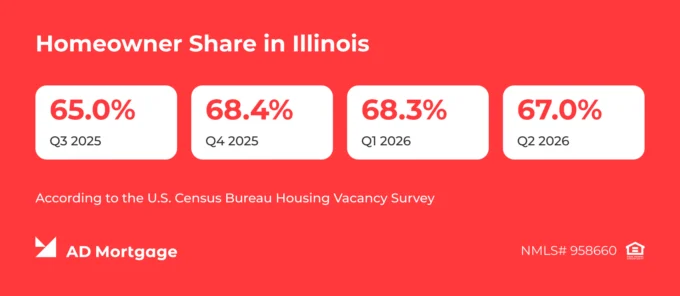
Illinois’ homeownership rate remained relatively stable throughout the year, declining from 68.3% in Q1 to 67.0% in Q2. Among owner-occupied homes, 59.7% carried a mortgage, according to U.S. Census Bureau data.
Broker Takeaway: With nearly six in ten owner-occupied homes carrying a mortgage, many Illinois homeowners remain sensitive to interest-rate movements. As rates change, this creates potential demand for refinance, cash-out refinance, home-equity, and second-mortgage scenarios – particularly for homeowners seeking to lower payments, access equity, or consolidate higher-interest debt.
Housing Market Outlook for Q4 2026: Three Metrics to Watch
While brokers do not need to monitor every macroeconomic parameter, it is worth watching three metrics that directly affect housing transactions:
- New listings show how many options buyers have and where negotiating leverage lies. The number of homes entering the market shapes competition, helping brokers quickly explain current market conditions to clients.
- Days on the market reflect the pace of transactions and can indicate how much flexibility buyers have when negotiating terms. If days on the market increase, buyer leverage tends to increase as well.
- Sales volume and housing prices are the most important indicators for borrowers. However, ongoing homeownership costs should also be part of the conversation – particularly in Illinois, where property taxes are relatively high.
Broker Takeaway: Depending on current market conditions, buyers may take more or less time choosing a property, consider refinancing or a second mortgage, or negotiate more assertively with sellers.
To help your client find the right mortgage solution, use Quick Pricer Pro in the AIM Partner Portal to price your loans quickly.
Not a Partner yet? Complete the Broker Package and get access to innovative tools for an efficient loan workflow.