Loan Modification vs. Forbearance: How Brokers Can Help Clients
September 16, 2026
Add AD Mortgage as your preferred source on Google
The core difference between mortgage forbearance and loan modification is permanence. A loan modification permanently changes the terms of an existing mortgage to make payments more manageable.Mortgage forbearance temporarily pauses or reduces monthly mortgage payments during a hardship, then ends and regular payments resume. A third option, payment deferral, moves missed payments to the end of the loan term.
Put another way, a forbearance agreement is a temporary agreement to pause payments, while a loan modificationis a permanent rewrite of the loan itself. Borrowers request all three from theirmortgage servicer, not from a new lender. Mortgage brokers help clients understand hardship relief options, prepare documentation, and open the servicer conversation early.
“With a loan modification, you can make a change to your terms, and it is a credit event. With a loan forbearance, think of it like a temporary pause. People confuse them because they are both a change to an existing mortgage.“
— Anna Veselenak, Account Executive at AD Mortgage
A loan modification changes the existing mortgage terms to make payments more manageable.
Forbearance is a temporary relief. It does not erase missed payments, which remain owed to the mortgage servicer.
Payment deferral moves missed payments to the end of the loan without changing the monthly payment. It is not the same as forbearance.
Borrowers work with their mortgage servicer, not a new lender, to request modification, forbearance, or deferral.
Documentation matters: a hardship letter, income, expenses, and supporting records will be required to determine if a Borrower qualifies.
Early servicer contact typically expands the loss mitigation options still available.
Brokers can help clients understand the options, prepare questions, and reach the servicer early.
What is Mortgage Forbearance?
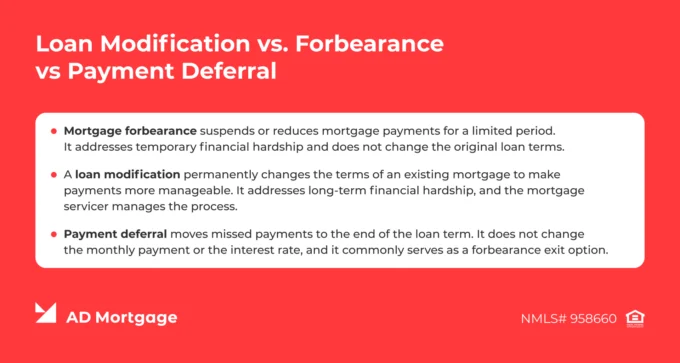
Mortgage forbearance suspends or reduces mortgage payments for a limited period, addressing temporary financial hardship and not changing the original loan terms.
Interest may continue to accrue during the forbearance period, depending on the loan type and the agreement. The relief is a temporary pause, not forgiveness. Missed payments still need to be repaid once the borrower’s financial situation stabilizes, which is why forbearance suits a temporary hardship rather than a permanent one.
How Forbearance Works
The borrower may initiate a forbearance by contacting the mortgage servicer. The servicer will review the borrower’s financial hardship and, if approved, will offer a forbearance agreement defining the relief period and repayment expectations. Get those terms in writing. That document governs what happens next.
What Happens after the Forbearance Period Ends?
The end of the forbearance period triggers a repayment decision with the servicer, which may come in the form of a repayment plan, payment deferral, or a loan modification. A repayment plan spreads missed payments across future monthly payments. Payment deferral relocates the deferred amount to the end of the loan. Modification can permanently change loan terms to help manage payments.
One point brokers should state plainly to clients with FHA insured loans: according to HUD’s Mortgagee Letter of January 2025, servicers cannot require repayments of skipped payments in a lump sum once forbearance ends. The Borrower(s) may choose to provide a lump-sum payment at the end of forbearance, though, it is not a requirement. The loan remains delinquent until the missed amounts are addressed through an exit option.
What is a Loan Modification?
A loan modification permanently changes the terms of an existing mortgage to make payments more manageable. The modification process addresses long-term financial hardship, and is managed by the mortgage servicer.
Loan modification differs from refinancing in one crucial way. A modification restructures the existing loan. Refinancing replaces the existing loan with a new loan, which means an additional underwriting review.
Common Ways a Mortgage May Be Modified
Mortgage modifications attempt to reach an affordable payment through several available options. Extending the loan term reduces the monthly payment, but may increase total interest paid over the life of the loan. Lowering the interest rate reduces the monthly payment, but may increase the total interest paid over the life of the loan depending on the terms of the modification. Capitalization adds certain past-due amounts to the principal balance.
A partial claim may resolve missed payments on certain FHA loans. A trial payment plan usually precedes a final modification agreement to ensure the Borrower(s) can keep up with the agreed upon terms
What is Mortgage Payment Deferral?
Payment deferral moves missed payments to the end of the loan term, while keeping the monthly payment or the interest rate consistent. Payment deferrals commonly serve as a forbearance exit option.
Fannie Mae describes a payment deferral as placing certain past-due amounts into a non-interest-bearing balance that is due at maturity, or earlier upon the sale or transfer of the property, refinance, or payoff of the interest-bearing principal balance. The borrower then resumes making the regular monthly payment. Fannie Mae and Freddie Mac both offer payment deferral subject to defined eligibility limits, including a cap on cumulative deferred payments over the life of the loan.
An FHA partial claim works similarly by placing eligible past-due amounts into a zero-interest junior lien that generally becomes due upon maturity, sale, refinance, payoff, or other specified termination events.
Loan Modification vs Forbearance vs Payment Deferral: Key Differences
Forbearance pauses payments temporarily, while loan modification changes the loan terms permanently. Payment deferral postpones repayment of missed amounts without altering existing loan terms. The three options address different hardship durations: forbearance for short-term hardship, deferral for a resolved hardship with recovered income, and modification for a permanent income change.
Differences between forbearance, payment deferral and loan modification
Feature
Forbearance
Payment Deferral
Loan Modification
Broker Note
Main Purpose
Suspends payments
Relocates missed payments
Restructures loan terms
Match to hardship length
Timeline
Temporary, defined period
One-time resolution
Permanent
Set expectations early
Monthly Payment
Paused or reduced
Unchanged
Changed
Deferral surprises clients
Existing Loan Terms
Preserved
Preserved
Modified
Only modification rewrites terms
Missed Payments
Still owed
Moved to loan end
Capitalized or resolved
Nothing is forgiven
Credit Reporting
Depends on agreement
Depends on agreement
Typically reported
Get terms in writing
Documentation
Lightest
Moderate
Heaviest
Scales with permanence
Best Fit
Short-term hardship
Income recovered
Income permanently lower
Ask which applies
Forbearance vs Deferment: What is the Difference?
The main difference between forbearance and deferment is timing. Forbearance pauses payments during an active hardship. Deferment resolves missed payments after the hardship ends. When a client asks which is better — forbearance or deferment — the answer depends on whether the borrower will be able to resume making regular payments.
A client whose hardship is continuing may need to ask the servicer about extending or entering forbearance. A client who has resumed regular income, but cannot repay the missed amount at once, may be evaluated for payment deferral or a repayment plan.
When should the Borrower(s) contact the servicer? Before missing a payment, if possible; as soon as a hardship is foreseeable, or before the forbearance period ends. Waiting until the loan has been delinquent for months narrows down what the servicer can still offer to help cure the loan.
Which Option May Fit the Borrower’s Situation?
To help clients prepare for a productive conversation with their servicer, brokers should understand whether the hardship appears to betemporary, or long term, and what documentation may be requested. The servicer evaluates eligibility and determines which options are available under the applicable investor or agency guidelines.
Common Financial Hardship Scenarios
These examples can help brokers explain which options a servicer may consider, but they do not determine eligibility.
A temporary job loss may lead the servicer to consider forbearance.
A client whose income has permanently decreased often points toward loan modification.
Recovered income after a hardship may lead to payment deferral or a repayment plan.
Short-term medical expenses may constitute a need for forbearance or a repaymentplan.
Who May Qualify for a Loan Modification?
Servicers evaluate income, expenses, and hardship documentation. A documented long-term hardship supports a loan modification application anddemonstrated ability to make the modified payment influences approval. However, neither guarantees it.
How the Loan Modification Process Usually Works
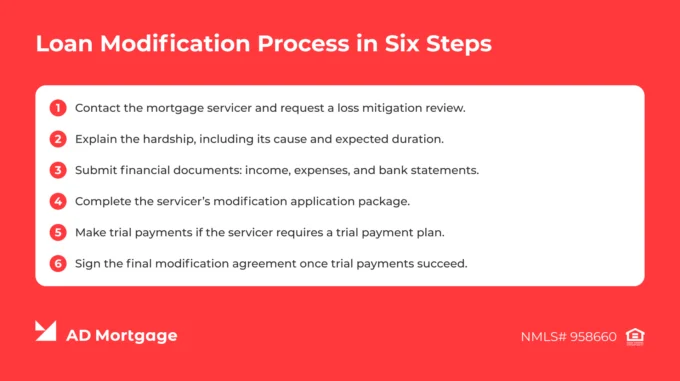
The modification process begins with contacting the mortgage servicer and generally runs through six stages.
Contact the mortgage servicer and request a loss mitigation review.
Explain the hardship, including its cause and expected duration.
Submit financial documents: income, expenses, and bank statements.
Complete the servicer’s modification application package.
Make trial payments if the servicer requires a trial payment plan.
Sign the final modification agreement once trial payments succeed.
Completing the required trial payments is generally necessary before a modification can become permanent, but it does not independently guarantee final approval. The servicer controls the review, timeline, and outcome of the modification process.
Documents Borrowers May Need
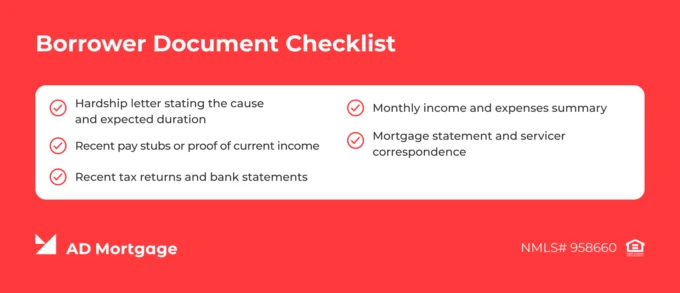
Complete documentation can accelerate servicer review. Incomplete files are the most common avoidable delay.
Financial Documents
Pay stubs, tax returns, and bank statementsverify the borrower’s income and expenses. Servicers want a current picture, so recent statements matter most.
Hardship Documentation
A hardship letter explains the cause and expected duration of the financial hardship. That pairing is the specific content servicers look for.
Can Forbearance, Deferral, or Loan Modification Hurt Credit?
Credit reporting, and any effect on the borrower’s credit score, depends on the agreement terms and the borrower’s status when relief begins. Relief entered while current is generally reported differently than relief entered while already delinquent.
The written agreement should explain how the account will be treated, but credit reporting also depends on applicable law, investor requirements, the borrower’s prior payment status, and the servicer’s reporting obligations. Brokers should encourage clients to ask how the account will be reported and obtain the relief terms in writing. Relief entered while current is generally reported differently than relief entered while already delinquent. A written agreement determines how the servicer reports the account, which is why brokers should push clients to get terms documented.
Missed payments that occurred before a relief agreement may still appear on the credit report. During the COVID-19 pandemic, the CARES Act established credit reporting protections for pandemic-era forbearance. Those protections were specific to the pandemic and should not be understood as a general rule that prevents negative credit reporting whenever a borrower receives a forbearance or other payment relief.
Other Mortgage Relief Options
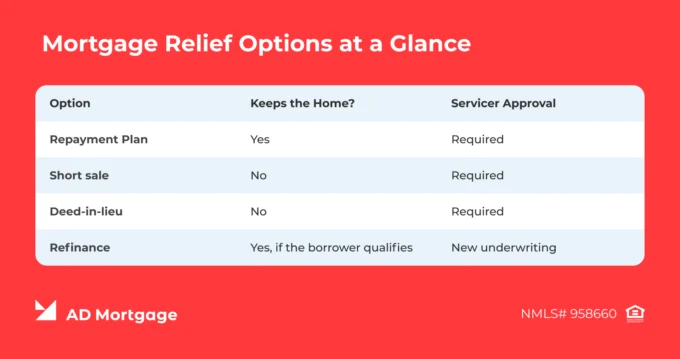
Loss mitigation encompasses the options servicers use to avoid foreclosure. Beyond the three main paths, four more come up in client conversations.
Repayment Plan
A repayment plan adds a portion of missed payments to each regular payment, restoring the loan to current status upon completion. Repayment plans fit borrowers who can pay somewhat more than usual.
Short Sale
A short sale allows the borrower to sell the home for less than the remaining loan balance. It requires servicer approval and may be considered when retaining the home is no longer realistic.
Deed-in-Lieu of Foreclosure
A deed-in-lieu of foreclosure voluntarily transfers ownership to the mortgage holder, or its designee, and may avoid formal foreclosure. Availability and responsibility for any remaining deficiency depends on the agreement, investor requirements, and applicable state law.
Refinance (Only if the Borrower Still Qualifies)
Refinancing replaces the existing mortgage with a new loan and requires the borrower to qualify under current credit and income standards. Refinance is not a universal hardship solution: a borrower already delinquent generally will not qualify. Where a client does still qualify, Conventional, FHA, and VA options are worth comparing.
Loss Mitigation Options by Loan Type
Every mortgage program has its own rules for helping borrowers recover from a financial hardship and avoid foreclosure. The options below summarize the main loss-mitigation paths by loan type, eligibility, documentation requirements, and available terms depend on the borrower’s circumstances and current program guidance.
Conventional Loans (Fannie Mae / Freddie Mac)
Fannie Mae and Freddie Mac back conventional conforming loans. TheFlex Modificationprogram applies a series of steps designed to reach a 20% principal and interest payment reduction target for eligible borrowers. Payment deferral is generally available when a borrower’s hardship has been resolved and the borrower can resume making the full contractual monthly payment, while a Flex Modification is generally intended for borrowers experiencing a permanent or long-term hardship.
FHA Loans
FHA follows a loss mitigation waterfall, a defined order of options servicers must work through to evaluate loss mitigation options for eligible borrowers. FHA’s permanent home retention options become effective October 1, 2025, and includes a standalone partial claim, a standalone loan modification, a combination modification with partial claim, and Payment Supplement. For borrowers who cannot afford their existing monthly payment, certain options are designed to achieve a 25% reduction in the principal-and-interest portion of the payment. A trial plan may be required before a payment solution is finalized. PerHUD, borrowers may receive only one permanent home retention option within any 24-month period, absent a presidentially declared disaster.
VA Loans
VA options changed recently, so verify current status before advising. The Veterans Affairs Servicing Purchase programclosed to new submissions on May 1, 2025. The VA began accepting Partial Claimtrial-payment-plan events on June 15, 2026. Servicers were given an implementation period of 180 days from June 1, 2026, so borrowers should confirm current availability with their servicer. Eligible borrowers generally complete a three-month trial payment plan before the overdue amount is placed into a VA-held partial claim. Upon successful completion, the partial-claim process pays the overdue amount to the servicer and brings the mortgage current, while the borrower remains responsible for the partial claim under the applicable VA terms.
USDA Loans
USDA Rural Developmentdoes not offer workout plans directly on guaranteed loans. Borrowers contact their servicing lender, and options may include informal or special forbearance, loan modification, special loan servicing, and pre-foreclosure sale.
Official Resources Borrowers May Need
The CFPB provides guidance on mortgage hardship and servicer communication. HUD-approved housing counselorsoffer loss mitigation guidance at no cost to the borrower. The mortgage servicer remains the borrower’s first point of contact for any relief request.
How Mortgage Brokers Can Help
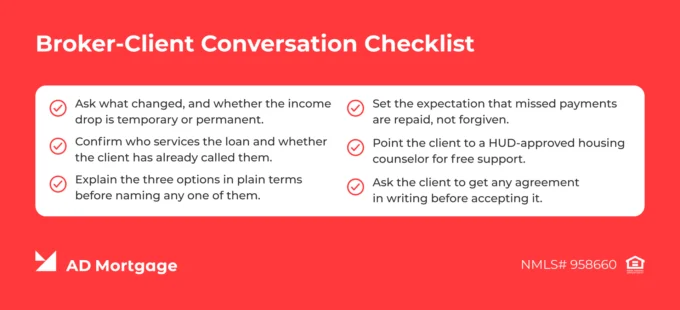
Brokers translate loss mitigation options into client-friendly explanations and help clients prepare hardship documentation before servicer contact. Early broker guidance reduces borrower confusion during a difficult period.
State the limit clearly with every client: brokers do not control a servicer’s loss mitigation decisions. What brokers control is preparation, expectation-setting, and timing. If the borrower has recovered sufficiently to qualify for a new mortgage, the broker can also evaluate whether refinancing offers a viable alternative. That is a separate process from the servicer’s modification or forbearance review.
“A loan modification is a change to the terms of the loan. A forbearance is a temporary pause or reduction in loan payment. A broker can help a borrower struggling to make payments by offering options for refinance to a lower rate or a lower monthly payment; changing to different terms, such as 30 YR, ARM, or Interest Only; or switching loan programs.“
— Jacquez Stephens, Account Executive at AD Mortgage
These conversations are becoming more common. The Mortgage Bankers Association reported the delinquency rate on one-to-four-unit residential properties at4.37% at the end of the second quarter of 2026, up 44 basis points year over year, with loans in foreclosure at 0.67%.
AD Mortgage’s Role and Services
AD Mortgage supports mortgage brokers with tools and partner resources. The AIM Partner Portal streamlines loan processing tasks for broker partners, and the mortgage glossary gives clients plain-language definitions of the terms in this article.
When a client’s hardship resolves and a new loan becomes the right answer, submit a scenario and an Account Executive will review the file.
What is the difference between forbearance and deferment?
Forbearance pauses payments during an active hardship. Deferment resolves the missed payments after the hardship ends by moving them to the end of the loan term. Forbearance buys time; deferment settles what that time created. Both leave the original loan terms intact.
Which is better, forbearance or deferment?
The better option depends on whether the borrower can resume regular payments. A client still in hardship needs forbearance. A client whose income recovered but who cannot repay several months at once is a better fit for deferment or a repayment plan.
Is loan modification the same as refinancing?
No. A modification restructures the existing loan, keeping it in place with new terms. Refinancing replaces the existing loan with a new loan, which requires the borrower to qualify under current credit and income standards. Modification is a servicer process, not a new origination.
Does loan modification hurt your credit?
Credit reporting depends on the agreement terms and the borrower’s status when relief begins. Modifications are often reported, and missed payments before the agreement may already appear. Ask the servicer how the account will be reported and get that answer in writing.
Can a borrower get a loan modification after forbearance?
Yes. Modification review is one of the standard forbearance exit options, alongside a repayment plan, payment deferral, or reinstatement. The servicer evaluates the borrower’s current income and hardship documentation to determine which exit fits and may require a trial payment plan before issuing a final agreement.
What should a borrower do first if they cannot make a mortgage payment?
Contact the mortgage servicer before missing a payment, if possible. Early contact typically preserves more loss mitigation options than waiting until the loan is months delinquent. A HUD-approved housing counselor can help at no cost, and brokers can help the client prepare documentation beforehand.
Conclusion
The forbearance vs loan modification distinction comes down to three outcomes. Forbearance provides temporary payment relief. Loan modification provides a permanent change to loan terms. Payment deferral provides a way to repay missed amounts later without changing the monthly payment.
Brokers who can explain that distinction clearly, and who get clients talking to the servicer early, add real value during a hard stretch. AD Mortgage supports brokers with the tools and scenario help to stay useful to those clients through the recovery and into their next loan.