Post content:
Add AD Mortgage as your preferred source on Google
Ask five different Oklahomans where to live and you will likely get five different answers – and all of them are defensible. The Oklahoma housing market offers diverse homebuying opportunities.
A commuter chasing Oklahoma City’s job market wants something different than a retiree eyeing a dock on Grand Lake, who wants something different again than a buyer drawn to the wide-open, low-cost counties of the western plains. Oklahoma’s housing market doesn’t resolve into a single verdict, and it shouldn’t.
What it does offer is range: fast-growing suburbs ringing Oklahoma City and Tulsa, lake towns like Grove riding a wave of second-home demand, and rural counties across the west and southeast where a modest income still stretches into homeownership. AD Mortgage spent time in the data behind all of it, working through the numbers to flag the locations across Oklahoma most worth a buyer’s attention in 2026.
AD Mortgage is a wholesale mortgage lender with over 20 years in the industry. We offer a wide range of mortgage solutions, innovative technologies for broker partners, and 24/7 support. Become a Partner to work with the lender that helps you win.
Oklahoma Real Estate Market Overview
This report draws on a range of factors to paint a broad picture of what homebuyers, realtors, and mortgage professionals are up against across Oklahoma.
The complete range of research and supporting data is available in the downloadable Oklahoma Homebuyers Guide PDF. However, below is an overview of the primary categories we explored and considered while evaluating housing opportunities across the state:
- Median Home Prices
- Homebuying Entry Costs
- Taxes and Insurance
- Median Incomes
- Cost of Living
- Location
- Down Payment Assistance (DPA) Programs
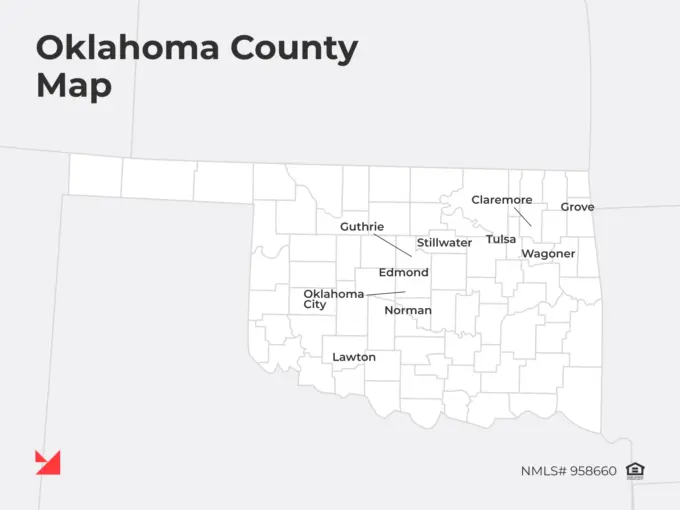
For Oklahoma, we focused on a combination of major metropolitan areas, growing suburban communities, and smaller rural markets that we believe present unique opportunities for different types of buyers. While cities such as Oklahoma City and Tulsa continue to attract buyers seeking employment opportunities and urban amenities, locations like Stillwater, Lawton, and Claremore may appeal to buyers seeking relatively affordable housing, a strong sense of community, or a quieter pace of life.
This report is designed to provide readers with a practical starting point when comparing housing markets across Oklahoma. The downloadable guide includes additional charts, market data, and affordability comparisons to help buyers better understand both the upfront and long-term costs associated with homeownership in different regions of the state.

Our rankings are based on 2025 housing and economic data, along with local market insights and affordability trends available when this was written. They are intended as a helpful starting point for exploring housing options across Oklahoma, rather than a definitive list of the state’s ‘best’ places to live.
For a deeper look at Oklahoma’s real estate landscape, the charts and analysis below examine housing costs, lifestyle factors, and regional variations that can make each market unique.
The Price of Buying and Owning a Home in Oklahoma
For most people shopping for a home, cost of entry is the first hurdle, so that’s where our evaluation starts. The tables below break down the estimated down payment required for a typically priced home across various Oklahoma markets, grouped into tiers based on affordability and entry cost.
Price to Enter: Cost of Buying a Home in Oklahoma
Higher Entry Cost Markets
| County | Typical Home Value | Est. DP 3% | Est. DP 5% | What This Market Feels Like |
|---|---|---|---|---|
| Logan | $316,608 | $9,498 | $15,830 | Fast-growing market north of Oklahoma City |
| Delaware | $293,386 | $8,802 | $14,669 | Lake-centered market with strong second-home demand |
| McClain | $288,701 | $8,661 | $14,435 | Oklahoma City suburb with rapid residential growth |
| Rogers | $287,433 | $8,623 | $14,372 | Tulsa-area market attracting new development |
| Wagoner | $286,092 | $8,583 | $14,305 | Expanding commuter market with lakeside appeal |
Moderate Entry Markets
| County | Typical Home Value | Est. DP 3% | Est. DP 5% | What This Market Feels Like |
|---|---|---|---|---|
| Muskogee | $160,790 | $4,824 | $8,040 | Historic regional hub with steady housing demand |
| Haskell | $160,210 | $4,806 | $8,011 | Quiet rural market with wide-open spaces |
| Pushmataha | $160,147 | $4,804 | $8,007 | Forested market popular with outdoor enthusiasts |
| Comanche | $156,839 | $4,705 | $7,842 | Military-driven market anchored by Fort Sill |
| Beckham | $156,215 | $4,686 | $7,811 | Energy and transportation hub in western Oklahoma |
More Accessible Entry Markets
| County | Typical Home Value | Est. DP 3% | Est. DP 5% | What This Market Feels Like |
|---|---|---|---|---|
| Harper | $79,883 | $2,396 | $3,994 | Agricultural market with low housing costs |
| Greer | $78,560 | $2,357 | $3,928 | Small farming community with affordable homes |
| Harmon | $65,011 | $1,950 | $3,251 | One of the state's most affordable housing markets |
| Tillman | $61,378 | $1,841 | $3,069 | Rural county offering low-cost homeownership |
Purchase price is only one piece of the puzzle, though. Buyers in Oklahoma also need to factor in ongoing expenses – property taxes, insurance, utilities, and the cost-of-living gap between one part of the state and another.
The spread is wide: Logan and Delaware counties sit at the pricier end, while Harper and Tillman sit near the floor – proof that Oklahoma’s housing options stretch across almost any budget or lifestyle a buyer might have in mind.
Cost to Hold: Ongoing Ownership Costs by County
Lower home prices do not necessarily mean lower monthly homeownership costs. In Oklahoma, factors such as property taxes, homeowners insurance, utility expenses, and regional cost-of-living differences can have a meaningful effect on long-term affordability. For example, Harmon and Tillman counties rank among the state’s most affordable based on home purchase prices, yet they also have some of the highest ongoing costs relative to home value. Buyers in these areas should therefore account carefully for taxes and insurance rather than assuming a lower purchase price will automatically mean a lower monthly payment.
To provide borrowers with a clearer picture of potential expenses, we compared typical home values with estimated property taxes and homeowners insurance – the primary components, along with principal and interest, that make up a mortgage’s principal, interest, taxes, and insurance (PITI) costs. You can find the comparison table in the Guide PDF.
Need help finding the right mortgage solution for your client? AD Mortgage offers a full range of loan programs, and our experts match your scenario with a tailored program within 30 minutes.
It’s All about Location: Best Places to Live in Oklahoma
While home prices and ownership costs play a major role in housing decisions, they are only part of the equation. Location and its associated cost of living are also important considerations, as they can have a significant effect on day-to-day life.
Even with the growing popularity of remote work and the convenience of online services such as shopping and food delivery, some experiences still depend on being close to the places people value. Whether it’s dining at a favorite restaurant, catching a movie with family, or having convenient access to healthcare and schools, proximity can make a meaningful difference in quality of life.
At the same time, ‘location’ is difficult to measure objectively. Oklahoma’s geography varies considerably, from the Great Plains in the west and the Cross Timbers through the central part of the state to the lake-filled hills of northeastern Oklahoma. To account for these differences, we consulted local experts to identify some of the state’s most notable places to live.
Initial Results
The tables above will not pinpoint exactly where you should buy in Oklahoma, but they provide a useful starting point for understanding how housing costs vary across the state counties and cities.
As in many states, home values in Oklahoma differ substantially from one county to another, with less populated rural areas generally offering the lowest prices. However, the more remote counties in western and southeastern Oklahoma may not suit every buyer, even when places such as Harmon and Tillman offer attractive purchase prices.
There’s also an important distinction between purchase price and ongoing affordability. Harmon and Tillman have the lowest typical home values on our list, yet they rank highest for ongoing costs as a percentage of home value. In other words, the least expensive places to buy aren’t necessarily the least expensive places to own a home over time.
Down payment assistance (DPA) is another important part of the affordability equation, and we explore available options in the PDF guide in detail.
Taking these factors together, Oklahoma City emerges as the strongest overall choice for many Oklahoma buyers, combining the shortest savings timeline among the state’s major metros with a moderate ongoing cost burden and a broad selection of down payment assistance programs. Below, we explore our other top picks and what makes each one worth considering.
Oklahoma City
Numbers rarely line up this neatly: the state capital also happens to post the quickest savings timeline of any major Oklahoma metro, and it backs that up. Oklahoma City also offers the deepest down payment assistance toolkit in the guide. That combination alone puts it at the top of our list.
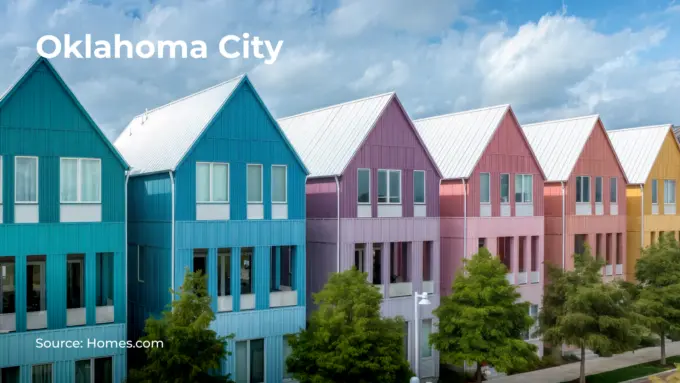
Tinker Air Force Base anchors a job market that stretches well beyond aviation into bioscience, energy, and state government, while a decade-plus of downtown reinvestment – Bricktown’s entertainment strip, the Boathouse District along the river – has given the city a pull it did not have a generation ago.
The Oklahoma City HOME DPA Program is the headline number here: up to $18,000, plus another $5,000 toward buying down an interest rate, for buyers who meet the income limits. Paired with a five-and-a-half-year savings timeline, it’s hard to beat for a city this size.
Tulsa
Ask a longtime Tulsan what the city is about and you’ll get more than one answer: Art Deco skyscrapers built on oil money, a riverfront that’s been reimagined around the Gathering Place park, and a music and food scene that’s grown well past its blues-and-barbecue reputation.
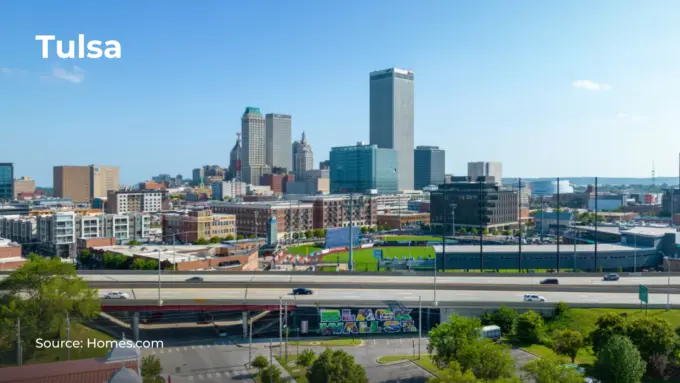
The oil-town label undersells where the jobs actually come from now – aerospace, healthcare, and finance carry as much weight as energy does today, giving the local economy a cushion it didn’t have decades ago.
First-time buyers get a real assist here: the Tulsa Housing Authority forgives 3.5% of the loan amount after five years in the home.
Norman
Half college town, half Oklahoma City commuter suburb – Norman doesn’t fully commit to either identity, and that’s precisely what buyers seem to like about it.
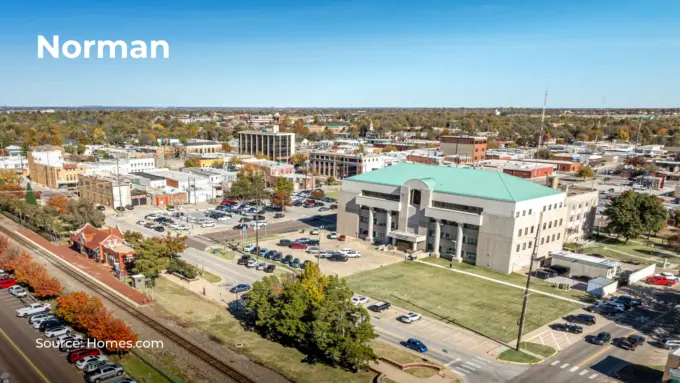
The University of Oklahoma sets the tone, but the National Weather Center and a growing healthcare sector round out a job base that isn’t purely tied to the academic calendar.
Prices here sit above what you’d pay closer to the capital, though household incomes are strong enough to keep the math from getting out of hand. The Norman Down Payment Assistance Program, funded through HUD’s HOME program, puts up to $14,999 toward closing the gap for income-eligible buyers.
Edmond
Edmond plays a different game than most of the cities on this list: it is not chasing affordability, it is selling top-rated schools, low crime, and the kind of polish that comes with money.
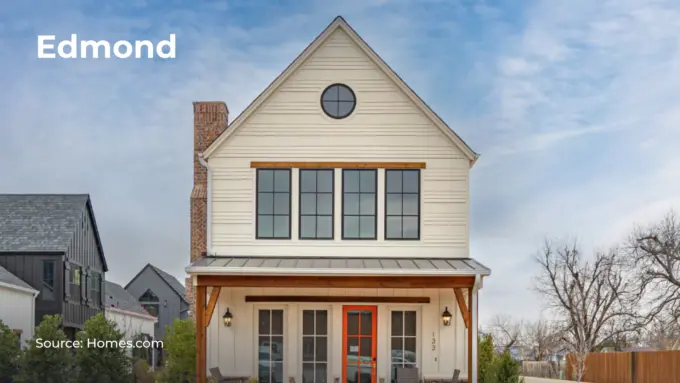
The University of Central Oklahoma and a steady influx of corporate offices help explain why household incomes here outpace every other city in this guide.
Home values in Edmond are the highest we tracked – no way around that – but those same high incomes keep the savings math surprisingly competitive with cheaper markets. The Edmond Homebuyer Assistance Program covers up to half the required down payment, capped at $14,999, for buyers who qualify.
Stillwater
Oklahoma State University does not just anchor Stillwater’s economy – it shapes almost everything about who lives there and what they earn, which matters more than usual for this guide’s purposes.
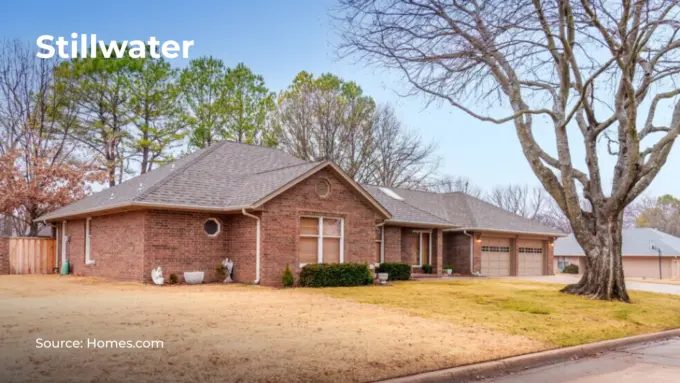
A large student population pulls median income down relative to home prices, and the arithmetic shows: Stillwater’s savings timeline runs longest of any city here, at nearly twelve years.
That’s not a reason to write it off, just a reason to plan differently. The Stillwater Homebuyer Assistance Program offers up to $5,000, forgiven after seven years in the home, which takes some of the pressure off buyers willing to play the long game.
Does your client plan to purchase in Oklahoma or in other parts of the country? AD Mortgage serves brokers with complex or out-of-the-box borrower scenarios, helping you match your client with the right solution.
Lawton
If speed to homeownership is the priority, Lawton wins outright – the shortest savings timeline in this entire guide, built on the lowest home values paired with a median income that holds up better than the price tag suggests.
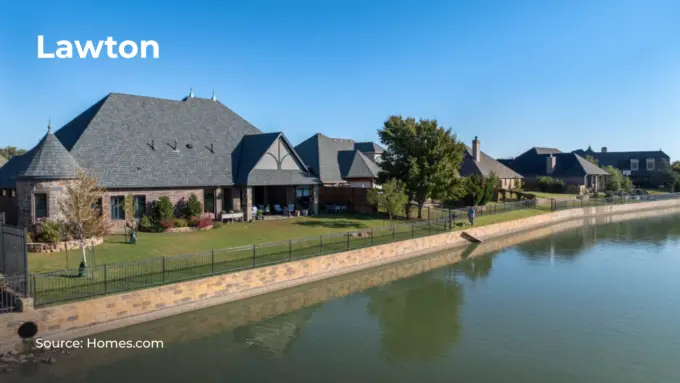
Fort Sill drives much of the local economy, alongside agriculture and a healthcare sector that serves a wider region than the city itself. The Wichita Mountains Wildlife Refuge sits close enough to be a weekend habit rather than a special trip.
The Lawton First-Time Homebuyer Program adds up to $15,000 on top of an already favorable starting position, split between a forgivable loan and a repayable one – a combination that’s hard to match anywhere else on this list.
Claremore
Will Rogers was born here, and Claremore still trades a bit on that small-town, storyteller charm – antique shops downtown, a lake nearby, Route 66 running through the middle of it.
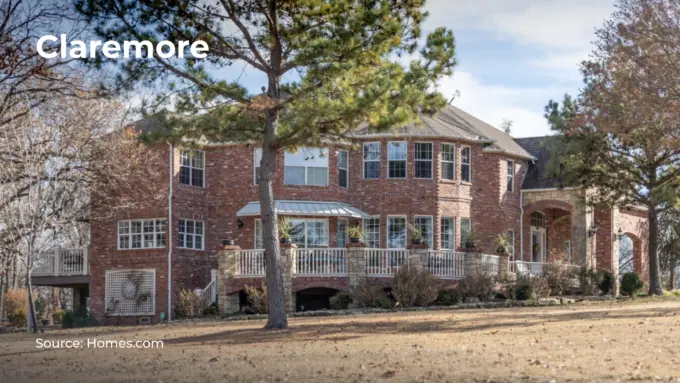
Rogers State University gives the city an anchor beyond tourism, and steady residential growth along the highway corridor suggests Tulsa’s commuter reach keeps extending outward.
The trade-off is a savings timeline that runs longer than Tulsa’s own, despite sitting just up the road – worth weighing against the appeal of trading city pace for something quieter.
Guthrie
Before Oklahoma City ever held the title, Guthrie was the state capital – and it still looks the part, with one of the best-preserved Victorian downtowns anywhere in the country.
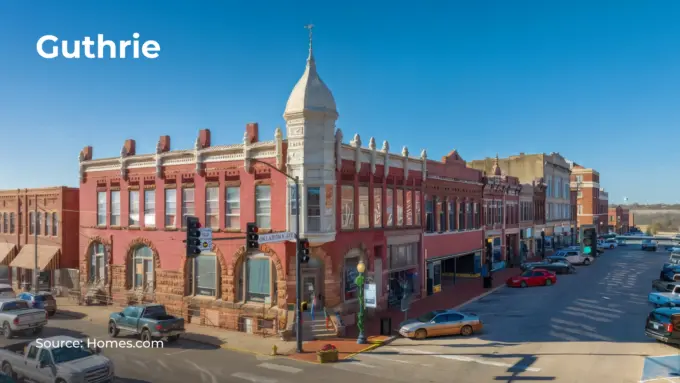
Tourism and historic preservation carry real economic weight here, alongside a growing share of residents who commute north from the city into Logan County’s expanding corridor.
Prices have crept ahead of what local incomes alone would predict, stretching the savings timeline past Oklahoma City’s. The statewide OHFA Down Payment Programs are still on the table for buyers who need help closing that gap.
Grove
Grand Lake O’ the Cherokees does most of the selling for Grove – marinas, golf courses, a tourism season that runs long and hard, and a steady pull for retirees and second-home buyers looking for water views.
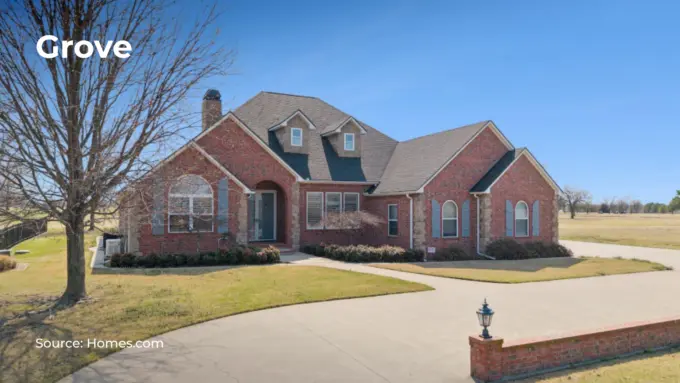
That same lake demand is a double-edged sword: it’s driven typical home values above several larger Oklahoma cities, and it shows up in one of the longer savings timelines in this guide.
Buyers drawn to the lifestyle should not expect a bargain, but the statewide OHFA Down Payment Programs – up to 3.5% of the loan amount – can still soften the entry cost.
Wagoner
Think of Wagoner as Tulsa’s quieter cousin – close enough for a real commute, small enough to still feel like a town, with Fort Gibson Lake thrown in as a bonus.
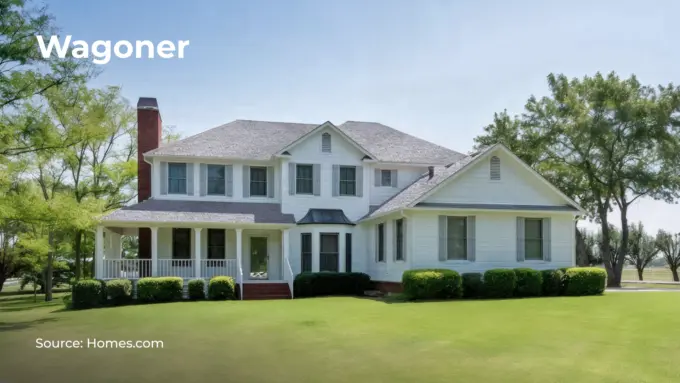
Growth here has followed the commuter corridors more than any single employer, and the local economy leans on small business and regional service jobs rather than one dominant industry.
The savings timeline lands on the faster end for this guide, and the statewide OHFA Down Payment Programs remain available on top of that – a solid case for buyers who want Tulsa-area access without Tulsa-area pricing.
Finding Your Place in Oklahoma
Oklahoma’s housing market offers a unique mix of growing metro areas, lake towns, and peaceful rural communities. From the urban energy of Oklahoma City and Tulsa to the college-town charm of Norman and Stillwater and the wide-open landscapes of the western plains, Oklahoma provides a wide range of opportunities for different types of homebuyers and budgets.
The data shows that there is no single ‘best’ place to buy a home in Oklahoma. The ideal location depends on your budget, lifestyle preferences, career plans, and long-term goals. Some buyers may prefer the job opportunities and amenities of larger cities, while others may be looking for affordable homes, quiet neighborhoods, and a slower pace of life.
For the complete picture – including detailed market data, affordability comparisons, and community insights – download the Oklahoma Homebuyers Guide. Whether you are purchasing your first home, relocating with your family, or searching for a new place to settle down, this guide will help you explore your options and make a more confident decision.
Thank you!
We’ll contact you as soon as possible

Oops, something went wrong
Please try to send form again