Mortgage Insurance Explained: Costs, Types & Cancellation Strategies for Brokers
·15 min read
Add AD Mortgage as your preferred source on Google
What is mortgage insurance and why do I need to buy it? This is a common question for many borrowers ask when buying a home especially if they are first-time homebuyers. Mortgage professionals must not only be able to answer this question competently, but also in a way that soothes the anxiety of a borrower faced with a variety of fees and other costs they may not factored into their homebuying equation.
Fortunately, a good broker or MLO that is armed with extensive knowledge can not only explain the complexities of mortgage insurance but also show their client how to best navigate the process in order to reduce costs in either the short or long term. This can build trust while rotating a negative into a net positive for the borrower.
We have compiled a comprehensive guide on the intricacies of mortgage insurance, the various types available, when it is required and for what types of loans, and some helpful pro tips.
What is Mortgage Insurance?
The short answer is that mortgage insurance protects the lender and not the borrower, in the event the borrower defaults on the loan. This insurance reduces the lender’s risk and allows them to provide funding for riskier borrowers or those with low down payments.
It is often necessary to explain to borrowers that it is not homeowner’s insurance (liability and property) or mortgage protection insurance (MPI), which is a life and disability policy. We will cover those types of insurance here as well.
Two most common types of mortgage insurance in the US
Private Mortgage Insurance (PMI)
For conventional loans where the borrower has less than 20% down payment
Usually costs around 3%–1.5% of the loan amount annually
Is often cancelable after the borrower reaches 20% equity.
Mortgage Insurance Premium (MIP)
For FHA loans, regardless of down payment
Has an upfront fee (usually 1.75%) plus an annual premium
Not cancelable in most cases unless you refinance into a different loan program.
How mortgage insurance affects borrowers
Helps borrowers qualify for a home loan with less money down.
Adds to monthly payments, affects affordability.
Not homeowner’s insurance – protects the lender, not the property.
Why does Mortgage Insurance Exist?
Mortgage insurance was created to protect lenders from financial loss, which consequently made homeownership more accessible.
Following the 1929 Wall Street crash and the Great Depression that followed, there were massive defaults on home loans. This wreaked havoc on the banking system, and many banks failed. Those that survived were often unwilling to extend home loans because they were seen as too risky.
To help alleviate the problem, the Federal Housing Administration (FHA) was created in 1934 to help develop and stabilize the market. The FHA then created government-backed mortgage insurance to encourage lenders to assist homebuyers. Mortgage insurance, now backed by the government, allowed lenders to offer mortgages at less risk. They could also set longer repayment terms and smaller down payments.
Why Mortgage Insurance was needed:
To protect lenders – With insurance, lenders were willing to approve more loans to borrowers with modest savings, because they were no longer taking on the full risk of default.
To lower down payment barriers – Before mortgage insurance, buyers typically needed 30%-50% down. Mortgage insurance reduced this requirement, making homeownership possible for the middle class.
To boost the housing market – By enabling more people to buy homes, mortgage insurance helped fuel economic growth and stabilize housing finance systems.
The involvement of the government in the housing industry as part of FDR’s New Deal forever changed the mortgage industry and most would argue in very positive ways. Mortgage insurance was specifically created as a response to housing market instability, encouraging lenders to participate in home financing, and providing much broader access to homeownership working Americans.
What Types of Mortgage Insurance are There?
There are a variety of mortgage insurance types that are utilized based on the lending conditions and the loan program involved. Here is a quick breakdown of each followed by a quick reference table.
Private Mortgage Insurance (PMI)
Use:Conventional loans (not government-backed)
Conditions: Borrower has less than 20% down payment
Cost: Usually around 0.3%–1.5% of the loan amount annually
Cancelation: Can be canceled when loan-to-value (LTV) hits 80%
Mortgage Insurance Premium (MIP)
Use:FHA loans
Conditions: Always required, regardless of down payment
Function: Similar to mortgage insurance as it protects lender if borrower defaults
VA Funding Fee (an insurance variation)
Use:VA loans (for eligible veterans)
Structure: One-time upfront fee
No monthly mortgage insurance payment
Function: Offsets taxpayer cost of guaranteeing the loan
Type
Loan Type
When Required
Cancelable?
PMI
Conventional
<20% down
Yes (at 80% LTV)
MIP
FHA
Always
Rarely (needs refi)
USDA Fee
USDA
Always
No
VA Fee
VA
Always (one-time)
N/A (no monthly insurance)
Additional Mortgage Insurance Options
Traditional mortgage insurance (PMI or MIP) is the standard route, but there are some alternative types and structures of mortgage insurance or risk mitigation available to suit certain situations. These products can be especially helpful for brokers working with non-traditional borrowers and/or private lenders.
Lender-Paid Mortgage Insurance (LPMI)
Paid by thelender, but a higher interest rate is charged
Use: Conventional loans
Pros: No separate monthly insurance premium
Cons: Higher rate is permanent unless you refinance
Single-Premium Mortgage Insurance
One upfront payment instead of monthly premiums
Borrower or lenderpaid and it is often financed into the loan
Use: Conventional loans
Pros:No monthly MI payment, lower debt to income ratio (DTI)
Cons:No refund if borrower sells or refinances
Split-Premium Mortgage Insurance
Partial upfront premium and lower monthly payments
Use: Conventional loans
Useful for borrowers with higher DTI and lowers monthly costs
A good middle-ground between monthly and single-pay MI
Cons: Second loan may have higher rates or payment conditions
Alternative Type
Key Benefit
Ideal For
LPMI
No MI line item
Buyers with strong credit
Single Premium
Lower monthly payment
Long-term buyers
Split Premium
Flexibility
Buyers managing DTI
Piggyback Loans
Avoid PMI entirely
High-income buyers with limited cash
Risk-Based Pricing
No MI required
Non-QM borrowers
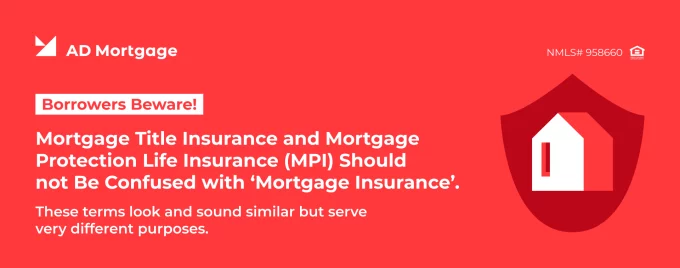
Mortgage Title Insurance
A one-time insurance policy that protects mortgage transaction against legal ownership issues with the home’s title. It protects and is required by most lenders in case title problems arise. However, there is optional ‘owner’s title insurance’ that can be purchased to protect the homeowner/borrower. This insurance covers a range of issues including undiscovered liens, forgeries, fraud, errors in public records, or disputes over ownership and pays legal fees if someone challenges the ownership. Mortgage title insurance is paid in full at closing.
Mortgage Protection Life Insurance (MPI)
A type of life insurance that pays off the mortgage if the borrowers dies, becomes disabled, or in some policies, lose their job. It protects the borrower, their family, and dependents by eliminating the mortgage debt. The lender is also protected since the loan will be paid off. The policy pays off the remaining balance of the home loan and is not related to the value of the home. It is paid monthly and is not always part of the mortgage lending process.
Mortgage Insurance Costs: What Your Clients Should Expect
Mortgage insurance does add to a borrower’s monthly cost, but it can be the tool that opens the door for homeownership since the down payment can be as little as3%. Here are some things borrowers should be informed of during the process.
Private Mortgage Insurance (PMI) – For Conventional Loans
Required when the down payment is less than 20%.
Costs 0.3-1.5% of the loan amount annually depending on credit score and LTV
Premiums paid monthly as part of the mortgage payment
Cancelable by request at 80% LTV and automatically at 78%
FHA Mortgage Insurance Premium (MIP)
Required for all FHA loans regardless of the size of the down payment
Annual premiums cost 0.15-0.75%
Upfront premium is 1.75% of the loan amount but can be rolled into the loan
All FHA loans, regardless of down payment
Not Cancelable except for refinancing into another loan program that doesn’t require it
USDA Loan Guarantee Fee
Required for all USDA loans
Costs35% of the loan annually, but is paid monthly
Upfront fee of 1% of loan
Not Cancelable. It is applied for the life of the loan.
VA Funding Fee (similar to mortgage insurance)
Required for all VA loans unless the veteran has an exemption
One-time fee of 1.25-3.3% of the loan amount depending on down payment and other factors
No monthly mortgage insurance
Broker Tip: Borrowers should understand that mortgage insurance is based on risk and the cost is directly related to their credit score. However, it can be temporary, and it enables them to put less money down.
Put Down 20% at Closing. This avoids PMI altogether and is the smoothest way to skip PMI; however, it is often not feasible for first-time buyers.
Reach 20% Equity Early. Pay down your loan early and request PMI cancellation once your loan-to-value (LTV) reaches 80%. This can be done by making extra monthly payments, lump-sum payments, and reappraisal of the home if the value appreciates.
Automatic Cancellation at 78% LTV. The Homeowners Protection Act (HPA) requires PMI to automatically drop off once LTV hits 78% (based on original value).
Refinance to Remove PMI. If your home has appreciated significantly, refinancing into a new conventional loan can eliminate PMI.
For FHA Loans (MIP)
Refinance into a Conventional Loan. FHA MIP usually lasts for the life of the loan, especially with less than 10% down. A borrower with 20% equity and good credit, can refinance to eliminate MIP.
Other Creative Strategies
Split-Premium Mortgage Insurance – Pay part of the premium upfront and reduce monthly cost.
Single-Premium Mortgage Insurance – Pay all MI upfront. Eliminates monthly MI payments and good strategy for long-term owners.
Lender-Paid Mortgage Insurance (LPMI) – The lender covers PMI in exchange for a slightly higher interest rate. Can’t be canceled, but it may lower monthly payments until refinancing is possible.
Piggyback Loan (80-10-10) – Avoid PMI by taking a second mortgage for part of the loan. A second loan may have higher rates, so this approach is not for everyone.
Example:
80% first mortgage
10% second loan
10% down payment
Broker Tip: Explain to clients the long-term cost of mortgage insurance vs. the lost opportunitycost of waiting to buy. In many cases, paying MI for a few years is worth getting into the market sooner.
Structuring Loans to Minimize Mortgage Insurance: 3 Case Scenarios
These three case studies illustrate how thoughtful structuring can reduce or eliminate mortgage insurance (MI). It provides a comparison of loan types, payment strategies, and borrower profiles.
Case 1: Low-Credit FHA vs. High-Credit Conventional
Factor
FHA Loan
Conventional Loan
Credit Score
620
740
Loan Amount
$300,000
$300,000
Down Payment
3.5%
5%
MIP/PMI Cost
0.55% annual + 1.75% upfront
0.40% annual PMI
Monthly MI
~$138/month
~$100/month
Upfront MI
$5,250 (rolled in)
None
Cancelability
No (lifetime unless refi)
Yes (at 80% LTV)
Cash to Close
~$10,500
~$15,000
Net Insight: Conventional is best long-term if client qualifies because of lower MI, cancelable, and no upfront fee. FHA is better for lower-credit borrowers with limited savings.
Case 2: Lender-Paid vs. Borrower-Paid PMI
Factor
Borrower-Paid PMI
Lender-Paid PMI
Credit Score
720
720
Loan Amount
$350,000
$350,000
Down Payment
10%
10%
PMI Structure
0.5% annually (~$146/month)
$0 monthly
Interest Rate
6.50%
6.875%
Monthly Payment
$2,346
$2,431
Total MI Cost (5 yrs)
~$8,760
~$12,900 (via higher rate)
Cancelability
Yes
No (factored into rate)
Net Insight: Lender-paid PMI is better if the borrower plans to sell or refinance within 3–5 years. Borrower-paid PMI is cheaper over time and cancelable.
Case 3: VA Loan vs. Conventional for Eligible Veteran
Factor
VA Loan
Conventional Loan
Eligibility
Veteran
N/A
Loan Amount
$400,000
$400,000
Down Payment
0%
5%
MI
None
0.40% PMI (~$127/month)
Funding Fee
2.15% ($8,600 rolled in)
None
Monthly Payment
~$2,620
~$2,510
Cash to Close
~$0
~$20,000
Net Insight: VA loan provides lower upfront cost, no monthly MI, and is the clear winner for eligible buyers and those with limited funds.
Summary: What Brokers Should Watch
Strategy
Ideal Borrower
FHA
Low credit, limited cash
Conventional w/ PMI
Strong credit, long-term horizon
LPMI
Short-term owners/refinance plans
VA Loan
Eligible veterans. Unbeatable in most cases
Compliance & Disclosure Essentials for Mortgage Insurance
Compliance can be yet another hurdle for brokers to overcome. The Real Estate Settlement Procedures Act (RESPA) and the TILA-RESPA Integrated Disclosure (TRID) have specific requirements. These are often time sensitive. Prepare your mortgage transactions to be transparent, compliant, and armored against audit or repurchase risk.
RESPA & TRID Timing for MI Disclosures
RESPA requires clear disclosure of all settlement costs including mortgage insurance. It also requires that MI appear on the Loan Estimate (LE), which is required within 3 days of application. Finally, the Closing Disclosure (CD) also must accurately show the final MI costs.
TRID rules dictate that the LE must disclose any upfront MI premium, the monthly MI payments, and state whether the MI is cancelable. Additionally, the CD must have the upfront premium if it is financed, the final monthly MI cost, and the total MI over a 5 year period in the ‘Comparisons’ section of the documents.
Broker Tip: Disclose MI early and accurately. Even a miscalculation of mere cents can trigger issues and cause delays.
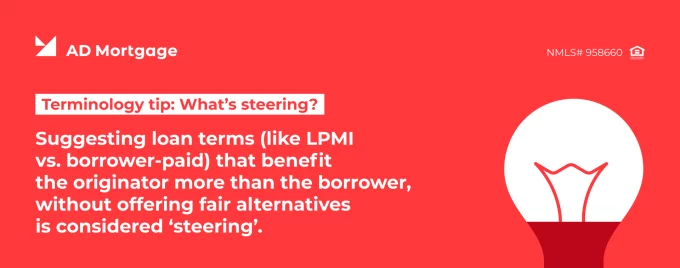
Presenting MI Options Without Steering
The best practice is for brokers to present at least three options whenever possible to borrowers. A good plan includes borrower-paid monthly PMI, lender-paid MI with a rate impact explained, and a single-premium MI if one is available.
It’s highly recommended to provide written summaries of each structures positives and negatives and show clear cost comparisons over a 5-year period as well as the life of the loan.
Things to avoid include pushing higher-rate LPMI without showing the tradeoff. Also, don’t minimize cancelability or long-term cost differences. Lastly, be sure to document borrower preferences and rationale as a failsafe if issues arise later.
Record-Keeping to Avoid Repurchase Risk
Mortgage insurance is a compliance flashpoint. Take it seriously, then handle it with clarity, neutrality, and documented care. Utilize the following tips to stay in compliance and avoid problems down the road. A little bit of work now can save headaches and heartache later.
Keep these on file for at least 3 years (or per investor guidelines)
Signed Loan Estimate and CD
MI cost worksheets or comparison summaries (especially if MI was optional)
Notes documenting borrower choice among MI options
Email or system logs showing MI discussions
Any lender or broker communication about MI pricing
Broker tip: Organize with digital folders for disclosures, pricing comparisons, and client communication — repurchase risk often comes from “invisible intent,” not missing forms.
Mortgage Insurance: Frequently Asked Questions
What determines PMI rates?
PMI rates are primarily based on:
Credit score – higher scores = lower premiums
Loan-to-value (LTV) ratio – the higher the LTV, the higher the risk
Down payment – More down = lower premiums
Loan type and term – fixed vs. adjustable, 15-year vs. 30-year
Occupancy type – primary residences usually get better rates than second homes or investment properties
What does mortgage insurance cover?
Mortgage insurance protects the lender, not the borrower.
It reimburses the lender if the borrower defaults on the loan and the property is sold for less than the outstanding mortgage balance.
It does not cover home damage, pay off the loan if the borrower dies, or help the borrower avoid foreclosure.
How soon can PMI be removed?
PMI can be removed by several different methods:
A borrower can request its removal when the LTV is at 80% (based on original value), if the borrower has a good payment history.
It is automatically removed at 78% LTV under federal law (Homeowners Protection Act).
It can be eliminated earlier with a new appraisal showing significant home appreciation (lender approval required).
Refinance into a conventional loan to drop PMI entirely.
Is MI tax-deductible in 2025?
As of now, mortgage insurance premiums are not tax-deductible.
The previous deduction expired at the end of 2021 and hasn’t been renewed by Congress. However, check with your tax professional for specific details on deductions that may be available to you.
Does MI protect brokers from repurchase liability?
No. Mortgage insurance protects the lender, not the broker. If a loan is found to be non-compliant or misrepresented, the broker may still face repurchase or indemnification requests, regardless of MI coverage.
Conclusion
Equipped with this knowledge, brokers will be prepared to handle the wide range of questions that borrowers often have. Mortgage insurance and how it can/will affect them during and after the lending process doesn’t have to be a sore spot if brokers follow these tips and plan accordingly.
Thank you, you're successfully subscribed! Please confirm your subscription in your email.