Post content:
Add AD Mortgage as your preferred source on Google
Arizona has a diversified and fast-growing economy with a strong high-tech core, which is why the number of jobs here keeps growing. Many of those who move to Arizona for work eventually start looking for a place to live, and for someone who can help them secure financing. If you’re considering a career as a mortgage loan officer (MLO) in Arizona, now is a good time to start.
At first, the path might seem complicated: you’ll need to figure out the licensing requirements and keep track of every deadline. But you won’t have to do it alone. At AD Mortgage, we’ve put together a step-by-step plan that walks you through how to become a mortgage loan officer.
Before focusing on Arizona-specific requirements, you’ll need to complete several federal steps that apply nationwide. Our Federal Requirements Guide breaks down each one, helping you build a solid foundation before moving on to the state-specific process.

Why Becoming an Arizona MLO Is a Good Decision
Arizona offers a strong combination of population growth, new-home construction, and property values above the national median. Those conditions can create purchase-loan opportunities with relocating households, buyers in new developments, move-up buyers, and real estate investors.
“Arizona is a great market for new MLOs. A motivated loan officer can work with everyone from first-time buyers and investors to retirees and luxury clients, while building valuable relationships with real estate agents, builders, and other referral partners,” – shares Rich Simon, owner of AZ Lending Experts LLC.

Arizona’s Population Growth Doubles the National Rate
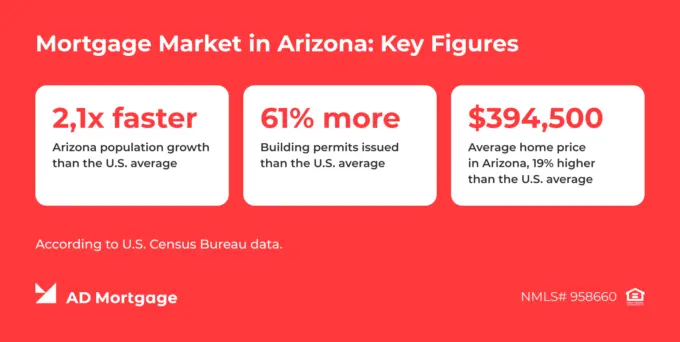
The U.S. Census Bureau estimates that Arizona’s population increased from 7,158,104 in April 2020 to 7,623,818 in July 2025. That is a 6.5% increase, representing approximately 465,700 additional residents in a little over five years.
The United States grew by 3.1% during the same period. Arizona therefore grew at more than twice the national rate.
A larger population expands the pool of renters who may become homeowners, current owners who may move, and households relocating into the state. Population growth does not guarantee loan production, but it provides originators with more potential borrowers and more reasons to build relationships with real estate agents and homebuilders.
Arizona Issues Building Permits at a High Per-Capita Rate
The U.S. Census Bureau recorded 51,532 Arizona building permits in 2025. Based on the state’s 2025 population estimate, that equals approximately 6.8 permits per 1,000 residents.
The national figures show 1,431,616 permits and a population of 341,784,857, or approximately 4.2 permits per 1,000 residents. Arizona’s per-capita permitting rate was about 61% higher than the national rate.
Permits indicate a substantial pipeline of planned construction. MLOs who develop builder and real estate referral relationships can compete for buyers who need financing in new communities. This includes borrowers whose circumstances require more than a standard conventional loan.
Arizona Home Values Support Larger Loan Amounts
The U.S. Census Bureau reports that the median value of an owner-occupied home in Arizona was $394,500 during the 2020-2024 reporting period. The national median was $332,700, making Arizona’s figure approximately 19% higher.
Higher property values often produce larger loan balances, although an originator’s compensation depends on the employer’s plan, applicable compensation rules, and funded production. Combined with Arizona’s faster population growth and active construction market, the value difference provides a prospective MLO with several sources of purchase business.
Mortgage Loan Officer Salary in Arizona
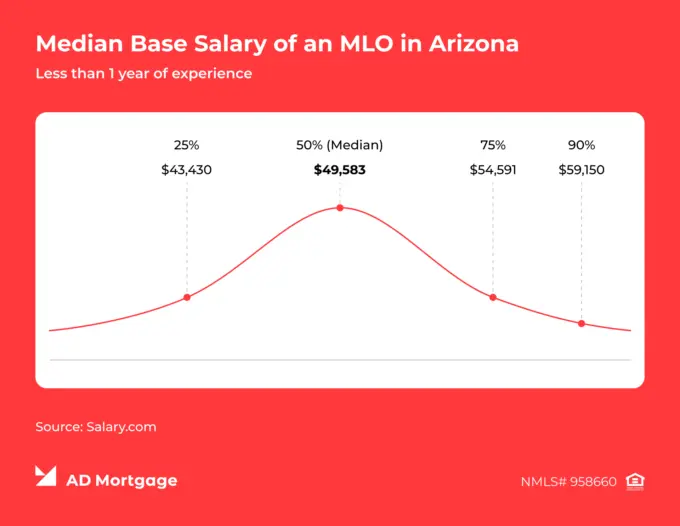
Salary.com’s Arizona data list an average annual salary of $49,583 for a Mortgage Loan Officer I as of July 1, 2026. The reported middle range is $43,430 to $54,591, and the 90th percentile is $59,150. Salary.com describes this level as covering roughly zero to two years of experience.
Glassdoor’s Arizona mortgage loan officer data shows a much higher median total-pay estimate. Median compensation of an MLO with <1 year of experience ranges from $88,000 to $153,000 per year, according to self-reported data of 767 employees. Professionals with 4-6 years of experience usually receive between $96,000 and $175,000 yearly.
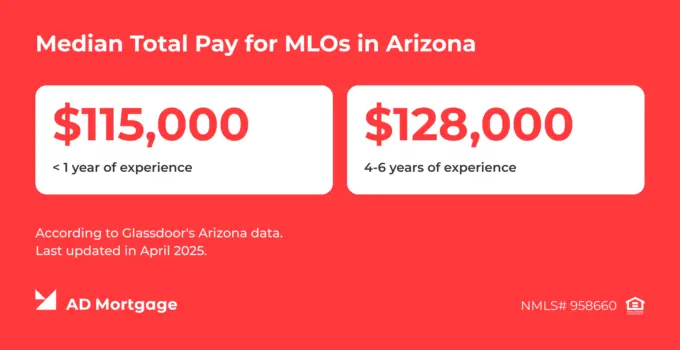
Salary.com reports a benchmark for an entry-level salaried position, while Glassdoor’s total-pay estimate includes additional compensation that may reflect commissions and incentives. Actual income varies from one MLO to another, shaped by production, experience, lead sources, referral relationships, employer policies, and market conditions.
While earning potential attracts many new originators, understanding Arizona’s licensing framework is the first step toward entering the profession.
Understanding Arizona’s Licensing Terms
Arizona law uses “loan originator” for an individual who takes a residential mortgage application, offers or negotiates residential mortgage terms for compensation, or performs covered loss-mitigation activity. “Mortgage loan officer” and “MLO” are the common industry terms for the same licensed role, though these terms are not established by law.
The Arizona MLO License is regulated by the Arizona Department of Insurance and Financial Institutions (DIFI).
A mortgage broker or mortgage banker is the licensed business that employs and supervises loan originators. An individual joining an established company needs a loan originator license. A person opening a brokerage needs a separate company-level mortgage broker license and an individual MLO license if that person will personally originate residential loans.
Arizona also uses the term “responsible individual” for the qualified person who actively manages a licensed mortgage broker. This person carries legal responsibility for the company’s compliance with Arizona’s licensing rules and serves as the state’s designated representative for that license. They actively manage the business, but managing it doesn’t require them to personally originate loans – that still needs a separate MLO license.
Arizona Mortgage Loan Officer License: Quick Facts
Requirement Arizona details Regulator Arizona Department of Insurance and Financial Institutions (DIFI) Licensing system Arizona mortgage brokers, mortgage bankers, and loan originators apply for and maintain their licenses through NMLS, according to the DIFI Mortgage Lending page Pre-license education 20 hours completed within the three years before application, including 3 hours of federal law, 3 hours of ethics, 2 hours of nontraditional mortgage lending, and 4 hours of Arizona law Exam Arizona law requires an examination developed or deemed acceptable by NMLS. The applicable examination is the SAFE MLO National Test with Uniform State Content; Arizona does not require a separate state MLO examination State fees DIFI lists a $350 application fee and a $100 mortgage recovery fund charge. A qualifying employer bond can replace the recovery-fund payment. A separate license fee ranges from $37.50 to $187.50 based on the submission period. Keep in mind, that fees are subject to change Additional NMLS charges The official NMLS fee schedule lists a $35 individual processing fee, $110 SAFE test, $36.25 live-scan background check, and $15 credit report Renewal deadline December 31 each year; the license is suspended after that date and expires if not renewed by January 31 Governing law Arizona Revised Statutes, Title 6, Chapter 9, Article 4, including A.R.S. §§ 6-991 through 6-991.22
Arizona doesn’t have one flat licensing fee. Before paying for education, applicants typically spend $546.25 on state and NMLS application fees, the test, a background check, and a credit report.
On top of that, Arizona charges a separate license fee, and some applicants also pay a $100 recovery-fund fee. Add it all up, and the final total lands between $583.75 and $833.75, depending on when you apply and whether your employer already covers the required bond.
Take into account that fees can change. Always confirm current fees through NMLS and DIFI before filing.
How to Receive Your MLO License in Arizona
Federal Requirements
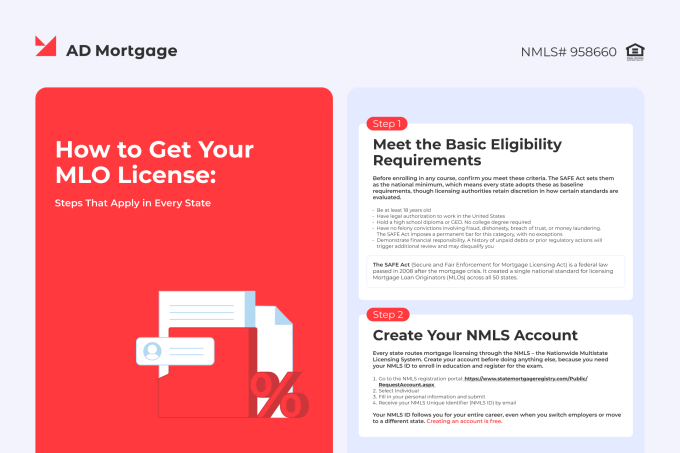
The nationwide licensing process includes these steps:
- Create an individual account through the NMLS Resource Center
- Complete the NMLS-approved pre-license education, including at least 20 hours of SAFE Act coursework and any additional hours required by Arizona
- Pass the SAFE MLO National Test with Uniform State Content
- Submit fingerprints for the FBI criminal background check
- Authorize a credit report through NMLS
- Complete and submit Form MU4
- Obtain sponsorship from a licensed company to activate your license
Our Federal Requirements Guide explains these nationwide steps in more detail.
Arizona-Specific MLO License Requirements
Arizona requires the following in addition to standard NMLS licensing:
1. Complete four hours of Arizona law within the 20-hour total
Arizona requires four hours of state law, but it includes those hours inside the 20-hour pre-license total. You do not need 24 hours if your approved package already contains the correct Arizona content.
Arizona law also requires the pre-license education to have been completed during the three years immediately before the application. Someone relying on older coursework should check the NMLS education record before filing.
2. Satisfy Arizona’s recovery-fund or employer-bond requirement
Arizona requires protection through one of two routes. An applicant generally pays $100 into the state’s mortgage recovery fund, or the employer or registered exempt person supplies a qualifying bond of at least $200,000 that covers its originators.
The Arizona licensing statute states that MLOs don’t need to pay into the recovery fund if their employer’s bond already covers them. We recommend checking with your employer first and not assuming the $100 fee is waived.
3. Budget for both the application fee and the license fee
The DIFI mortgage-lending fee page lists a $350 nonrefundable loan originator application fee. Arizona then charges a separate license fee based on when the application is submitted:
- January through March: $150
- April through June: $112.50
- July through September: $75
- October: $37.50
- November through December: $187.50
The November–December amount accounts for the short remainder of the current license year and the upcoming annual period. These charges are separate from the NMLS, testing, background-check, credit-report, recovery-fund, and education costs. Be aware that fees are subject to change.
4. Complete Arizona’s employer-activation process
Passing the test and getting approved doesn’t automatically mean an MLO can start originating loans on their own. Under A.R.S. § 6-991.04, DIFI holds onto the license until a licensed mortgage broker, mortgage banker, or consumer lender sends written notice of employment, or a registered exempt person notifies DIFI of an exclusive contract.
Arizona also won’t let an MLO work for two mortgage brokers or bankers at the same time. And before an MLO can start originating loans, their employer or registered exempt person needs to finish the activation process first.
Need to Renew Your Arizona MLO License?
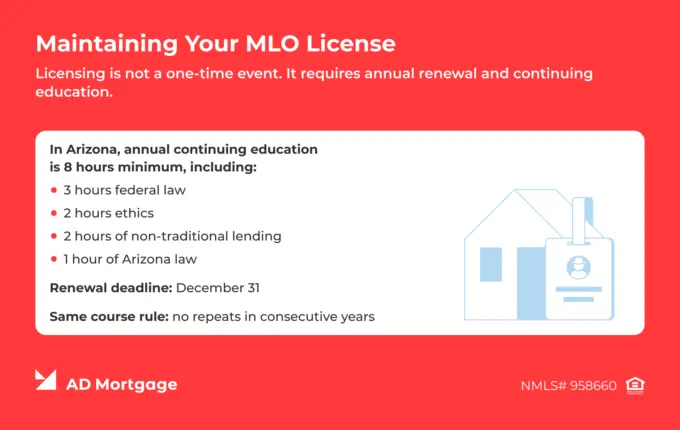
An Arizona loan originator must renew their license by December 31. To do that, an MLO has to complete the eight hours of NMLS-approved continuing education (CE) (one of which is Arizona-specific).
MLOs can complete CE through NMLS-approved providers, online or in a classroom. Besides that, some industry associations and mortgage events also host qualifying classes.
- Arizona Association of Mortgage Professionals (AZAMP) is an NMLS-approved provider that offers public and private CE classes during the year. Its Annual Expo is also a chance to combine CE credit with networking, alongside AzAMP’s year-round class schedule and online course options.
- Arizona Mortgage Lenders Association (AMLA) hosts continuing education classes, including SAFE Act training, as part of its broader educational and networking programs for the state’s mortgage industry. It’s geared more toward companies and institutions than individual MLOs, so confirm current course listings carry NMLS approval before registering.
AD Mortgage exhibited at the Arizona Mortgage Expo 2026 (hosted by AZAMP) in July. Brokers connected with our account executives, talked through their active deals, and found the best loan solutions for their clients.

How to Receive a Mortgage Broker License in Arizona
If you want to start your own business, you’ll need a mortgage broker license. You can’t run the company on an individual MLO license alone. Here’s how to become a mortgage broker in Arizona in 6 steps:
- Form and register the business. Create the legal entity, establish a company record through NMLS using Form MU1, and make sure the company is registered to do business in Arizona by the time the license is granted.
- Apply for the Arizona Mortgage Broker License. Submit the company application through NMLS and maintain a principal place of business in Arizona.
- Designate a responsible individual. Under Arizona law, this person must actively manage the brokerage and generally reside in Arizona unless DIFI grants a qualifying exemption. The responsible individual must have at least three years of mortgage-broker, loan-originator, or equivalent lending experience during the preceding five years, complete an approved course within the preceding three years, and pass Arizona’s mortgage broker test.
- Post the required surety bond. The company must post a $10,000 bond if its investors are limited to institutional investors or a $15,000 bond if it uses any noninstitutional investors.
- Pay the company fees. The state fee statute lists a $500 mortgage broker application fee. The annual assessment is $250 for a broker that closed 50 or fewer loans in the preceding year and $500 for a broker above that threshold, excluding NMLS and branch charges. These fees are also subject to change. lists a $500 mortgage broker application fee. The annual assessment is $250 for a broker that closed 50 or fewer loans in the preceding year and $500 for a broker above that threshold, excluding NMLS and branch charges.
- License the people who will originate loans. The company license does not replace an individual MLO license. Anyone who takes residential mortgage applications or offers or negotiates loan terms for compensation must hold an Arizona loan originator license.
The company license carries more experience, bonding, management, and compliance requirements than an individual MLO license. Many new originators build production and operational experience under an established company before opening their own brokerage.
Advice for Future Arizona MLOs
Rich Simon, owner of AZ Lending Experts LLC, shared what makes the difference for MLOs starting out in Arizona:
“As a new MLO, you are starting from scratch, so it is critical to map out your days and weeks and create a consistent schedule that is heavily focused on lead generation. Choosing the right mortgage company can make all the difference. You do not just need a place to hang your license – you need training, accountability, systems, and a proven plan. The right company will give you the road map, but you still have to follow it every day.”
That plan starts with the fundamentals in this article: complete your education, pass the exam, and line up an employer who will invest in your growth.
DIFI has 120 days to approve or deny your license once they receive your complete application and fees. That 120-day clock doesn’t count education, test prep, fingerprints, fixing paperwork issues, or your employer activating your license. File a complete, accurate NMLS application to avoid the delays you can control. Expect to pay around $583.75 to $833.75 in official fees, not counting education tuition. That covers the $350 Arizona application fee, $35 NMLS processing fee, $110 SAFE test, $36.25 live-scan background check, $15 credit report, your Arizona license fee (which depends on when you file), and possibly a $100 payment to the mortgage recovery fund. If your employer carries a bond, you skip the recovery-fund fee, but paper fingerprints, retesting, course tuition, and vendor charges can push your total higher. Note that all mentioned here fees are subject to change. No. Arizona doesn’t require a college degree to become an MLO. You just need to complete the education, pass the test, clear the background screening, submit your application and fees, and have an employer activate your license. No. Arizona law requires the same exam NMLS uses everywhere: the SAFE MLO National Test with Uniform State Content, plus four hours of Arizona-specific law education. There’s also a separate Arizona mortgage broker test, but that only applies to the responsible individual at a company-level broker license, not to a regular MLO applicant. No. You can set up your NMLS account, finish your education, and pass the SAFE test before you have a job lined up. Arizona can even approve your application before you’re employed. But your license won’t go active for origination until an eligible employer files the required notice, or a registered exempt person reports an exclusive contract with you. Arizona gives you two ways to meet this requirement: you pay $100 into the mortgage recovery fund, or your employer (or registered exempt person) carries a bond of at least $200,000 covering its originators. Most MLOs never buy a separate personal bond. Just confirm which route applies to you before you budget for licensing costs. You renew your Arizona MLO license every year by December 31, once you’ve completed your required CE. If you miss the deadline, your license goes into suspension. On top of that, if you skip renewal past January 31, it expires. So, we recommend starting your CE early so your provider has time to report it to NMLS before you file.
FAQ: Become a Mortgage Loan Officer in Arizona
How long does it take to become a mortgage loan officer in Arizona?
How much does an Arizona MLO license cost?
Do I need a college degree to become an MLO in Arizona?
Does Arizona require a separate state MLO exam?
Do I need an employer before I apply?
Do Arizona MLOs need an individual surety bond?
How often must I renew an Arizona MLO license?
Start Your Arizona Mortgage Career
The path to becoming an MLO in Arizona takes real effort – education, tracking deadlines, lining up a sponsoring employer. None of it is complicated on its own, but it adds up. Once you clear those steps, though, you’re looking at a market with population growth above the national pace and home values that keep climbing. That combination makes an Arizona MLO license worth the work.
A license opens the door, but the right lending partner can have a lasting impact on your long-term success.
AD Mortgage is a wholesale mortgage lender. We work with originators across Arizona and other states to help them grow their business.
AD Mortgage supports licensed MLOs and Broker Partners with Conventional, FHA, and Non-QM programs, including DSCR, Bank Statement, and Foreign National options. That range gives new originators a program for nearly any borrower who walks through the door.
EXPLORE WHOLESALE LENDING WITH AD MORTGAGE
Compliance note: This article was last reviewed in August 2026. Licensing requirements, fees, education rules, and event schedules may change. Confirm current information with the Arizona Department of Insurance and Financial Institutions and the NMLS Resource Center before applying or renewing. This article is for general informational purposes and is not legal advice.
Thank you, you're successfully subscribed! Please confirm your subscription in your email.
Thank you, you're successfully subscribed! Please confirm your subscription in your email.