
Post content:
How to Become a Mortgage Loan Officer in Virginia in 2026
Add AD Mortgage as your preferred source on Google
Virginia is one of the most active mortgage markets in the country. According to CFPB HMDA data, more than 203,000 loans were originated here in 2025, and most of that volume went to home purchases. Many of these sales were made possible by mortgage loan originators (MLOs).
To start helping others buy their homes, you need a license. In Virginia, as well as in many other states, MLO licensing is a two-level process. You need to meet federal requirements, and then satisfy state standards as well.
To help you with the federal baseline, we have prepared a guide that covers all steps, fees, and deadlines.
In this article, we focus on the state-level requirements for Virginia, so you know what to expect as you start your path to an MLO license.
Why Becoming a Virginia MLO is a Good Decision
Before you spend money on coursework, look at the market you are going to enter.
Virginians Keep Buying Homes
According to CFPB HMDA data for 2025, lenders originated 203,054 mortgages worth about $77.6 billion in the state. Home purchases account for 103,337 of those loans, worth roughly $46.7 billion. Purchase business starts with real estate agents and referral partners, and a newcomer can reach it locally.
‘Virginia gives you four different markets inside one license. Northern Virginia is high-balance and jumbo, Richmond is steady move-up business, Hampton Roads is one of the biggest VA loan markets in the country, and the Shenandoah Valley has become a real short-term rental and second-home market. A new originator here can learn conventional, VA, FHA, and investment financing without ever leaving the state. On top of that, our employment base is federal, military, healthcare, and universities, so Virginia doesn’t swing as hard as other states when the market turns. That stability matters a lot when you’re building your first two years of business.’
– shares Reba Sledd Coleman, Licensed Mortgage Loan Originator.

Also, Virginia loans are large. The average purchase mortgage in the same data came to roughly $452,000, and prices keep rising. Virginia REALTORS reported a statewide median sale price of $460,000 in June 2026, up 3.1% from a year earlier.
‘Virginia is an excellent state for new Mortgage Loan Originators because it offers a unique combination of economic stability, population growth, and housing diversity. New MLOs have the opportunity to work with a broad range of borrowers, including first-time homebuyers, military families, move-up buyers, and investors. Virginia’s housing market continues to show strength, with improving inventory levels, steady home value appreciation, and strong demand across many regions of the state.’
– explains Jill Johnson, TPO Account Executive at AD Mortgage.

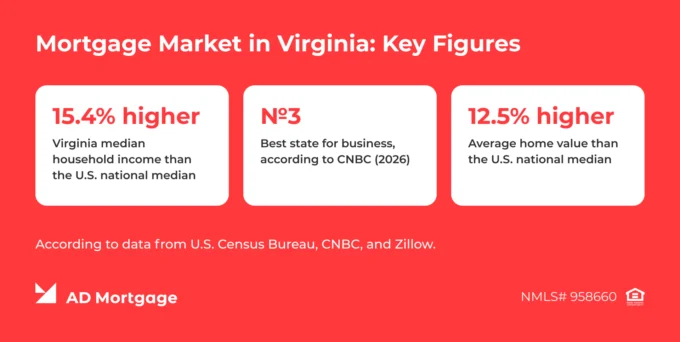
Incomes and population growth support that demand. U.S. Census Bureau QuickFacts puts median household income in Virginia at $93,170, well above the $80,734 national figure. The state also keeps gaining people: net migration drove 68.5% of its growth since 2020, according to the UVA Weldon Cooper Center. Newcomers who arrive for a federal posting or a data-center job in Northern Virginia can turn into your clients the moment homeownership starts crossing their minds.
Salary of a Mortgage Loan Officer in Virginia
Pay depends on the structure of the job, because commission makes up most of the income in this role.
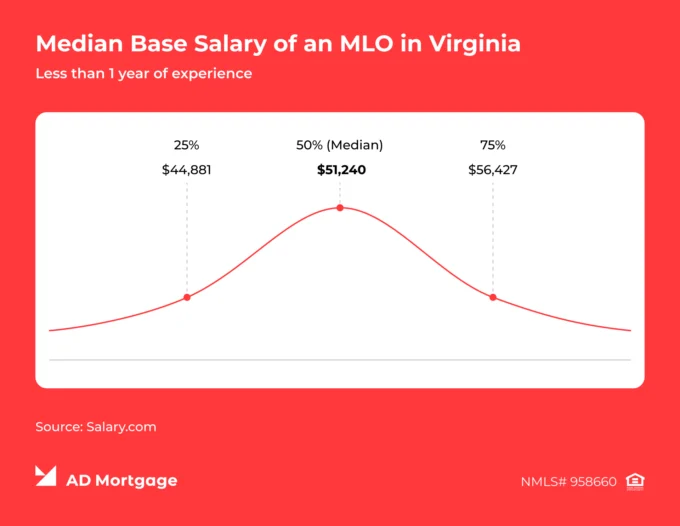
According to Salary.com, entry-level MLOs in Virginia (under one year of experience) earn a median base salary of $51,240 per year. This is base pay only, not including commissions.
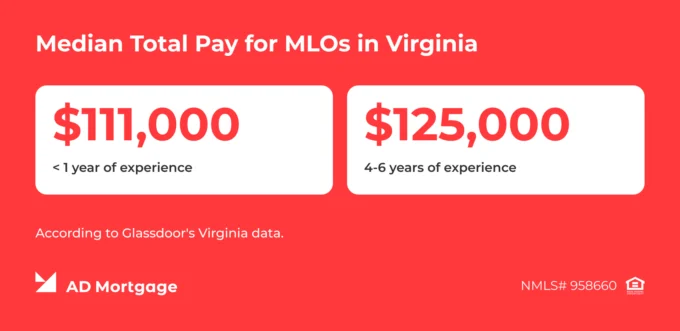
But base pay is only part of the picture. According to Glassdoor’s Virginia data, based on 255 salaries submitted as of April 2025, total pay for a Virginia mortgage loan officer with less than 1 year of experience is $111,000, and for a professional with 4-6 years in career, it’s $125,000. Originators report those figures themselves, they include commission and describe an established practice.
Depending on the employer’s payroll schedule and compensation plan, commission may be paid several weeks after a loan closes. Under the loan originator compensation rule in Regulation Z, pay cannot depend on the terms of a loan, such as its interest rate. No employer can reward an originator for quoting a higher one. Many plans quote basis points of the loan amount, and Virginia’s larger balances help there, but some pay hourly or a flat amount per file.
Thus, before accepting an offer, ask these questions:
- Is there a draw, and is it repayable?
- Is there a salary floor, and for how long?
- Do leads come to you, or do you find your own?
- Who pays for continuing education and annual renewal?
Virginia Mortgage Loan Originator License: Quick Facts
Regulator Virginia State Corporation Commission, Bureau of Financial Institutions Licensing system NMLS (Nationwide Multistate Licensing System and Registry) Pre-license education 20 hours of NMLS-approved coursework, with no additional Virginia-specific hours (NMLS Virginia requirements) Exam SAFE MLO Test, National Component with Uniform State Content (UST), and no separate Virginia state test (NMLS Virginia requirements); $110 test fee (NMLS MLO Testing Handbook); 75% to pass, three consecutive attempts allowed 30 days apart, and a six-month wait after three failures (§ 6.2-1709) State application fee $150 (10VAC5-161-30), plus the $35 NMLS processing fee, the FBI background check at $36.25 to $46.25 depending on fingerprint method, and the $15 credit report (NMLS processing fees) Total estimated cost Approximately $550 – $850, covering the $150 state fee, the $110 exam, the NMLS, FBI and credit-report fees, and a pre-license course at $200 – $500, which varies by provider Renewal deadline December 31 each year, with the NMLS renewal window open November 1 – December 31; $100 state fee plus the $35 NMLS processing fee (10VAC5-161-40) Governing statute Code of Virginia, Title 6.2, Chapter 17: Mortgage Loan Originators (§ 6.2-1700 et seq.) (law.lis.virginia.gov); companies hold a separate license under Chapter 16
Understanding the Terminology
In Virginia law, there are three items that might cause confusion.
A Mortgage Loan Originator (MLO) is the licensed individual who takes a borrower’s application and handles the loan through closing. That is the license this guide covers.
A mortgage broker is generally a company, although it may also be an individual, that submits borrowers’ loan applications to one or more lenders. MLOs typically work for, or are sponsored by, licensed companies like this. Virginia licenses those companies separately under Chapter 16. Most people searching ‘how to become a mortgage broker in Virginia’ need the individual MLO license below.
There is one more distinction to know. If you work for a bank, a credit union, or one of their regulated subsidiaries, you become a federally registered MLO. Your employer simply registers you in NMLS (NMLS confirms that the SAFE Act requires no pre-license education or SAFE test for this kind of registration).
But if you start working for a mortgage broker or a non-bank lender, you become state-licensed. In these cases, everything we describe below applies.
Federal registration does not automatically satisfy the education and testing requirements for a Virginia license. If you move from a bank or credit union to a state-licensed mortgage company and have not previously completed the required education and testing, you will need to complete the 20 hours of pre-licensure education and pass the SAFE MLO Test.
How to Obtain Your MLO License in Virginia: Step by Step
Federal Requirements
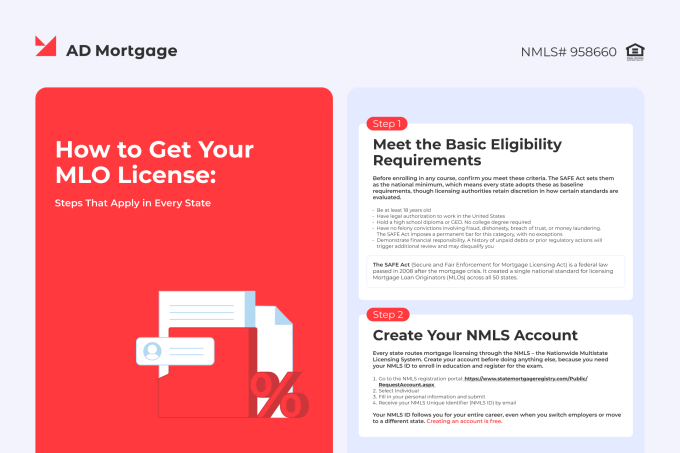
Every state starts from the same federal baseline. The SAFE Act, the Secure and Fair Enforcement for Mortgage Licensing Act of 2008, sets it:
- Create an account at the NMLS Resource Center to receive your NMLS ID
- Complete 20 hours of NMLS-approved pre-licensure education (PE)
- Pass the SAFE MLO Test (National Component with Uniform State Content)
- Submit fingerprints for an FBI criminal background check
- Authorize a credit report through NMLS
- Complete Form MU4, the individual application, in NMLS
- Obtain sponsorship from a licensed company, which activates an approved license
One scheduling tip: book your fingerprint appointment as soon as your NMLS account exists. The FBI check runs in parallel with your coursework, and leaving it until after the exam adds weeks for nothing.
For a detailed walkthrough of each federal step, download our complete MLO licensing guide.
Virginia MLO License Requirements
In Virginia, every federal step still applies. On top of that, four state-specific rules shape how you move through the process.
1. Skip the extra education, but watch the clock
In Virginia, the 20-hour course only lasts for three years. So, enroll when you are ready to test and apply, not before.
2. Skip the state exam
Virginia adopted the Uniform State Content, so the national test covers the state requirement and NMLS lists no Virginia-only exam.
3. Pay the $150 state application fee
Pay the $150 application fee through NMLS when submitting your application to the Bureau of Financial Institutions. Monitor your NMLS account afterward. If the Bureau requests information needed to complete a deficient application and does not receive it within 60 days, the application may be considered abandoned unless the Bureau approves an extension.
4. Know who files the surety bond
Every application needs one. A company licensed or exempt under Chapter 16 files a single bond covering all of its originators, including you. An originator outside that arrangement files an individual bond, starting at $25,000 and rising with volume. In either case, the bond has five days to reach the Bureau after you file the application.
What the Bureau Checks in Your Credit
Virginia publishes its standard in detail. You can check your own record before spending a dollar.
There is no minimum credit score. 10VAC5-161-45 lists four thresholds that count against financial responsibility:
- more than $2,000 in judgments or collection accounts
- more than $1,000 in tax or governmental liens
- more than $3,000 in delinquent accounts
- any foreclosure in the past seven years
The list ends with a catch-all for other debts the Commission considers relevant. These factors do not necessarily result in automatic disqualification, however. The Commission may still find an applicant financially responsible if the applicant demonstrates good-faith efforts to satisfy the debts and shows that circumstances such as lost income, divorce, medical expenses, or a natural disaster substantially impeded those efforts.
Need to Renew Your MLO License?
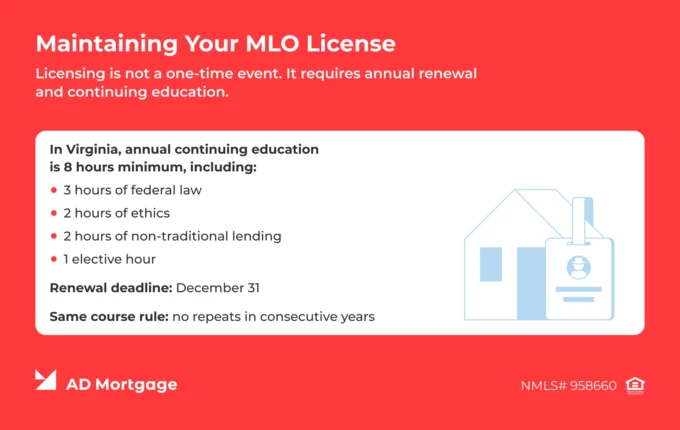
Virginia MLO licenses renew every year through NMLS, between November 1 and December 31. The state renewal fee is $100, plus NMLS’s own $35 annual processing fee.
If you miss December 31, you still can complete every requirement and pay a $30 reinstatement fee before March 1. But if you miss that window too, you’ll need to file a brand-new application. That’s why most Virginia originators knock out their hours in the fall, well ahead of the deadline crunch.
How to Receive a Mortgage Brokerage License in Virginia
If you already hold an MLO license, you might also want to open your own company. Virginia licenses companies separately under Chapter 16 of Title 6.2:
- File Form MU1, the company application, and Form MU2 for control persons, through NMLS.
- Post a surety bond. The regulation sets $25,000 for a broker and $50,000 for a lender or a combined lender and broker, rising with origination volume to as much as $150,000.
- Pay the application fee: $500 for a mortgage broker license, $500 for a mortgage lender license, or $1,000 for combined authority, plus $150 for each office. None of it is refundable.
- Meet the financial standard. A mortgage lender must show at least $200,000 in funds available for the business. A broker-only company does not.
- Satisfy the Bureau on fitness. The Commission reviews the finances, record, experience, and general fitness of your company and its principals, and it must conclude that you will run the business fairly and in the public interest. Your license covers only the offices you name in the application, and each one carries its own fee.
Most originators take this step later: get licensed, work under an established lender, then decide whether to run a company.
Advice for Future Virginia MLOs
Licensing gets you into the industry, but what happens after that depends on the choices you make early. We asked people who work with Virginia originators every day what they’d tell someone just starting out.
According to Reba Sledd Coleman, the current market may present an opportunity for new originators. ‘A lot of people left this industry between 2022 and 2024, so there is less competition for the originators who stayed and the ones coming in now,’ says Reba.
- The purchase market is the best place to learn the job.
‘Purchase business is built on relationships and problem-solving, not on a phone ringing because rates dropped. If you learn to structure a file when it’s hard, you’ll be unstoppable when it gets easy again,’ explains Reba.
- Treat every file like it’s your own loan on your own house.
‘I’ve never looked at a file and thought about the paycheck attached to it, and that’s the whole reason I’m still here after a decade. Clients can tell the difference,’ Reba adds.
- Know your guidelines cold to earn the referral when other lenders already said no.
As Reba puts it, ‘Anyone can quote a rate, but the originator who earns the referral is the one who can look at a self-employed borrower‘s returns, or tip income, or a DSCR file, and say yes when three other lenders already said no.’
- Technology has freed up more time for the part of the job that builds a book of business.
‘Modern CRM systems, digital mortgage platforms, and automated workflows allow MLOs to operate more efficiently and spend more time helping clients and referral partners,’ notes Jill Johnson, TPO Account Executive at AD Mortgage.
- Find a mentor early and learn the fundamentals before you chase volume.
‘Seek out mentors who can provide guidance and help you navigate the challenges that come with a new career. The more knowledgeable and confident you become, the more value you can provide to your clients,’ Jill advises.
- Build relationships from day one.
‘The most successful MLOs are trusted advisors who consistently communicate, follow up, and put their clients’ interests first,’ Jill concludes.
None of this requires experience on day one. Successful MLOs think strategically and treat every deal as a problem to solve.
Plan on 6 to 14 weeks. The 20-hour course, the SAFE exam, and the background and credit checks drive most of the time. Starting work can take longer. The license stays inactive until an employer sponsors you in NMLS, so start that conversation early. No. Virginia does not require a college degree to obtain an MLO license. A high school diploma or GED is all that is required. Applicants must still satisfy the applicable education, testing, background-check, credit-review, application, bonding, and sponsorship requirements. Plan for roughly $550 – $850: the $150 state fee, the $110 exam, the NMLS processing, FBI background-check and credit-report fees, and a pre-license course at $200 – $500. Budget a little more if you need a second exam attempt, and about $200 to $260 a year afterwards to keep the license current. You are not alone: NMLS reports a 53% first-time pass rate as of December 31, 2024. Wait 30 days, pay the $110 again, and retake it. After three consecutive failures the wait grows to six months. Give a prospective employer a realistic test date rather than an optimistic one. Possibly, if you meet all federal temporary-authority requirements. Often, yes. Virginia grants temporary authority on the federal terms of the SAFE Act. You qualify when three things are true: Temporary authority doesn’t last forever. It stops as soon as one of these happens: you withdraw your application, Virginia decides not to approve it (or tells you it plans to), Virginia issues your license, or 120 days pass and your application is still incomplete. This option is meant for people who already have a license in another state or a federal registration. If you’re new to the industry, it doesn’t apply to you. You can’t originate loans until Virginia issues your license and your employer sponsors you in NMLS. Everything else in this guide still applies to you, too. Renew through NMLS between November 1 and December 31 each year. Before submitting your renewal, complete 8 hours of NMLS-approved continuing education and pay the $100 state renewal fee plus the $35 NMLS processing fee.
FAQ: Become a Mortgage Loan Officer in Virginia
How long does it take to become a mortgage loan officer in Virginia?
Do I need a college degree to become an MLO in Virginia?
How much does it cost to get a Virginia MLO license?
What happens if I fail the SAFE exam?
I'm licensed in another state or registered at a bank. Can I originate in Virginia while my application is pending?
When do I renew my Virginia MLO license, and how many CE hours do I need?
Virginia’s Borrowers Won’t All Fit One Box
Your clients in Virginia won’t all qualify for the same loan. A veteran, a self-employed contractor, or an investor buying a fourth rental each need a different program.
AD Mortgage works with Broker Partners nationwide, including as a Virginia mortgage lender, offering a full range of programs – Conventional, FHA, VA, and a complete Non-QM lineup. We back it all with the technology and support new originators need to close more loans.
Last reviewed: October 2026. Not legal advice. Salary figures come from third-party sources, are estimates, and are not a guarantee of what any individual will earn. Licensing requirements and fees are subject to change. Always verify current requirements directly with the Virginia State Corporation Commission, Bureau of Financial Institutions, and the NMLS Resource Center before beginning your application.
Thank you, you're successfully subscribed! Please confirm your subscription in your email.