
Post content:
Add AD Mortgage as your preferred source on Google
Choosing the right mortgage lender requires borrowers and their mortgage professionals to evaluate loan options, complete costs, service, and reliability.
For a loan originator, choosing the right mortgage lender involves understanding your financing needs, comparing multiple qualified lenders, reviewing complete loan costs, and evaluating each lender’s service and reliability. The lender you pick shapes your client’s interest rate, the closing costs, and how smoothly the home loan reaches the closing table. This guide walks through seven steps, from assessing your finances to comparing Loan Estimates line by line.
Key Takeaways
- Start with your own numbers. Your credit score, debt-to-income ratio, and down payment determine which potential lenders and programs are realistically available to you.
- Banks, credit unions, direct lenders, online marketplaces, and mortgage brokers differ in pricing, program range, and level of service.
- Compare Loan Estimates line by line – rate, APR, lender fees, and rate-lock terms – not just the headline rate.
- AD Mortgage is positioned as the Lender of Choice that helps brokers win. As the broker-voted Top 5 Wholesale Lender, we offer a wide range of mortgage solutions and innovative technologies, helping our partners close deals fast and efficiently.
Step 1: Understand the Financial Situation and Mortgage Needs
Before you contact a lender, get clear on where you stand. The right lender should offer a sufficiently broad range of programs to meet your clients’ needs.
Credit Score. The borrower’s credit score is one of the strongest drivers of the rate – a higher score generally means a lower interest rate. Most conventional programs start around 620, but pricing improves in tiers, with the best rates typically reserved for 740 and above. Lenders prefer stronger credit profiles, which can also give borrowers access to more competitive pricing and loan programs.
Debt-to-Income Ratio. Most lenders use the debt-to-income (DTI) ratio – total monthly debt payments divided by gross monthly income – to judge whether the borrower can absorb a new mortgage payment. Many programs cap DTI in the low-to-mid 40s, though limits vary by loan type and lender.
Down Payment. Down payment requirements vary between lenders and programs, from 3% on some conventional loans to zero on government-backed loans, including VA loans and USDA loans. What the borrower puts down affects the rate, the payment, and whether they will carry mortgage insurance. FHA loans are government-backed and carry looser qualifying requirements than conventional financing, which makes them common among first-time homebuyers.
Budget and Loan Size. Measure the target price range against the conforming loan limit in your county – the ceiling set by Fannie Mae and Freddie Mac. Above it, the borrower is in jumbo loans territory, where requirements tighten, and fewer lenders compete.
If your clients’ finances do not fit the standard mold – they are self-employed, buying investment property, a foreign national, or working through a recent credit event – lender selection matters more for you than for most buyers. Program availability varies widely. AD Mortgage offers a full range of loan programs, including Non-QM solutions, to help our partners serve their clients efficiently.
Step 2: Understand the Different Types of Mortgage Lenders
Mortgage lenders do not all work the same way. While mortgage brokers and LOs partner with wholesale lenders, borrowers have options beyond these lenders. For brokers, understanding the different types of lenders is crucial to helping clients explore their options and choose the lending solution that best fits their needs.
Banks
National and regional banks are financial institutions that originate mortgages alongside checking, savings, and investment accounts. If the borrower already works with their local bank, they may qualify for relationship pricing or fee discounts. Banks hold loans to their own underwriting standards, which can mean a narrower menu of programs and slower timelines than specialized lenders.
Credit Unions
Credit unions are member-owned nonprofits, and that structure often shows up as competitive rates and lower fees than comparable banks. The borrower will need to meet membership eligibility, usually based on where they live, work, or worship. Their footprint tends to be regional, and their program menus may be limited, but service is often more personal.
Direct Mortgage Lenders
Direct lenders originate, underwrite, and fund loans directly rather than routing the file through another lender. Because they control the loan process end to end, they can often move quickly and resolve questions without a middle layer. Some direct lenders, including certain private lenders, specialize in borrowers or transactions that fall outside traditional lending guidelines. The trade-off is that the borrower is limited to the products on their shelf – if the situation falls outside it, they may need to start over somewhere else.
Online Mortgage Lenders and Marketplaces
Online lenders let borrowers apply, upload documents, and track progress without meeting anyone in person. Marketplaces go further, collecting quotes from several lenders at once. Both prioritize speed and rate transparency. The trade-off is less handholding: straightforward files move fast, while complicated ones can stall when nobody owns the details.
Mortgage Brokers
A mortgage broker does not lend money. A broker takes one application, shops it across a panel of lenders, and manages the file through to closing. Brokers work through wholesale lending channels, which price differently from retail, and they typically have access to specialized programs including Non-QM mortgage options. Compensation comes either from the borrower or from the lender.
Here’s how the five types compare at a glance.
| Lender Type | Best For | Main Trade-Off |
|---|---|---|
| Banks | Existing customers who want relationship pricing and one-stop banking | Narrower program range; often slower timelines |
| Credit Unions | Members looking for lower fees and personal service | Membership eligibility; regional reach |
| Direct Lenders | Borrowers who want speed and a single point of accountability | Limited to that lender's own product shelf |
| Online Lenders and Marketplaces | Straightforward files and fast rate comparison | Less support when a file gets complicated |
| Mortgage Brokers | Comparing many lenders at once; non-standard borrower profiles | Experience varies by individual broker |
Working with a broker gives borrowers access to a wide range of loan programs, including options for non-standard borrower profiles. This flexibility can help more borrowers achieve homeownership through a more personalized approach and potentially more favorable terms.
Step 3: Find and Vet Potential Mortgage Lenders
Start with referrals. Colleagues, competitors, and real estate agents work with lenders regularly and often know which ones have a strong track record of closing loans on time in your local market. Ask them for feedback on the wholesale lenders they have worked with.
Then, search online for reviews. A consistent pattern across dozens of reviews can provide far more insight than any single review.
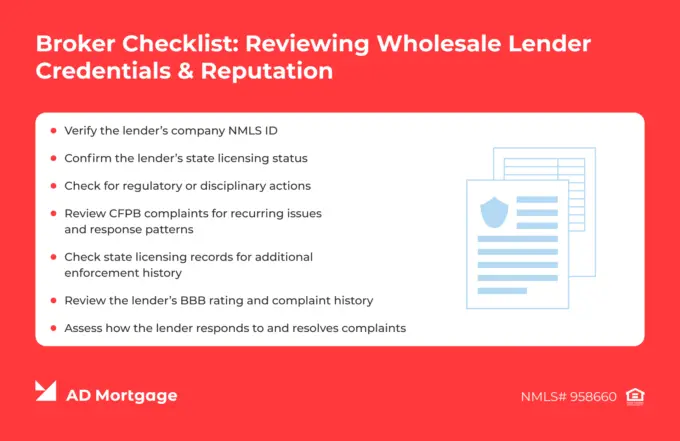
A reputable wholesale lender should be transparent about its credentials and regulatory information. Before applying for approval, verify the lender’s company NMLS ID and check the following sources:
- NMLS Consumer Access – Helps verify the company’s licensing information and regulatory history, including certain enforcement or disciplinary actions.
- CFPB Consumer Complaint Database – Provides insight into consumer complaints and how the company responds. Focus on recurring patterns rather than complaint volume alone.
- State Licensing Records – Your state regulator may provide additional licensing or enforcement information that is not immediately apparent elsewhere.
- Better Business Bureau (BBB) – Can offer additional insight into complaint history and how the company handles and resolves disputes. Use it as a supplementary source rather than your primary measure of reputation.
Aim for a shortlist of three to five lenders. That’s enough to expose real pricing differences without turning the search into a second job.
Step 4: Compare Mortgage Rates, APRs, Terms, and Fees
Brokers must understand how mortgage pricing and payment structures work to serve their clients effectively and identify the most competitive loan options. Small differences in rates, fees, and loan terms can compound over decades, so the best way to evaluate lenders is to compare specific, itemized, and equivalent offers.
Interest Rate and APR
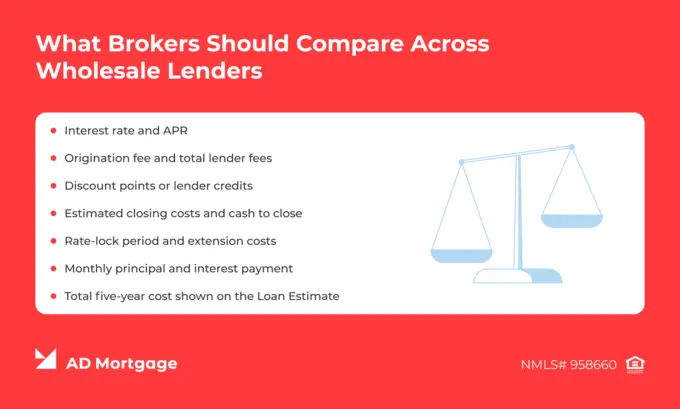
The interest rate determines the interest charged on the borrower’s outstanding loan balance. APR expresses the broader cost of borrowing by incorporating certain finance charges, including some lender fees and discount points, into the calculation. Two different lenders can quote an identical interest rate while their APRs differ because of differences in applicable fees and costs. For a broker, the interest rate helps estimate the borrower’s payment, while APR provides an additional measure for comparing the overall cost of credit. However, APR should not be used as the sole measure when comparing loan offers.
Lender Fees and Closing Costs
Closing costs typically run 2% to 5% of the loan amount and are generally split into two groups. Lender-controlled charges – the origination fee, plus application, processing, and underwriting fees – should be compared across wholesale lenders. Third-party costs such as appraisal, title, and recording fees may be determined by outside providers, although borrowers may be able to shop for certain services. Always ask for an itemized Loan Estimate and review the individual charges so you can identify potential hidden fees and compare the true cost of each offer rather than relying on the headline rate.
Mortgage Terms and Monthly Payments
Fixed-rate loans typically come in 15- and 30-year terms. Shorter terms mean higher payments but far less total interest; longer terms ease cash flow and cost more overall. Adjustable-rate mortgages typically begin with a fixed-rate period and then adjust according to the loan terms and adjustment schedule. An ARM may make sense for a borrower who expects to move or refinance before the rate adjusts, but it can carry greater payment risk for borrowers who plan to keep the loan long term. Run each scenario through a monthly mortgage payment calculation before committing.
Rate-Lock Terms
A rate lock holds the quoted rate for a specified period, commonly 30, 45, or 60 days, although available lock periods and pricing vary by lender and loan type. Ask each wholesale lender about the cost of the lock, what happens if the loan does not close within the lock period, and whether extension fees apply. Also ask whether a float-down option is available, which may allow the borrower to obtain a lower rate if market pricing improves before closing. A quote without a clearly defined lock period is difficult to compare with a quote that includes one.
Compare Equivalent Offers
Rates move daily, so quotes gathered a week apart tell you nothing. Collect and compare offers as close to the same time as possible, using the same loan scenario – including loan amount, down payment, credit profile, loan term, product type, and rate-lock period. Pay close attention to discount points and lender credits. Points require additional cash upfront in exchange for a lower rate, while lender credits can reduce upfront costs in exchange for a higher rate. To make a fair comparison, account for these differences and compare the total cost and terms of equivalent loan offers – not just the advertised interest rate.
Step 5: Evaluate the Lender’s Service and Mortgage Loan Process
The price isn’t the whole picture. For a broker, a wholesale lender with better service can be worth more than one offering a marginally lower rate, particularly when a closing date is at stake.
Communication. Ask how you’ll communicate with your account executive, how quickly they respond, and whether you get a dedicated contact or a rotating queue.
On-Time Closing. Delays can cost your borrower a rate lock or, in a competitive market, the contract itself. Ask what share of the lender’s loans close on the originally scheduled date and how they handle loans that are at risk of missing the closing date.
Servicing. Many lenders sell servicing after closing, meaning the company your borrower sends payments to will not be the one you submitted the loan to. Ask whether they retain servicing or transfer it, and to which loan servicer.
Technology. A functional portal for uploading documents and tracking status can save you and your team significant time. Ask to see it and understand the broker workflow before you commit.
Step 6: Questions to Ask a Mortgage Lender
Ask these questions while you are evaluating wholesale lenders, before you commit to a lender. The answers reveal as much about how a lender will support you as a broker as the rate does.
- Which mortgage programs do you offer for borrowers in my clients’ situations? Program availability varies widely, especially for self-employed, investors, and other non-standard borrowers.
- Do you offer lender credits or discount points? Both shift costs between the interest rate and the borrower’s cash to close.
- How long is your rate lock, and what would an extension cost?
- How long does the prequalification process usually take? Ask about typical turn times and what can cause delays.
- How do you communicate and provide loan status updates? Ask about frequency, communication channels, and who will provide updates – not just whether updates are available.
- What is your typical closing timeline? Compare it against the closing date in your borrower’s purchase contract.
- Who will handle my application and underwriting questions? Find out whether you get a dedicated account executive and consistent underwriting support or a rotating team.
- Will you service the mortgage after closing? If not, ask whether servicing is typically transferred and to whom.
- Which documents will my borrowers need? Expect pay stubs, tax returns, W-2s, and bank statements at minimum, depending on the borrower and loan program.
- What could cause the quoted terms or costs to change? Ask how appraisal results, credit changes, documentation, and underwriting findings could affect the loan terms or costs.
Step 7: Compare Offers and Make Your Decision
Prequalification is an informal estimate based on information the borrower supplies, with little or nothing verified. Preapproval is a more thorough assessment: the lender reviews the borrower’s credit and documentation and issues a letter stating how much the borrower can likely borrow and under what terms. For brokers, preapproval helps establish a realistic budget for the borrower and demonstrates to sellers that the borrower is a serious buyer. Note: AD Mortgage does not issue preapprovals.
Submit the borrower’s application to appropriate wholesale lenders. Then, the lender must provide a loan estimate within three business days of receiving it, according to the Consumer Financial Protection Bureau. It’s a standardized three-page form, which is exactly what makes side-by-side comparison possible: every lender’s version puts the same numbers in the same places.
The most common objection to shopping around is the potential impact on the borrower’s credit, and it’s largely unfounded. FICO and VantageScore both treat multiple mortgage inquiries in a short window as a single inquiry — current FICO versions use a 45-day window, while older FICO versions and VantageScore use 14 days. As a broker, encourage borrowers to complete their mortgage rate shopping within a focused period rather than spreading applications over several weeks or months. Freddie Mac found that during the high-rate months of late 2022, borrowers who collected at least four rate quotes could have saved more than $1,200 annually.
When you decide, weigh three things: the total five-year cost shown on the Loan Estimate, the service quality you observed while comparing lenders, and your confidence that the wholesale lender will support you and your borrower through closing.
Conclusion
AD Mortgage has 20 years of experience and partners with more than 9,000 mortgage brokerages nationwide, helping brokers succeed with competitive loan options, innovative technology, and knowledgeable support. If you’re looking for a wholesale lending partner that helps brokers win, become an AD Mortgage partner today.
FAQ: How to Choose a Mortgage Lender
What are Mortgage Lender Red Flags?
Pressure to sign immediately or to skip comparison shopping is the clearest warning sign. Others include refusing to put a Loan Estimate in writing, verbal fee quotes that shift once documented, no verifiable NMLS registration, unexplained late changes to terms, and unsolicited outreach advertising rates far below market. Any lender who won’t commit numbers to paper belongs off your list.
Should You Choose a Mortgage Lender Based Only on Rates?
No. A low advertised rate can come with higher origination fees, a short rate lock that expires before closing, or a weak on-time closing record. Compare rates, APR, lender fees, and five-year cost on the Loan Estimate, then consider the lender’s service, communication, and ability to close on schedule. A quarter-point pricing advantage means little if the lender creates delays that put your borrower’s closing at risk.
What Makes a Good Lender?
Transparent pricing you can verify in writing, current licensing you can confirm through NMLS Consumer Access, loan programs that genuinely fit your borrowers’ profiles, responsive communication throughout the homebuying process, and a documented record of closing loans on time. A strong wholesale lender should also provide consistent underwriting support and clear guidelines, giving brokers confidence when placing different types of borrowers. The lender with the lowest rate isn’t always the best choice if its service, underwriting, or closing performance puts the borrower’s transaction at risk.

Thank you!
We’ll contact you as soon as possible

Oops, something went wrong
Please try to send form again