Can You Get a Mortgage Without Tax Returns? Options for Self-Employed Borrowers
·15 min read
Add AD Mortgage as your preferred source on Google
Short answer: Yes. In many cases, your client can get a mortgage without tax returns through alternative-documentation programs: bank statement, P&L, DSCR, asset utilization, 1099, and WVOE loans. These are no-tax-return mortgage options, not no-documentation loans.
Traditional loans generally require tax returns, and the standard underwriting process works best when a borrower can demonstrate stable, consistent income.Alternative-doc and Non-QM programs replace traditional tax-return documentation with other forms of income or asset documentation. Your job is to identify why the returns do not work, then match your client to the program built for that reason.
Many borrowers can get a mortgage without tax returns when the right alternative-doc program fits their profile.
A traditional mortgage typically requests two years of tax returns from self-employed borrowers.
Bank statement, P&L, DSCR, asset utilization, 1099, and WVOE loans serve as alternative paths to tax-return documentation.
No tax return mortgage loans still require documentation, credit review, down payment, and full underwriting.
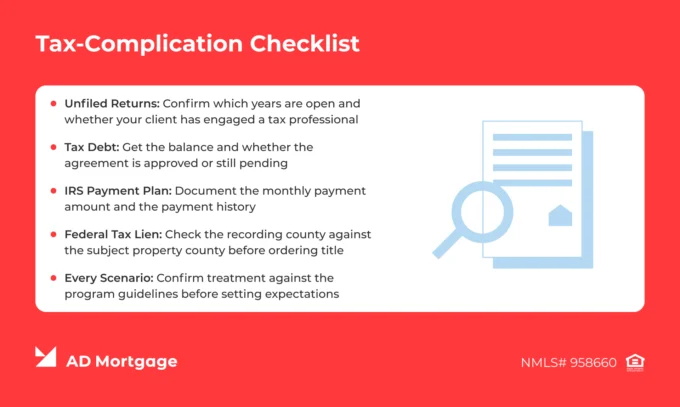
Unfiled returns, IRS payment plans, tax debt, and liens require separate underwriting review. They are not the same as choosing alternative documentation.
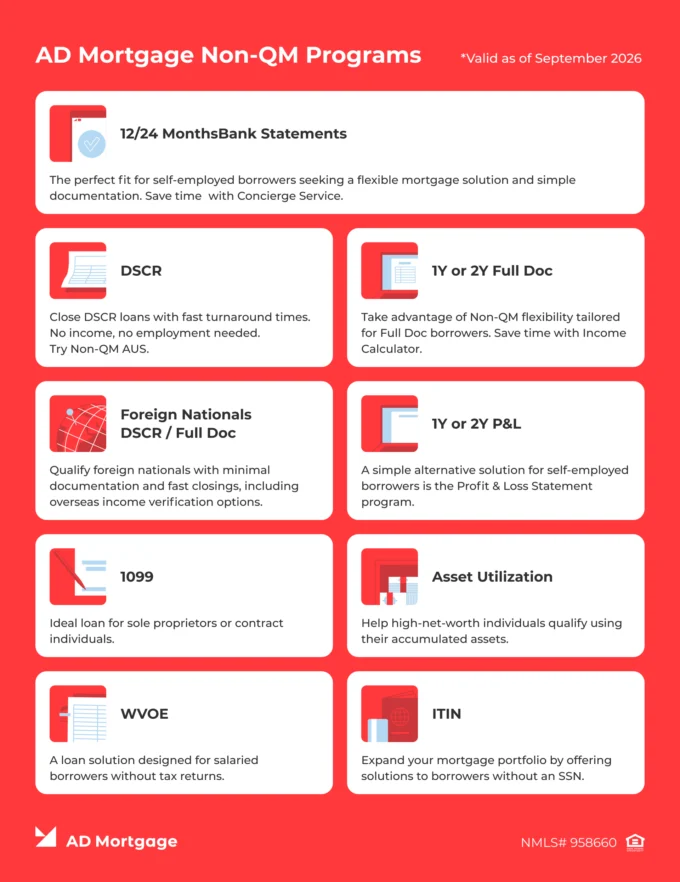
AD Mortgage serves brokers with complex or out-of-the-box borrower scenarios through six alternative loan programs.
Do You Need Tax Returns to Get a Mortgage?
Not always. Most lenders use tax returns when they need to verify self-employment income under traditional underwriting guidelines. However, not all borrowers need tax returns for a mortgage on every program. Mortgage lenders that do not require tax returns exist, usually Non-QM lenders offering alternative loan programs.
W-2 employees may not need two years of returns if pay stubs, W-2s, a written verification of employment, or an IRS transcript satisfies the lender. Non-QM programs qualify borrowers when traditional income documentation does not tell the story.
One line to keep in front of every client: ‘without tax returns’ does not mean ‘without documentation.’
‘No, you do not need tax returns to get a mortgage. You usually need them for conventional and government, but not for non-QM. A borrower might want a mortgage without tax returns because they might not make a traditional kind of income (self-employed, investment properties, etc.). A broker can help by educating the borrower on their options.’
— Anna Veselenak, Account Executive at AD Mortgage
When Tax Returns Are Required
Self-employment income triggers tax-return requirements on most traditional loans, as does commission-heavy or layered income. Returns let lenders calculate DTI, confirm business stability, and reconcile the application against IRS data. Form 4506-C authorizes lender access to IRS transcripts through the Income Verification Express Service.
A qualified mortgage written to Conventional or FHA standards usually asks a self-employed client for two years of tax returns, and business returns may apply in some ownership scenarios. Brokers also ask whether a client can use a tax transcript instead of a W-2 for a mortgage. On a traditional file the transcript supports the W-2, it does not replace the income analysis.
When You Can Skip Them
Alternative-doc and Non-QM loan programs review income without personal tax returns. Each substitutes a different document set:
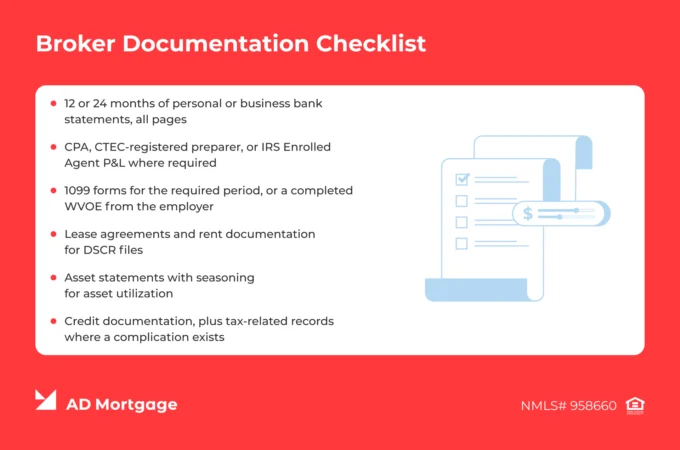
Personal or business bank statements document business or personal cash flow.
P&L statements support business-income review.
DSCR loans qualify borrowers on property cash flow, removing personal income entirely.
Qualifying assets support the ability-to-repay calculation under an asset-based mortgage.
1099 forms and written employment verifications cover specific income types.
Why Some Borrowers Can’t Provide Their Tax Returns
Tax returns often understate the current earning power of self-employed borrowers. The gap between what a return shows and what a business produces is the reason most of these files exist.
Self-Employed Individuals and Fluctuating Income
For self-employed individuals, income may move month to month. A return filed eighteen months ago may not accurately reflect the business’s current revenue, expenses, or operating structure. Fluctuating income fails to fit W-2 underwriting models, which assume a steady pay cycle. Bank statement reviews can provide a more current view of business deposits and cash-flow activity.
Business Write-Offs and Multiple Income Sources
Business write-offs reduce taxable income. Reduced taxable income then weakens traditional DTI qualification, because the underwriter sees the net figure, not gross cash flow. A client with $400,000 in deposits and aggressive deductions looks thin on paper and strong in the bank. Multiple income streams, including investment income, can compound the problem.
Unfiled Returns or Outstanding Tax Debt
Some borrowers look into obtaining a mortgage without tax returns for a different reason: unfiled returns, IRS debt, an installment agreement, or a tax lien. This approach is not the same as choosing alternative documentation. Approval depends on loan type, payment history, lien status, title impact, and current guidelines. Borrowers with unfiled or incomplete returns should consult a qualified tax professional before proceeding.
Mortgage Options Without Tax Returns
Different borrower scenarios require different mortgage programs – a self-employed borrower with strong deposits needs a different product than an investor using rental income. Parameters below reflect AD Mortgage guidelines as of August 2026; confirm current terms in the guidelines and matrices.
Bank Statement Loans
Bank statement loans calculate income from 12 or 24 months of personal, business, or combined business bank statements. They fit self-employed borrowers with strong deposits. Expense factors adjust the calculation, so the qualifying income typically lands below gross deposits. Concierge Service runs that calculation for you.
Large deposits may also require additional explanation or documentation depending on the program.
Profit & Loss Statement Loans
P&L loans document business income through a profit and loss statement. A P&L is income documentation, not a shortcut around it. AD Mortgage requires a licensed CPA, CTEC-registered preparer, or IRS Enrolled Agent to prepare it. P&L loans fit business owners whose returns lag current performance.
DSCR Mortgages
DSCR mortgages qualify borrowers based on the property’s debt service coverage ratio: what the property earns, not what the borrower earns. AD Mortgage requires no income and no employment documentation and covers short-term rentals. DSCR fits investors buying or refinancing rentals.
Asset Utilization Mortgages
Asset utilization mortgages convert qualifying assets into calculated income, dividing them by 60 months. Eligibility depends on asset type, seasoning, and liquidity: the program counts 100% of cash and money market, 100% of public securities, and 80% of retirement accounts. This asset-based mortgage fits high-net-worth, retired, or asset-rich clients.
1099 Loans
1099 loans document income through 1099 forms, using the last one year plus a one-year history with the same payer. The income figure comes from a third-party form rather than deposit analysis, which usually makes the file faster to document than a bank statement or P&L file. The program can fit an independent contractor or gig worker whose income is documented through 1099 forms.
‘We offer a 1099 program for our self-employed borrowers who tend to make more income than what is shown on their tax returns. It benefits our partners because it gives opportunities that would otherwise be missed and lead to more referrals.’
— Anyeshia Taylor, Underwriting Team, AD Mortgage
WVOE Loans
WVOE stands for Written Verification of Employment. WVOE loans verify income through employer-completed forms rather than borrower-supplied returns. AD Mortgage requires a two-year history with the same employer, fitting wage earners without a clean tax-return package.
Alternative-Doc Program Comparison Table
Program
Income Document
Min. FICO
Max CLTV
Best-Fit Borrower
Bank Statement 12/24
12 or 24 months of statements
620 or none
90%
Self-employed, strong deposits
1Y + 2Y P&L
P&L prepared by an eligible third-party tax professional
660
80%
Owner, returns lag performance
DSCR
Rent vs. debt service
620
80%
Real estate investor
Asset Utilization
Assets ÷ 60 months
620
80%
Retiree, asset-rich
1099
1099 forms, last 1 year
620; no-score options may be available
85%
Independent contractor
WVOE
Employer verification
620; no-score options may be available
80%
Salaried, no returns
Requirements for a No-Tax-Return Mortgage
No-tax-return mortgages require credit, down payment, reserves, and income or asset documentation. Alternative documentation shifts qualification requirements, it does not remove them. Expect review of credit score, LTV, reserves, loan amount, property type, occupancy, DTI where applicable, and loan purpose.
Credit Score and Down Payment Expectations
Alternative-doc programs offset documentation flexibility with stronger credit or a larger down payment. FICO, LTV, minimum down payment, and reserve requirements vary by program and profile, so run your client’s file through the Quick Pricer and pull current matrices before you quote.
Interest Rates vs. Traditional Loans
Flexible documentation typically carries higher interest rates and fees than comparable QM financing. Non-QM pricing depends on credit profile, LTV, occupancy, property type, and documentation type. A strong-credit DSCR file at 60% LTV and a thin-credit bank statement file at 85% are not the same conversation.
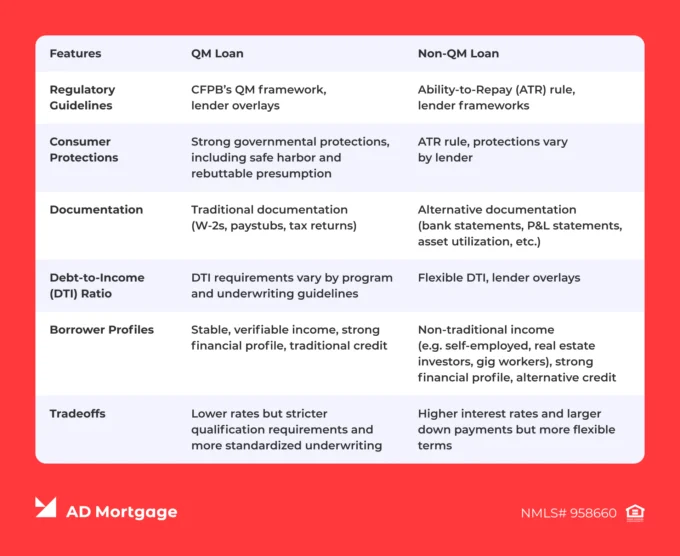
No-Doc vs. Traditional Loan Comparison
Today’s alternative-doc loans are not the no-doc loans of the 2000s. They require verified documentation and a documented ability to repay. Traditional loans commonly rely on W-2s, pay stubs, employment verification, and, when applicable, tax returns or transcripts. Alternative-doc loans rely on bank statements, P&L, assets, DSCR, 1099s, or WVOE.
Feature
Traditional / QM Loan
No-Tax-Return / Alternative-Doc Loan
Broker Note
Main income documentation
Tax returns, W-2s, pay stubs
Bank statements, P&L, 1099s, WVOE, assets, property cash flow
Identify the document set first
Best-fit borrower
W-2 earner, stable income
Self-employed, investor, contractor, asset-rich
Profile drives program
Tax return use
Central to qualification
Not required on eligible programs
Confirm per program
DTI review
Standard
Applies on most, excluded on DSCR
DSCR uses the property ratio
Property cash flow review
Rarely primary
Primary on DSCR
Investor files route here
Credit score
AUS-driven, often 620+
620 to 660 by product
Verify the current matrix
Down payment / LTV
As low as 3% down
Typically larger down payment
Flexibility costs equity
Pricing
Lower
Higher rates and fees
Price before quoting
Documentation burden
Heavy on tax records
Heavy on cash flow or assets
Different, not lighter
What If Your Client Has Unfiled Returns or Tax Debt?
Unfiled tax returns create underwriting and eligibility questions, plus an obstacle upstream: the IRS generally will not approve a payment plan for a taxpayer with missing returns, according to IRS guidelines. Tax debt affects DTI and cash-flow review. Neither issue is automatically disqualifying, and neither is automatically fine.
IRS Payment Plans and DTI Impact
IRS installment agreement payments count toward monthly debt obligations in DTI. On conventional financing, Fannie Mae B3-6-05 directs lenders to include the monthly payment when an approved agreement exists, and no federal tax lien has been filed against the subject property.
FHA differs. Under HUD Handbook 4000.1, a tax lien may remain unpaid where the borrower holds a valid repayment agreement and has made at least three consecutive on-time monthly payments, with no prepaying to satisfy that requirement. An IRS payment plan is not automatically acceptable everywhere.
When a Federal Tax Lien is Involved
A federal tax lien encumbers your client’s property title. Per the IRS, it is a legal claim against all of the taxpayer’s property, including property acquired after it arises, and the Notice of Federal Tax Lien puts creditors on public notice. That affects lien priority and loan eligibility.
On conventional loans, Fannie Mae B3-6-07 requires delinquent federal taxes under an installment agreement to be paid in full at or before closing where a Notice of Federal Tax Lien is recorded in the subject property county. Program treatment varies, but conventional financing may require the delinquent federal taxes to be paid in full at or before closing when a Notice of Federal Tax Lien is recorded in the subject-property county. Identify liens early and refer the client to a qualified tax professional or attorney.
How Brokers Can Help Their Clients
To make the program matching more efficient, brokers may follow these steps:
1. Identify the Right Borrower Profile
Each profile maps to a distinct documentation path. Start with how your client earns income and what documentation can prove it: self-employed business owner, write-off-heavy borrower, real estate investor, 1099 contractor, W-2 borrower without returns, asset-rich borrower, or borrower with unfiled returns or tax debt. What income does this client have, and what can they prove?
Advising a client on how to buy a house without tax returns is mostly a matter of explaining what replaces them. Set that expectation at the first conversation, not at submission. Request bank statements, P&L statements, and other business records early in the process to reduce processing delays.
3. Match the Profile to the Program
Self-employed cash-flow profiles match bank statement loans, investment-property profiles match DSCR, and asset-rich profiles match asset utilization. Tax-complication scenarios need additional review on top of the program fit.
Borrower Profile
Program Fit
Self-employed with strong deposits
Bank statement loan
Business owner whose returns lag performance
P&L loan
Real estate investor using rental income
DSCR mortgage
Asset-rich, retired, or high-net-worth
Asset utilization
Independent contractor paid on 1099
1099 loan
Wage earner without clean returns
WVOE loan
Unfiled returns, IRS debt, or lien
Additional underwriting review
‘You do not have to get a tax return. Most borrowers can qualify for alternative programs, such as bank statements, written verification of employment (WVOE), 1099, DSCR, etc. Brokers can help borrowers use alternative documentation and find programs that fit their financial profile.’
— Jacquez Stephens, Account Executive at AD Mortgage
Why Partner with AD Mortgage?
AD Mortgage is a wholesale mortgage lender with over 20 years of experience in the industry. Partner with AD Mortgage for award-winning technology and lending solutions that move your business forward.
Programs Built for Non-Traditional Income
AD Mortgage helps mortgage brokers place non-traditional income scenarios through bank statement, P&L, DSCR, asset utilization, 1099, and WVOE loan programs. A broker-voted Top 5 U.S. wholesale lender with 20 years in the industry, AD Mortgage works with more than 9,000 brokerage companies nationwide and lends coast to coast.
Concierge Income Calculation and the AIM Portal
Concierge Service evaluates complex income scenarios, including bank statement calculations, so you are not guessing at a qualifying figure. The AIM Partner Portal supports submission and workflow, ADwise handles guideline search, and the mortgage glossary gives clients plain-language definitions. For anything unusual, submit a scenario.
Yes. Buying a house without tax returns is possible through alternative-doc programs. Bank statement, P&L, DSCR, asset utilization, 1099, and WVOE loans qualify your client using other income or asset documentation. Credit review, down payment, reserves, and full underwriting still apply.
Do all mortgage lenders require tax returns?
No. Conventional and government programs commonly require tax returns when self-employment or other qualifying income must be analyzed. Eligible Non-QM programs may instead use bank statements, P&L statements, 1099 forms, employment verifications, qualifying assets, or property cash flow. No. Conventional and government loans generally do, but no tax return mortgage lenders are typically non-QM lenders. They verify your client’s income through bank statements, P&L statements, 1099 forms, employment verifications, qualifying assets, or property cash flow instead of returns.
Can you use bank statements as proof of income for a mortgage?
Yes. Bank statements serve as proof of income on bank statement loans. Lenders review 12 or 24 months of your client’s personal, business, or combined statements and apply an expense factor. Expect the qualifying figure to land below gross deposits.
How many years of tax returns do you need for a mortgage?
The number of tax returns needed depends on the loan program, income type, and underwriting findings. Traditional loans typically request two years of tax returns, though requirements vary by loan type, income type, and AUS findings. Some W-2 borrowers need fewer or none. A mortgage without 2 years of tax returns is possible on alternative-doc programs, which replace the requirement with other documentation entirely.
Can you get a mortgage with unfiled tax returns?
Unfiled tax returns complicate but do not always prevent mortgage approval. Outcomes depend on the loan type, the program guidelines, and whether tax debt or a federal tax lien exists. Have your client consult a qualified tax professional before you submit.
Why do lenders ask for tax returns?
Lenders ask borrowers to provide tax returns to verify income stability and calculate DTI. Returns show reported income over multiple years and confirm business viability for self-employed borrowers. They also let the lender reconcile the application against IRS transcript data.
Conclusion
Obtaining a mortgage without tax returns is possible in many cases. Alternative-doc programs still require documentation, credit review, and full underwriting. The right option depends on the borrower’s financial situation, income type, property, credit, down payment, assets, and tax situation. The broker adds value by matching the borrower’s income profile and available documentation to the right loan program.