
Multigenerational Homeownership: Is It Actually Cost-Efficient?
29% of multigenerational home buyers cite cost savings as a reason for purchasing a home together, reports NAR. Intuitively, living with your elder relatives seems way more cost-efficient than purchasing a home alone or with a spouse. However, the affordability does not guarantee better living conditions and more space – or a better financial outcome for the household. AD Mortgage analyzed what the numbers show regarding multigenerational homeownership.
Multigenerational and Single-Family Households Look Different
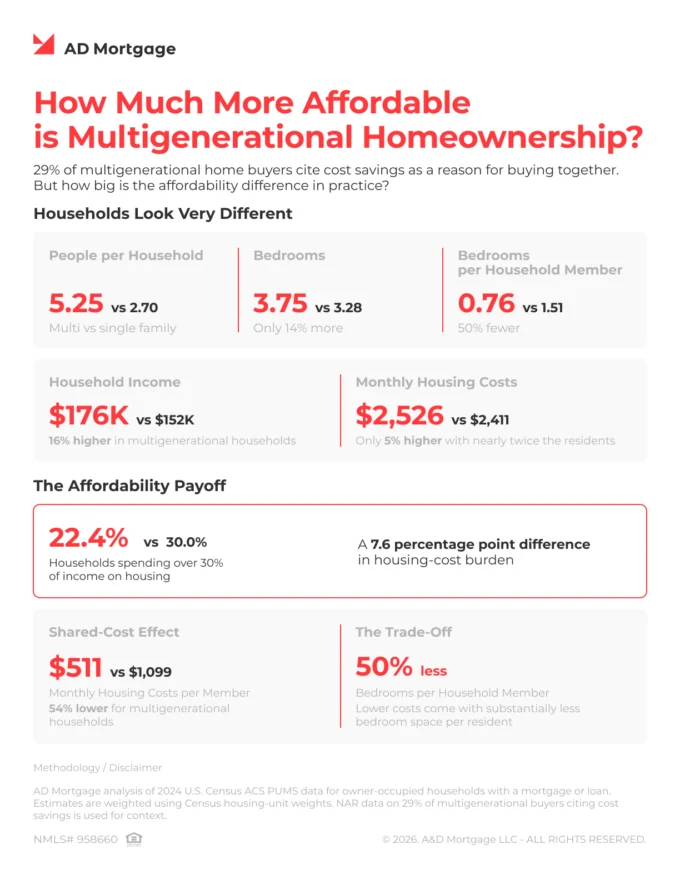
Apart from the price, multigenerational and single-family households differ in many ways. On average, multigenerational households include almost twice as many people as single-family households – 5.25 compared with 2.7. However, the number of bedrooms is only 14% higher (3.75 versus 3.28), despite having nearly double the number of residents.
The difference in the number of bedrooms per person is drastic. For multigenerational households, the number is 0.76, while for single-family households, it is 1.51. This means that multigenerational households have nearly 50% fewer bedrooms per household member.
The numbers do not necessarily indicate worse conditions in multigenerational households, but they can also mean less private space for each resident.
Cost Burden: How Much Do Households Spend on Housing
Multigenerational households generally earn more than single-family households, but the difference is nowhere close to the nearly 50% difference in the number of residents. On average, multigenerational households make $176,000 a year, which is 16% more than the $152,000 income of single-family households.
Housing takes a nearly similar amount of money for both groups – $2,526 for multigenerational households vs. $2,411 for single-family households. This 5% difference is surprising, considering the significant difference in the number of residents.
Therefore, 22.4% of multigenerational households and 30% of single-family households spend over a third of their income on housing. It demonstrates a 7.6-percentage-point lower cost burden for multigenerational households.
Lower Costs Come with Tighter Conditions
While total monthly housing costs differ by only 5% between the two groups, the cost per household member varies much more dramatically. On average, multigenerational households spend $511 per person per month on housing, compared with $1,099 among single-family households.
That means housing costs per resident are about 54% lower in multigenerational households, reflecting the financial benefit of sharing one’s housing expenses among more people.
However, those savings come with less private space as discussed previously. In other words, multigenerational living may lower each resident’s housing costs substantially, but it also generally means a more crowded home and less space per person.
Methodology
The AD Mortgage analysis is based on the 2024 U.S. Census ACS PUMS data for owner-occupied households with a mortgage or loan.