
For many borrowers, the interest rate becomes the deciding factor when comparing a second mortgage, HELOC, or cash-out refinance. Understanding what influences pricing allows brokers to set realistic expectations and recommend the most appropriate financing strategy before requesting a live quote.
Second mortgage rates depend on the loan structure, the borrower’s financial profile, available equity, property characteristics, and market conditions. For brokers discussing second mortgage rates in 2026, the useful question is not simply ‘What is the rate?’ A quote only becomes meaningful when it reflects the complete scenario.
A second mortgage is an additional lien secured by a property that already has a first mortgage. It is not a mortgage used to purchase a second home. Brokers who need a refresher on lien position, qualification, and common loan types can review our article ‘What is a Second Mortgage?’
Key Takeaways
- Second mortgage interest rates often exceed first-mortgage rates because the lender accepts a subordinate lien position and greater repayment risk.
- A fixed-rate second mortgage offers predictable principal-and-interest payments, while a variable-rate HELOC can change with its index and the borrower’s outstanding balance.
- Credit profile, CLTV or HCLTV, DTI, occupancy, property type, documentation, reserves, and mortgage history can all affect pricing.
- Brokers should compare the interest rate, APR, fees, payment structure, and total cost over the borrower’s expected holding period. They must evaluate current second mortgage rates through a live, scenario-specific quote rather than a generic market average.
- AD Mortgage offers closed-end Second Mortgage loans with loan amounts up to $500,000, CLTVs up to 90%, and DTIs up to 50%.
What are Second Mortgage Rates?
Second mortgage rates are the interest rates lenders charge on loans secured behind an existing first mortgage. The rate determines the interest portion of the payment, while the loan term, balance, amortization, and fees shape the borrower’s broader cost.
The phrase can refer to fixed second mortgage rates on closed-end home equity loans or variable HELOC rates on revolving lines of credit. Borrowers may also search for second home equity loan rates when they mean closed-end second-lien pricing. Two offers with similar starting rates can create different payments and long-term costs.
There is no single rate that represents every borrower. A lender prices the complete risk profile, and rates can change with market conditions. Brokers should use a current pricing tool, such as AD Mortgage’s Quick Pricer, when they need an individualized quote.
Why Second Mortgage Rates Can Be Higher Than First Mortgage Rates
Although benchmark mortgage rates influence the lending environment, second-lien pricing is driven by additional risk factors that do not affect first mortgages to the same extent.
As of July 2, 2026, the average rate for a 30-year fixed-rate mortgage (FRM) was 6.43%, down from 6.67% a year earlier, according to Freddie Mac’s Primary Mortgage Market Survey.
Lien priority drives much of the difference. If a foreclosure sale does not produce enough money to satisfy every lien, the first-mortgage lender receives payment before the second-mortgage lender. The second-lien lender therefore faces a greater chance of loss.
‘Second mortgage rates tend to run higher because it’s a second lien, or second in line to get that payment. It is seen as riskier because the borrower already has a first mortgage payment.’
– AD Mortgage Sales Team
The borrower also carries both obligations. Underwriting accounts for the first mortgage, proposed second mortgage, other debts, income, and remaining equity. A high combined debt load or thin equity position can increase risk even with an on-time mortgage history.
Lenders address that exposure through eligibility limits, underwriting requirements, fees, and pricing. The difference depends on the borrower, property, lien structure, program, and market at the time of the quote.
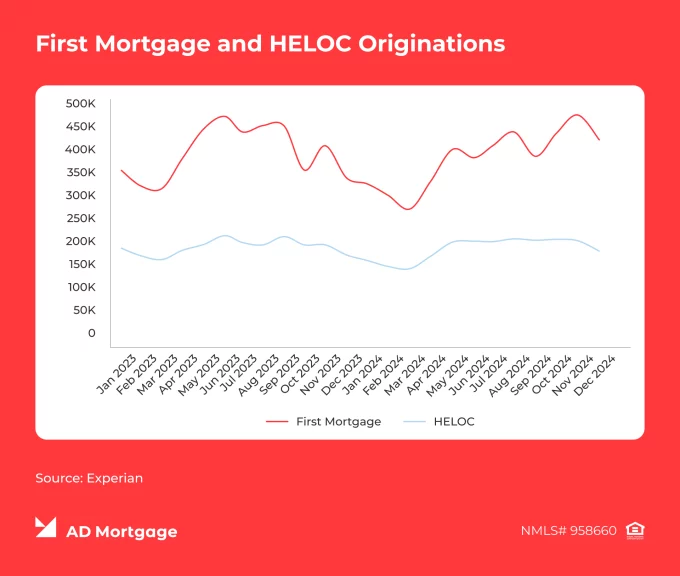
Fixed vs Variable Second Mortgage Rates
Borrowers who prioritize long-term budgeting confidence often prefer payment stability over rate flexibility, making a fixed-rate second mortgage an attractive solution. A HELOC usually has a variable rate, so both the rate and payment can change. The Consumer Financial Protection Bureau explains that some HELOCs allow borrowers to convert part of their balance to a fixed rate.
| Comparison Point | Fixed-Rate Second Mortgage | Variable-Rate HELOC |
|---|---|---|
| Rate Structure | Fixed for the loan term | Usually an index plus a lender margin |
| Access to Funds | Lump sum at closing | Revolving line during the draw period |
| Payment Pattern | Predictable principal-and-interest payment | Payment can change with the rate and outstanding balance |
| Strong Use Case | Known, one-time expense | Staged or uncertain expenses |
| Main Borrower Risk | Paying interest on the full funded balance | Rate increases and payment changes |
| Best Fit | Borrower values certainty | Borrower values flexible access and accepts variability |
A fixed-rate second mortgage may fit a borrower who knows the project cost, wants a lump sum, and values predictable payments.
A variable-rate HELOC can work better when the borrower needs funds in stages. The CFPB’s HELOC booklet explains that its rate generally combines an index with a margin. Brokers should identify the index, margin, adjustment timing, caps, draw and repayment periods, and any conversion option.
The right choice depends on the use of funds, payment tolerance, expected line usage, and repayment plan.
What Affects a Borrower’s Second Mortgage Rate?
Before reviewing pricing factors, brokers should first identify the borrower’s financial goals. Matching financing strategy to the borrower’s intended use often narrows the appropriate loan structure before rate comparisons begin.
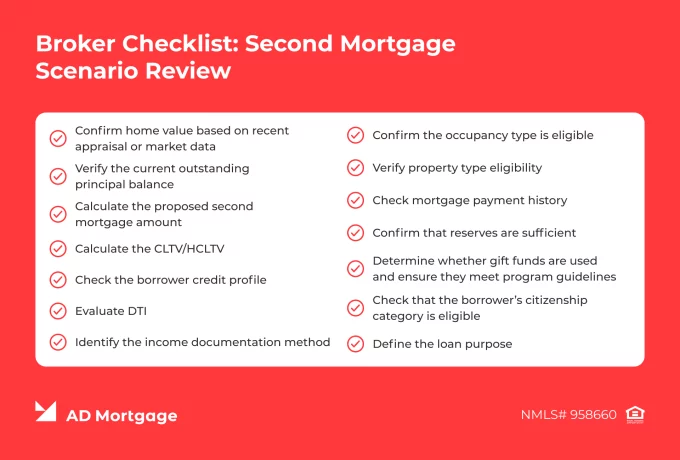
Use this checklist to review the connected second mortgage pricing factors:
- Credit score and overall credit profile: Payment history, recent credit events, revolving utilization, and score can affect eligibility and pricing.
- CLTV and HCLTV: CLTV compares total outstanding mortgage debt with property value. HCLTV also accounts for the full credit limit of a HELOC. Higher leverage leaves less protective equity for the lender.
- DTI: The debt-to-income ratio measures monthly debt obligations against qualifying income. A tighter DTI can reduce flexibility elsewhere in the file.
- Property type: Single-family homes, condominiums, multi-unit properties, and other property types can carry different guidelines and risk adjustments.
- Occupancy: Pricing and eligibility may differ for primary residences, second homes, and investment properties.
- Loan amount: Minimum and maximum loan limits, balance tiers, and fixed origination costs can affect the available options.
- Documentation type: Full documentation and alternative documentation programs evaluate income differently and may price differently.
- Mortgage history: Late payments, forbearance history, and other recent housing events can affect the lender’s view of repayment risk.
- Reserves: Strong post-closing liquidity can support the overall file, particularly when the borrower has multiple housing obligations or nontraditional income.
- Market conditions: Benchmark rates, investor demand, funding costs, and lender capacity can change available pricing.
These factors interact. A strong credit score does not cancel out excessive leverage, and substantial equity does not remove concerns about income or mortgage history. Brokers should price the complete file instead of treating one favorable metric as decisive.
Second Mortgage Rate vs APR
The interest rate reflects the charge for borrowing principal. The annual percentage rate, or APR, provides a broader cost measure by incorporating the rate and certain finance charges. The CFPB’s explanation of mortgage APR includes points, mortgage broker fees, and other charges in that broader measure.
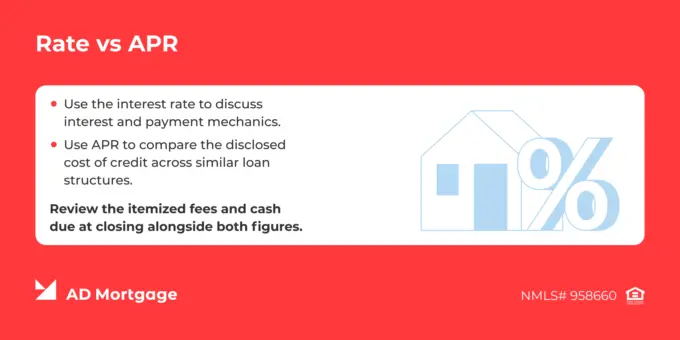
APR helps when fixed-rate offers have different combinations of rate, points, and fees. A lower note rate paired with high upfront charges may cost more.
APR also needs context. If the borrower expects to sell, refinance, or repay early, upfront costs will be spread across a shorter holding period. Compare the break-even period and total dollars paid over the borrower’s likely timeline.
Second Mortgage Rates vs HELOC Rates
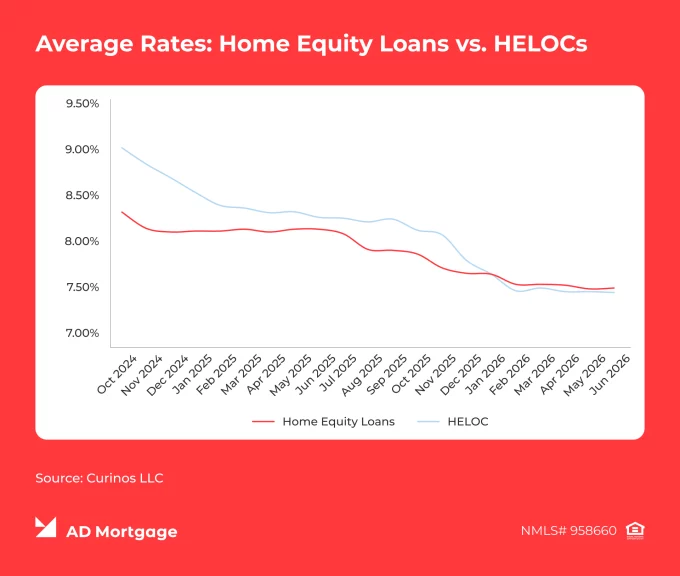
A closed-end second mortgage funds once and amortizes under a set schedule. A HELOC allows draws up to an approved limit during its draw period.
Compare second mortgage vs HELOC rates by structure, not only by the opening rate. Many HELOCs use an index such as the U.S. prime rate plus a margin. If prime changes, the rate may change at the next adjustment, subject to the plan’s terms and caps. Payments can also shift with line usage and the transition from draw to repayment.
A borrower who needs only part of the approved limit may value paying interest on the amount drawn. A borrower who needs the entire amount and wants stable payments may prefer a fixed-rate loan. Model the balance and payment during both draw and repayment periods.
Second Mortgage Rates vs Cash-Out Refinance Rates
A cash-out refinance replaces the first mortgage with a new, larger first-lien loan. A second mortgage leaves the existing first mortgage in place and adds a separate payment. That distinction can matter more than the nominal rate on either new loan.
If a borrower has favorable first-mortgage terms and needs limited equity, repricing the entire balance may create more total interest expense even when the new first-lien rate is lower than the second-lien rate. Replacing the first mortgage may work better when its existing terms are unfavorable.
Compare the blended cost, total payment, closing costs, cash received, amortization reset, and expected holding period. The detailed Second Mortgage vs HELOC vs Cash-Out Refinance article can help frame the decision.
| Borrower Scenario | Preferred Solution | Central Rate Question |
|---|---|---|
| Favorable first mortgage; known one-time expense | Fixed second mortgage | Does preserving the first mortgage reduce the combined cost? |
| Expenses occur in stages | HELOC | How could index changes and future draws affect payment? |
| Existing first-mortgage terms may improve | Cash-out refinance | Does repricing the full balance create a better total result? |
How Brokers Should Explain Rate Quotes
Start with the quote assumptions. Confirm the property value, first-mortgage balance, requested cash, credit profile, documentation, occupancy, property type, reserves, and closing timeline. State whether pricing is fixed or variable and includes points, credits, or other adjustments.
Then translate the rate into borrower impact:
- Explain the monthly principal-and-interest payment and any conditions that could change it.
- Show the interest rate and APR together, followed by the itemized fees.
- For a HELOC, identify the index, margin, rate caps, draw rules, and repayment-period payment structure.
- Compare total payment and total cost over the borrower’s expected holding period.
- Date the quote and explain that pricing can change until the rate is locked.
- Avoid describing an estimated quote as an approval, commitment, or guaranteed outcome.
Brokers can use the Second Mortgage program page to review current program parameters. AD Mortgage currently lists loan amounts up to $500,000, CLTV up to 90%, and DTI up to 50%, subject to program requirements and underwriting. Use Quick Pricer for live scenario pricing or submit a scenario when a file needs a tailored review.
Conclusion
Brokers should always compare second mortgage rates at the scenario level. A useful review covers lien position, fixed or variable structure, credit profile, CLTV or HCLTV, DTI, property details, documentation, reserves, fees, APR, payment behavior, and the borrower’s expected repayment timeline.
Because pricing and program requirements can change, brokers should update comparisons regularly and confirm the assumptions behind every quote. The best-fit option is the one that supports the borrower’s purpose while producing a payment and total cost they can manage.
AD Mortgage has 20 years of experience in the mortgage industry and offers a wide range of mortgage solutions, including the Second Mortgage program. Submit a loan scenario to receive a tailored solution in 30 minutes.
Second mortgage rates are the interest rates charged on loans secured by a property behind an existing first mortgage. The offered rate depends on the loan structure, borrower profile, property, leverage, and market conditions. They often are because the second-lien lender receives repayment after the first-lien lender in a foreclosure. The exact difference varies by scenario and program. They can be either. Closed-end home equity loans commonly use fixed rates, while HELOCs commonly use variable rates tied to an index plus a margin. Major second mortgage rate factors include credit profile, CLTV or HCLTV, DTI, property type, occupancy, loan amount, documentation, mortgage history, reserves, and market conditions. It may be better for a known, one-time expense when the borrower values predictable payments. A HELOC may fit staged expenses and flexible access, provided the borrower can manage variable rates and changing payments. Yes. Second mortgage APR helps compare the interest rate and certain finance charges across similar offers. Brokers should also review itemized fees, cash due at closing, and the borrower’s expected holding period. The nominal second-mortgage rate may be higher, but a second mortgage preserves the existing first mortgage. Compare the combined payment and total cost against the cost of refinancing the entire first-mortgage balance. AD Mortgage provides flexible underwriting for out-of-the-ordinary borrowers, helping partners serve a wide variety of scenarios. Borrowers may improve their position by maintaining strong credit, reducing revolving balances and DTI, preserving equity, documenting stable income, building reserves, and comparing scenario-specific offers. Final pricing remains subject to lender guidelines and current market conditions.
FAQ: Second Mortgage Rates
What are Second Mortgage Rates?
Are Second Mortgage Rates Higher than First Mortgage Rates?
Are Second Mortgage Rates Fixed or Variable?
What Affects Second Mortgage Rates?
Is a Fixed Second Mortgage Better than a HELOC?
Is APR Important on a Second Mortgage?
Are Second Mortgage Rates Better than Cash-Out Refinance Rates?
How Can Borrowers Get a Better Second Mortgage Rate?