
Post content:
How to Become a Mortgage Loan Officer in Texas in 2026
Add AD Mortgage as your preferred source on Google
Texas is one of the most active housing markets in the country with more than 335,000 homes sold in 2025. This market can support the career of a mortgage loan originator (MLO) for decades.
Of course, to build that career, you need to get licensed. Texas runs the process through two different agencies, but once you know which one fits your plans, the path is clear.
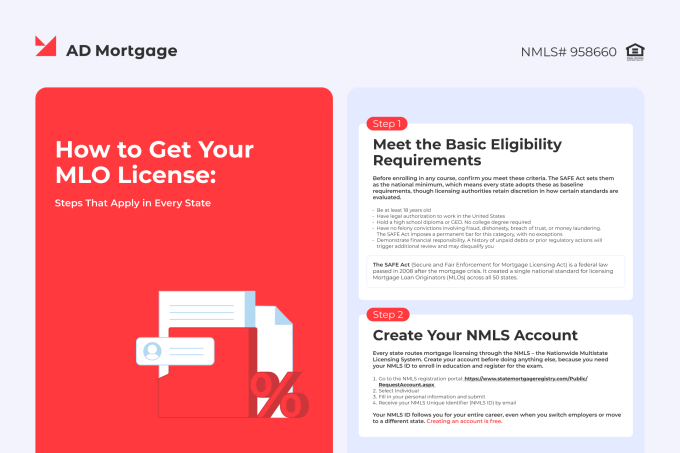
Much of what follows is Texas-specific, but the licensing journey begins with a set of federal steps that look the same regardless of your state. Our Guide with Federal Requirements lays them out, so you can handle that groundwork before you even reach the Texas details below.
From there, we will explain how to become a mortgage loan originator in Texas step by step. You’ll learn which regulator you need to register with, which fees to pay, and when. We also provide links to the official sources, so you can verify each detail yourself.
Why Becoming a Texas MLO is a Good Decision
We spoke with Blake Bearden, TPO Account Executive at AD Mortgage, who works closely with Texas originators every day. He sees firsthand what helps new originators succeed across the state:
“Texas is a great place to start your MLO career because the market is steady. There are no great fluctuations in housing prices, and right now, there is a solid stream of buyers moving to Texas from other states, taking advantage of not having income tax among other things, so the market is there for the taking. Being an LO is controlling your own future, you can work and make as much as you want.”

Blake sees the bigger picture from the wholesale side. Originators on the ground see more specific details. For instance, the opportunity tied to area median income (AMI), a federal benchmark for what a typical household earns in a given region:
“Affordability has been a hot topic the last several years. Texas has 13 to 14 million households that fall within 80% of the area median income (AMI). The most generous down payment assistance programs for first-time homebuyers require household income to fall in that range. That makes Texas home to millions of potential customers who are probably not even aware of the assistance available to them. And that’s just one area of opportunity in Texas.”
– explains Renee Dunn, Loan Officer at Secure Mortgage Company.

There are a lot of buyers already out there, waiting to be reached, and the housing numbers show that there are more on the way.
Texas Sells and Builds a Lot of Homes
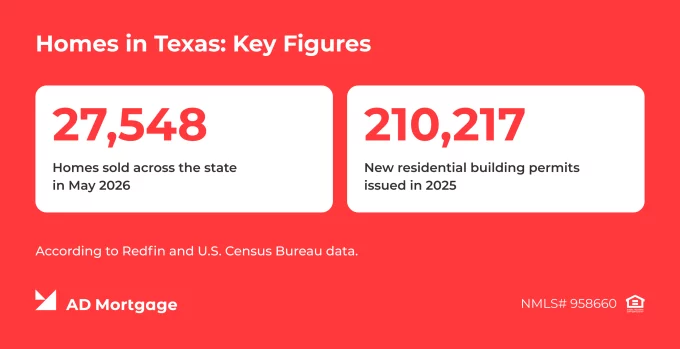
According to Redfin’s Texas housing market data, 27,548 homes were sold across the state in May 2026 at a median sale price of $343,779. More home sales usually translates into more loans to originate and enough volume to keep your pipeline full even in slower months.
Texas also keeps building. In 2025, Texas led the nation with 210,217 new residential building permits – more than any other state, according to U.S. Census Bureau data.
Numbers are supported by what people “in the field” say:
“Texas has an economy attracting more businesses and subsequent homebuyers unlike many other states. This gives an MLO more opportunities for purchase loans which, if handled properly, convert to refinances in the future. Texas provides a great way to build a consistent customer base given its size and population growth. Plus, there are more home builders in Texas than the next 3 states combined.”
– shares Brian Palmer, President of Pinnacle Funding Group, Inc.

Thus, a new MLO has more than one entry point: finance new construction, help move-up buyers trade into bigger homes, and serve the newcomers to Texas. Few states offer that much room to build a book of business from day one.
Salary of a Mortgage Loan Officer in Texas
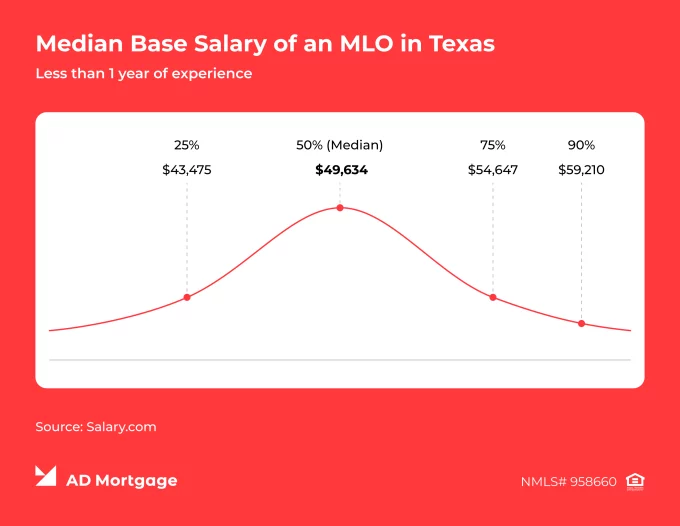
Compensation for Texas MLOs depends heavily on structure, since most of the earnings come from commission rather than base pay. Salary.com data for a Mortgage Loan Officer I in Texas shows an average base salary of $49,635 as of June 1, 2026, for the entry-level tier. However, base pay tells only a fraction of the story in a commission-driven role.
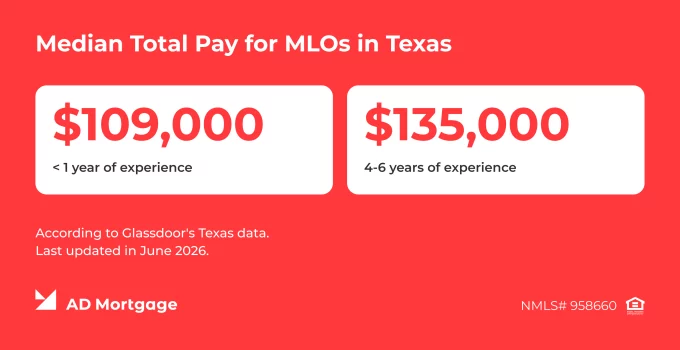
According to Glassdoor’s Texas data, based on 1,129 submitted salaries as of June 2026, the median total compensation for a Texas mortgage loan officer with <1 year of experience ranges from $82,000 to $148,000 per year. For more experienced MLOs, with 4-6 years in the profession, the total pay ranges from $101,000 to $188,000 per year.
Understanding the Terminology
Before taking the first steps into the industry, two points of confusion are worth clearing up, because Texas handles both differently than most states.
First, the job titles. A “mortgage loan originator” (MLO) is the legal term for an individual who takes a residential mortgage application or negotiates loan terms for compensation. “Mortgage loan officer” and “loan officer” are common workplace titles for the same role, although not established by law.
A mortgage broker, by contrast, is generally the company that employs originators and arranges loans between borrowers and lenders but can also be an individual.
Second, the two agencies. Texas is one of the few states where two regulators issue MLO licenses. Which one applies to you depends on what kind of loans your employer handles.
Most new MLOs go through the Department of Savings and Mortgage Lending (SML). If you are joining a mortgage company or mortgage bank to help people buy or refinance their primary home, this is your path. This guide focuses on it.
A smaller group goes through the Office of Consumer Credit Commissioner (OCCC) instead. This applies if your employer works with more specialized loan types, such as secondary mortgage, home-equity, manufactured-housing, or property-tax loans. But MLOs don’t hold licenses in both agencies for overlapping loan types. So, if you already have an SML license, you’ll handle secondary mortgage loans and home-equity loans under that same SML license, instead of getting a separate one through OCCC.
When in doubt, ask your prospective employer which agency they operate under. That answer also determines which pre-licensing education you’ll need.
Texas Mortgage Loan Originator License: Quick Facts
| Regulator | Texas Department of Savings and Mortgage Lending (SML) for most MLOs; the Office of Consumer Credit Commissioner (OCCC) licenses MLOs tied to certain regulated lenders |
| Licensing system | All applications run through the Nationwide Multistate Licensing System (NMLS). |
| Pre-license education | 23 hours for the SML path (the 20-hour national course plus 3 hours of Texas-specific content); 20 hours for the OCCC path (NMLS Texas-SML education requirements) |
| Exam | SAFE MLO National Test with Uniform State Content – no separate Texas exam (NMLS Texas-SML requirements) |
| State application fee | $125 SML application fee plus a $20 recovery fund fee (SML fee schedule announcement) |
| Total estimated cost | Approximately $550 – $1000, covering the $145 SML fees, the $110 SAFE test, the $36.25 FBI background check, the $15 credit report, the NMLS processing fee, and a pre-licensure course ($200 – $450, varies by provider) |
| Renewal deadline | December 31 each year through NMLS, with continuing education completed first (NMLS Texas-SML requirements) |
| Governing statute | Texas SAFE Act, Finance Code Chapter 180, with mortgage companies and bankers licensed under Chapter 156 and Chapter 157 |
How to Get Your MLO License in Texas: Step by Step
Federal Requirements
Every state shares the same federal baseline. Note that Texas adds to the education requirement below – the SML path totals 23 hours – but the rest of these steps are the same everywhere:
- Create an NMLS account at the NMLS Resource Center
- Complete 20 hours of NMLS-approved pre-licensure education (PE)
- Pass the SAFE MLO Test (National Component with Uniform State Content)
- Submit fingerprints for an FBI criminal background check
- Authorize a credit report through NMLS
- Complete Form MU4 (Individual Form) in NMLS
- Obtain sponsorship from a licensed company to activate your license
For a detailed walkthrough of each federal step, including deadlines and costs, download our complete MLO licensing guide.
Texas MLO License Requirements
The following requirements are specific to Texas and apply to the SML path:
1. Complete 3 extra hours of Texas-specific education.
The federal baseline is 20 hours, but the SML requires 23 hours: the 20-hour national course plus a 3-hour Texas-SML course covering state law, home-equity lending, reverse mortgages, and SML licensing rules, per the NMLS Texas-SML education requirements.
The SML will not let other states’ content count toward the 12 elective hours, so make sure your package is built for Texas. The OCCC path, by contrast, requires only the standard 20 hours.
2. Pay the SML fees.
Per the SML fee schedule, the MLO application fee is $125 plus a $20 recovery fund fee, both paid through NMLS. The recovery fund helps reimburse borrowers harmed by originator misconduct. According to SML, its fees remain among the lowest of any state.
3. Know the surety bond arrangement.
Texas, like some other states, requires a recovery fund contribution from every MLO, but the surety bond obligation is generally carried at the company level. The licensed mortgage company or banker that sponsors you maintains the bond that covers its originators, so most individual MLOs do not post a separate personal bond. Confirm your coverage with your sponsoring employer.
If you are unsure which agency applies to you, the SML addresses the SML-OCCC overlap directly in its FAQ, and questions can go to the department at 877-276-5550.
Need to Renew Your MLO License?
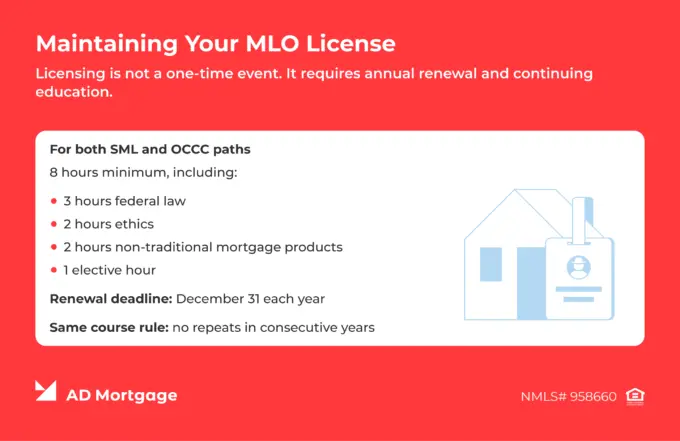
Texas MLO licenses expire every December 31. Before requesting renewal, you must complete 8 hours of NMLS-approved continuing education (CE): 3 hours of federal law, 2 hours of ethics, 2 hours of non-traditional mortgage lending, and 1 elective hour.
Texas does not require any state-specific CE hours. A provider can take up to seven days to report the completion to NMLS, so avoid leaving CE until the last minute.
In Texas, industry organizations that hold events with NMLS-approved CE classes are a practical way to knock out those hours while building a professional network. They include:
- Originator Connect Network – the organizer of the Texas Mortgage Roundup, which runs multiple events across the state each year and offers a free NMLS-approved CE class with pre-registration.
- Mortgage Bankers Association – the national industry association. Texas MLOs can attend NMLS-approved continuing education at some of these conferences and educational programming events.
The Texas Mortgage Roundup in San Antonio, produced by the Originator Connect Network, is an example. The event brings together brokers and lenders for a day of education and networking.
AD Mortgage exhibited at Texas Mortgage Roundup in 2026. Our company showcased our Non-QM programs and connected with Texas brokers.

How to Receive a Mortgage Broker License in Texas
For originators who want to run their own brokerage, Texas licenses the company separately from the individual. Texas Finance Code Chapter 156 governs residential mortgage loan companies – the license that covers brokering activity. The key steps:
- Form your business entity and create a company (Form MU1) record in NMLS
- Apply for the Texas Mortgage Company License through the SML, which is held by residential mortgage loan companies under Chapter 156
- Meet the financial responsibility requirement. Texas gives companies a choice: maintain $25,000 in net assets, or post a $50,000 surety bond instead. This amount is fixed and doesn’t scale with loan volume. Pay the $325 company application fee, set in the SML fee schedule
- Designate a qualifying individual to oversee compliance, and complete background and credit reviews for control persons
- Employ at least one sponsored, licensed Texas MLO to originate loans, and maintain ongoing obligations such as the Mortgage Call Report through NMLS
The company license carries more documentation and financial requirements than the individual license. Most originators build a book of business under an existing firm before opening their own.
Advice for Future Texas MLOs
Licensing gets you into the industry. What happens after that depends on the choices you make early – who you learn from, what you specialize in, and who you partner with. We asked people who have already built careers in Texas mortgage lending what they’d recommend someone just starting out.
Manoj Bhatia, President of Secure Mortgage Company, says it starts with where you begin your career:
“Choose a company that trains you. Look for experienced loan officers and real support behind you. Find a local broker with a long-term presence, one the community already trusts. That trust transfers to you the moment you start working under their name. Mentorship and training matter most in the beginning. They set you up for success in the long run.”

Once you’ve found that support system, the next step is what you do with it.
Renee Dunn, Loan Officer at Secure Mortgage Company, points to the fundamentals:
“Planning a marketing strategy is important. However, I believe equally important is taking the time to learn mortgage loan guidelines and research unique mortgage products and programs available. Being knowledgeable in your industry automatically makes you a better communicator.”
That same discipline applies to the lenders you choose to work with.
Brian Palmer, President of Pinnacle Funding Group, Inc., makes the case for consistency:
“I find consistency is the key to success in the mortgage industry regardless of market conditions. Establish relationships with a few lenders so you become very familiar with their processes and prices. Then, every realtor, home builder, and buyer knows exactly what to expect, so there are no surprises.”
Blake Bearden, TPO Account Executive at AD Mortgage, adds a warning about how to pick those lenders:
“One of the biggest pieces of advice I would offer a new LO is don’t chase the money. Getting the best price doesn’t always mean closing the loan. Pick a lender that you work well with, that knows you and you know them, that makes the process smooth and everyone is happy.”
Where you start, what you know, and who you work with are the key principles that shape a successful MLO career.
FAQ: Become a Mortgage Loan Officer in Texas
How long does it take to become a mortgage loan officer in Texas?
Most applicants finish in about six to eight weeks. The 23-hour SML education can be completed in a couple of weeks, the SAFE test scheduled shortly after, and the rest of the time covers the background check, the SML application review, and employer sponsorship.
What is the difference between a mortgage loan originator and a mortgage broker?
“Mortgage loan originator” (MLO) and “mortgage loan officer” are two names for the same role: an individual who takes mortgage applications and negotiates loan terms. A mortgage broker, by contrast, describes a business model – a company (or, less commonly, an individual) that employs MLOs and arranges loans between borrowers and lenders. Most new originators become a licensed MLO first, then join an existing mortgage company or brokerage; opening your own company later requires obtaining a company license and designating qualified management personnel who satisfy Texas licensing requirements.
What is the difference between the SML and OCCC licenses?
Both are Texas MLO licenses, but they cover different lending. The SML license is for originators working on primary residential mortgages at mortgage companies. It’s the path most new MLOs take; it requires 23 hours of education. The OCCC license applies to originators handling secondary mortgage, home-equity, property-tax, or manufactured-housing loans, and requires 20 hours.
How much does a Texas MLO license cost?
Expect roughly $550 – $1000 total: the $125 SML application fee plus the $20 recovery fund fee (SML fee schedule), the $110 SAFE test, the $36.25 FBI background check, the $15 credit report, the NMLS processing fee, and a pre-licensure course that typically runs $200 – $450 depending on the provider.
Can I start originating loans before my license is active?
No. You may not act as a mortgage loan originator until you hold the appropriate active authority to originate loans under Texas law. Specifically, sponsorship is generally required before a state-licensed MLO can originate loans for a licensed mortgage company.
I'm already licensed in another state – can I transfer my license to Texas?
Not exactly a transfer, but the process is faster than starting over. Your NMLS ID and your passing SAFE test score carry over, so you do not need to retake the national exam. What you do need for the SML path is the 3-hour Texas-specific education, a Texas license application through NMLS, and sponsorship from a Texas-licensed employer. Your existing federal 20-hour pre-licensure education is recognized, so the added lift is modest.
Do I need my own surety bond?
Generally, no. In Texas, the surety bond is typically carried by the licensed mortgage company or banker that sponsors you, not by the individual originator. You do contribute the $20 recovery fund fee at application. Confirm your bond coverage with your sponsoring employer.
Conclusion
Becoming a licensed MLO in Texas is a realistic goal. Once you’ve chosen the regulator, create the NMLS account, complete education, pass the SAFE test, clear your background and credit checks, pay the SML fees, and secure sponsorship from a licensed employer.
Once you are licensed, where you place your business matters as much as the license itself. AD Mortgage operates as a wholesale lender and partners with licensed Texas MLOs and brokers.
AD Mortgage offers Conventional, FHA, and Non-QM loan programs. Our Non-QM lineup includes DSCR, Bank Statement, and Foreign National loans. That range gives new originators a program for nearly any borrower who walks through the door.
EXPLORE WHOLESALE LENDING WITH AD MORTGAGE
Last reviewed: July 2026. Not legal advice. Licensing requirements and fees are subject to change. Always verify current requirements directly with the Texas Department of Savings and Mortgage Lending and the Office of Consumer Credit Commissioner (OCCC), along with the NMLS Resource Center, before beginning your application.
Thank you, you're successfully subscribed! Please confirm your subscription in your email.