Investment Property Loans: How to Match Your Client to the Right Program
·15 min read
Add AD Mortgage as your preferred source on Google
An investment property loan finances a property purchased to generate rental income or resale profit, and it’s classified as non-owner-occupied financing rather than a standard home loan. For brokers, though, an investment property loan isn’t just a product – it is a scenario-matching problem. Your client’s income profile, property type, documentation, and rental strategy all determine which program actually fits. Broker matches borrower scenario to loan program – and getting that match right is where you add the most value.
This guide walks through how investment property loans work, what separates them from primary residence financing, and how to route your client’s scenario to the right program – DSCR, conventional, portfolio, or an equity-based alternative.
Key Takeaways
Investment property loans help your client finance rental or income-producing properties.
Compared with primary residence loans, investment property loans typically require stronger credit, larger down payment, and cash reserves.
Rental income may support borrower qualification, especially in DSCR scenarios, depending on the program.
Conventional and DSCR loans evaluate income differently – a conventional loan qualifies borrower based on personal income and DTI, while a DSCR loan qualifies borrower based on the property’s cash flow.
Brokers add value by matching the client’s goal, property type, income profile, and documentation to the right loan option.
AD Mortgage helps brokers evaluate investor scenarios and move faster on submissions.
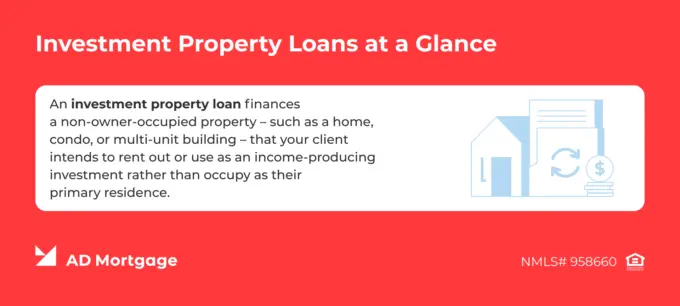
An investment property loan finances a non-owner-occupied rental or income-producing property – a home, condo, or multi-unit building your client intends to rent out or resell, not live in. Because repayment depends partly on the property’s rental performance rather than solely on your client’s paycheck, lenders apply stricter underwriting to investment property loans than they do to primary residence mortgages. Non-owner-occupied properties carry a higher perceived risk of default in the lender’s eyes, since vacancy or a slow rental market can interrupt the income stream that supports the payment.
That’s why loan program fit depends on more than just the purchase price – it depends on your client’s profile, property type, documentation, rental income, and overall investment strategy. Getting the borrower’s story right up front is what determines whether DSCR, conventional, or another path makes sense.
Investment vs Conventional Primary Residence Loans
A primary residence loan secures the borrower’s own home – the underwriting assumes the borrower lives there and repays the loan from personal income alone. An investment property loan, by contrast, is tied to a property your client doesn’t occupy, and it typically comes with a different rate and risk profile than a comparable primary residence loan. That said, conventional loans still permit certain investment property purchases under agency program rules – it is not a strict binary where conventional only applies to primary residences.
Feature
Investment Property Loan
Primary Residence Loan
Property Use
Rental, income-producing, or investment property
Borrower's primary home
Occupancy
Non-owner-occupied
Owner-occupied
Qualification
May use rental income or property cash flow (e.g., DSCR) depending on the program
Based primarily on the borrower's personal income and DTI ratio
Down Payment
Typically higher
Often lower
Credit and Reserves
Stricter credit and cash reserve requirements
More flexible requirements
Interest Rates
Generally higher due to increased lending risk
Typically lower
Best For
Real estate investors building rental portfolios
Homebuyers purchasing a primary residence
Owner-Occupied vs Non-Owner-Occupied
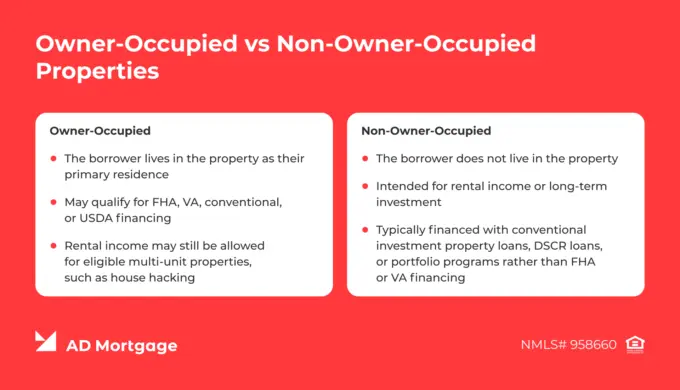
Occupancy status determines loan program eligibility, and this is one of the most common points of confusion for borrowers – and occasionally for less experienced brokers. Some clients use a ‘house hacking‘ strategy: living in one unit of a 2-4-unit property while renting out the others. House hacking combines owner occupancy with rental income, and it opens the door to FHA and VA financing, since both programs require the borrower to occupy one unit of an eligible 2-4-unit property.
That is the key distinction to keep straight: FHA and VA loans require owner occupancy and exclude non-owner-occupied investment property use entirely. They are owner-occupied entry paths, not investment property products – so if your client is buying a property, they will not live in at all, FHA and VA are off the table, and the conversation shifts to conventional, DSCR, or portfolio financing instead.
Investment Property Loan Requirements
Requirements vary by lender, program, occupancy, property type, and documentation – there’s no single universal number that applies across every scenario. Generally, conventional investment property loans follow standard agency-style guidelines, while DSCR loans are evaluated more on the property’s cash flow than on a fixed checklist. AD Mortgage program matrix defines current investment property requirements, and our partners can use Quick Pricer Pro to compare different scenarios.
Down Payment and Reserves
Investment property loan requires larger down payment than a primary residence loan. AD Mortgage’s DSCR program down payment requirements are scenario-dependent and best confirmed for the specific deal rather than quoted as a flat percentage.
The same goes for reserves on DSCR loans, which are evaluated case by case. Cash reserves demonstrate the borrower’s ability to cover payments during vacancy or repairs – even a strong property can sit empty for a stretch. Reserves are the buffer that keeps the loan performing during that gap when vacancy interrupts rental income.
Credit Score and DTI
Credit score affects loan eligibility and pricing, and the requirements differ sharply by program. For example, DSCR loans by AD Mortgage start at a minimum FICO of 620, though a DSCR ratio below 1 requires a minimum FICO of 680.
DSCR loan deemphasizes personal DTI. In a DSCR scenario, the property’s cash flow – not your client’s personal DTI – is the primary qualifying factor, which is exactly why DSCR opens doors for clients whose personal debt load wouldn’t otherwise pencil out.
How Rental Income Helps Your Client Qualify
Rental income can offset your client’s qualifying debt burden, but how it is used depends entirely on the loan type. Conventional guidelines commonly apply a vacancy adjustment to projected or documented rent. Fannie Mae instructs lenders to use 75% of the gross monthly rent when calculating qualifying rental income. However, this calculation does not apply to every conventional loan, every documentation method, or every lender.
DSCR loans take a different approach entirely: rather than layering rental income on top of a personal income calculation, DSCR replaces personal income documentation with a property cash-flow analysis. The debt service coverage ratio simply measures the property’s income relative to the mortgage payment.
With AD Mortgage’s DSCR program, a ratio above 1.25 is treated favorably, and – notably – a DSCR as low as 0 is accepted, meaning even a property with no measurable rental income relative to the payment can still be considered under the program’s no-ratio option. That’s a meaningfully wider door than conventional financing offers clients whose personal income picture doesn’t tell the full story.
Types of Investment Property Loans
The best investment property loan for your client depends on their income profile, the property type, available documentation, rental strategy, timeline, and exit plan. Here’s how the main options compare, starting with the program most brokers reach for first in investor scenarios.
DSCR Loans
DSCR stands for debt service coverage ratio, and a DSCR loan qualifies borrower based on the property income potential rather than traditional personal income documentation. This makes it particularly useful for real estate investors, self-employed borrowers, and multi-property investors – especially when tax returns understate actual cash flow, which happens often once write-offs and depreciation are factored in.
AD Mortgage’s DSCR program accepts a DSCR as low as 0, doesn’t require income or employment documentation, and goes up to 80% CLTV with loan amounts up to $3 million – a meaningfully wide net for investor scenarios that wouldn’t clear conventional underwriting. DSCR programs can also offer fast scenario turnaround, which matters when your client is competing for a property in a tight market.
Conventional investment property loans suit borrowers with documented income, strong credit, and a sufficient down payment – think W-2 employees with straightforward tax returns. Underwriting evaluates borrower’s personal income, DTI, reserves, and (where applicable) a vacancy-adjusted portion of rental income, all together. It’s often the most familiar path for brokers and the most predictable for clients who don’t need DSCR’s flexibility.
Portfolio Loans
A portfolio loan stays on the lender’s own balance sheet instead of being sold through standard agency channels. Balance-sheet retention enables more flexible scenario review – though it is worth being careful not to overpromise that flexibility before a scenario has actually been reviewed.
Portfolio loan accommodates borrowers or properties that don’t check every box on a standard agency form: unusual property types, complex borrower structures, or larger portfolios that don’t fit cleanly into conventional guidelines.
Cash-Out Refinance
A cash-out refinance converts existing property equity into usable funds by replacing the current loan structure entirely – your client ends up with a new, larger loan and the difference in cash. Extracted equity commonly funds another property purchase, renovations, debt consolidation, or another investment goal. Because it replaces the loan rather than adding to it, it’s worth walking through rate, payment, and long-term strategy with your client before recommending it over other equity options.
Home Equity Loans
A home equity loanprovides a lump sum secured by existing property equity, typically with a fixed repayment structure – useful when your client wants a predictable, one-time draw rather than ongoing access to credit.
A HELOC provides the revolving line with a draw period and variable rate, giving your client flexibility to borrow as needed rather than all at once. In either case, it’s worth reminding your client that missed payments put the property securing the debt at risk.
Bridge Loans and Hard Money Loans
Bridge loan funds short-term or time-sensitive investment scenarios – commonly used by fix-and-flip borrowers or investors who need funding faster than a conventional timeline allows. Hard money loans trade a higher cost for faster funding and more flexible collateral review, which is often exactly the trade-off a time-pressed investor wants. Because these are short-term by design, a fix-and-flip borrower relies heavily on a clear exit strategy and payoff plan – without one, the higher cost of bridge or hard money financing stops making sense.
Borrower scenario determines the optimal loan path more than any single data point does. Here are three common investor archetypes and how they tend to route.
The W-2 Investor
The W-2 investor is characterized by documented income, stable employment, and strong credit. W-2 investor profiles often align with a conventional investment property loan as a natural starting point. Though it’s still worth comparing down payment, reserves, and DTI before committing, since a DSCR or portfolio option might still fit better depending on the specific property and rental numbers.
The Self-Employed and Multi-Property Investor
For the self-employed and multi-property investor, tax returns may not show the full picture of their cash flow. Multiple financed properties can complicate DTI calculations and documentation.
When the property’s own cash flow supports the payment, DSCR is often the better path. Before routing here, broker reviews leases, rent schedules, market rent, and property expenses to confirm the numbers actually support a DSCR fit.
The Fix-and-Flip Borrower
This scenario is defined by a short holding period, a renovation budget, and an exit strategy – sell or refinance once the work is done. Fix-and-flip scenario aligns with bridge or hard money financing.
One important flag: if the property isn’t stabilized or rent-ready, it likely won’t qualify for DSCR or conventional financing, which is exactly why bridge or hard money exists as the interim step before a longer-term loan takes over.
Other scenarios worth keeping in your back pocket: a first-time investor buying a single-family rental, an experienced investor adding a short-term rental to their portfolio, or a client using a cash-out refinance to fund the down payment on another property.
Pros and Cons of Investment Property Loans
As any other mortgage product, investment property loans come with their own risks and tradeoffs.
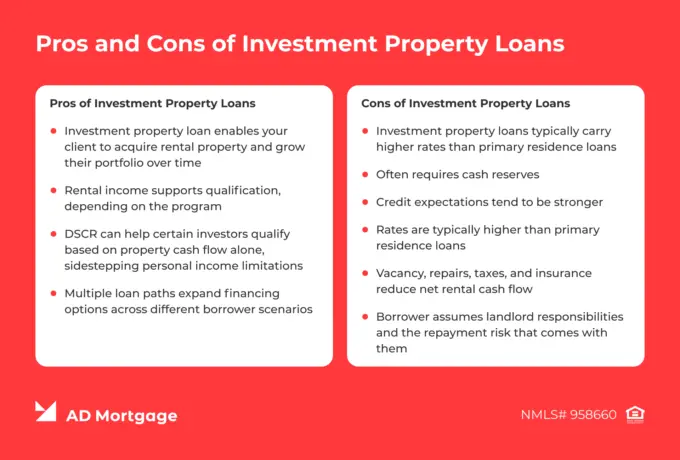
Pros of Investment Property Loans
Investment property loan enables your client to acquire rental property and grow their portfolio over time.
Rental income supports qualification, depending on the program.
DSCR can help certain investors qualify based on property cash flow alone, sidestepping personal income limitations.
Multiple loan paths expand financing options across different borrower scenarios.
Cons of Investment Property Loans
Investment property loans typically carry higher rates than primary residence loans.
Often requires cash reserves.
Credit expectations tend to be stronger.
Rates are typically higher than primary residence loans.
Vacancy, repairs, taxes, and insurance reduce net rental cash flow.
Borrower assumes landlord responsibilities and the repayment risk that comes with them.
How Your Client Can Strengthen Their Application
A few practical steps make almost any investment property scenario move faster and land better:
Clarify the property’s purpose – rental hold, resale, or short-term rental – since this shapes which programs even apply.
Gather lease documentation where available. Documented rental income from signed leases strengthens qualification more than projected rent alone.
Understand the difference between projected and documented rent before assuming a number will be usable.
Organize tax returns and bank statements ahead of submission – organized documentation accelerates underwriting review rather than stalling it mid-process.
Review credit profile early enough to address any issues before they become a qualification problem.
Confirm down payment and reserve amounts against the specific program being targeted, not a general assumption.
Estimate cash flow realistically, factoring in vacancy and maintenance costs.
Set expectations around appraisal, since appraisal establishes property value and, where ordered, market rent.
Compare loan options before submitting – a quick pre-submission comparison prevents a program mismatch that costs everyone time later.
Why Brokers Partner with AD Mortgage for Investor Loans
AD Mortgage supports brokers structuring investor scenarios, particularly when loan fit isn’t obvious from the outset. AD Mortgage scenario review resolves ambiguous loan-fit questions, and DSCR program helps real estate investors for whom property cash flow – not personal income – is the deciding factor.
DSCR as Low as 0, No Income and Employment Needed
AD Mortgage’s DSCR program accepts DSCR as low as 0, no income and no employment documentation required, up to 80% CLTV, and loan amounts up to $3 million. That combination covers a wide range of investor profiles, from a first-time landlord to an experienced investor scaling a portfolio.
Fast Turn Times
AD Mortgage provides fast scenario review and responsive broker support, helping brokers get a read on loan fit quickly rather than waiting through a lengthy back-and-forth.
Investment Property Loan FAQs
How Much Down Payment on an Investment Property?
Down paymentrequirement varies by program, occupancy, and property type. AD Mortgage’s Conventional Standard program starts at 3% down, though DSCR down payment requirements are scenario-dependent and best evaluated deal by deal rather than quoted as one flat number.
What Type of Loan is Best for an Investment Property?
The best loan type depends on income profile, property type, and documentation. A DSCR loan often fits when the property’s rental income supports the payment on its own. A conventional loan often fits when your client has strong personal income, credit, and documentation.
What Credit Score Do You Need for an Investment Property Loan?
Credit scorerequirement varies by program and lender. AD Mortgage’s DSCR loans require a minimum FICO of 620 (680 if the DSCR ratio is below 1), while its Conventional Standard program evaluates credit per AUS rather than against one fixed minimum.
Can Rental Income be Used to Qualify?
Yes, rental income supports qualifications. Conventional loans typically apply a vacancy-adjusted portion of projected or documented rent, subject to guideline limits. DSCR loans qualify based on the property’s debt service coverage ratio instead of a personal income calculation.
What is a DSCR Loan, and How Does It Work?
A DSCR loan qualifies borrower based on the property’s cash flow relative to its mortgage payment, rather than personal income or employment documentation. AD Mortgage’s version accepts a DSCR as low as 0, making it a strong fit for self-employed borrowers or investors whose tax returns don’t fully reflect their actual cash flow.
Can You Put Less Than 20% Down on an Investment Property?
Lower down payment options depend on program guidelines and borrower profile, and DSCR down payment options are evaluated per scenario.
Conclusion
An investment property loan finances a rental or income-producing property, and the right program depends on your client’s goal, property type, income profile, documentation, rental income, reserves, and timeline. Your job as the broker is matching that scenario to the right program – whether that’s DSCR, conventional, portfolio, or an equity-based option – rather than treating every investor client the same way.
AD Mortgage helps brokers evaluate DSCR and other investor loan paths, compare options side by side, and move a scenario forward quickly once the fit is clear. If you’re working through an investor scenario right now, submit it for a review or run the numbers through AD Mortgage’s tools to see which program fits your client best.