
Second mortgage closing costs vary widely, and published estimates disagree on the range. Bankrate cites 1% to 5% of the loan amount for home equity loan closing costs. However, second mortgage costs depend on the scenario, which is why a general range is a starting point rather than a quote.
Do you need help matching your client with the right scenario? We’ve got you covered. AD Mortgage offers a full range of loan programs, and our experts will help you choose the right one in 30 minutes.
Key Takeaways
- Published estimates for closing costs on a second mortgage span roughly 1% to 6% of the loan amount, so the figure is only useful once the scenario is defined.
- Valuation method drives much of the variation. There are cases where full appraisals are no longer required.
- A second mortgage APR typically includes certain upfront costs, such as origination fees and discount points. A HELOC APR may not include these costs, depending on the lender and fee structure.
- A second mortgage with no closing costs usually means the lender recovers those costs in another way, such as through a higher interest rate, added fees, or a prepayment penalty if the loan is paid off early.
- AD Mortgage offers closed-end Second Mortgage loans with loan amounts up to $500,000. Become a Partner and we’ll help grow your business with the right solutions.
What Closing Costs Come with a Second Mortgage?
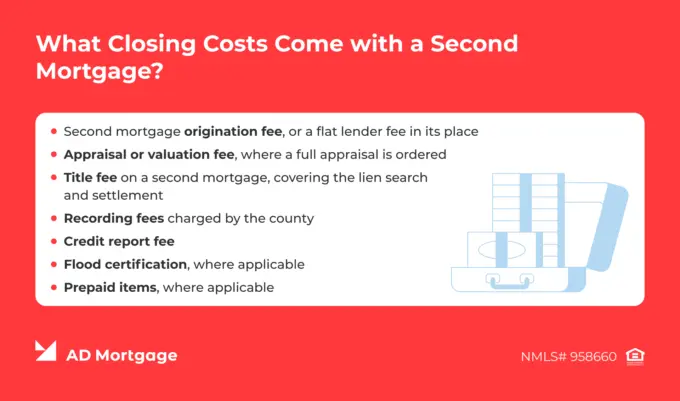
A second mortgage carries a wide range of fees – these are the same categories as a first mortgage, usually in smaller amounts:
- Second mortgage origination fee, or a flat lender fee in its place
- Appraisal or valuation fee, where a full appraisal is ordered
- Title fee on a second mortgage, covering the lien search and settlement
- Recording fees charged by the county
- Credit report fee
- Flood certification, where applicable
- Prepaid items, where applicable
Not every fee appears on every file.
Why Closing Costs Vary
Several factors move the number:
- Loan amount, since percentage-based fees scale while fixed fees do not. A smaller second lien can carry a higher effective cost percentage.
- Property location, because recording fees, transfer taxes, attorney requirements, and title pricing are set at the state and county level.
- Property and occupancy type, as condos and investment properties can add complexity.
- Credit profile and combined loan-to-value, which influence both pricing and the depth of review.
- Valuation method accounts for one of the larger swings. According to the MBA Home Equity Study, in 2024, 47% of home equity originations used an Automated Valuation Model (AVM) and 26% used a desktop valuation, leaving 24% that required a full appraisal.
Confirming the valuation method before quoting avoids building a second mortgage appraisal fee into an estimate that will not generate one. - Lender pricing accounts for the rest. Some keep home equity loan fees low and priced into the rate. Others do the reverse.
Second Mortgage Fees at a Glance
The table below sets out each common charge, what it covers, and when it tends to apply. Amounts depend on the lender, the state, and the second mortgage program being priced, so the broker notes are framing points rather than pricing guidance.
| Fee Type | What It Covers | When It May Apply | Broker Note |
|---|---|---|---|
| Origination / Lender Fee | Underwriting, processing, lender compensation | Most closed-end second mortgages | Often the most flexible line. Ask whether it can be repriced into rate. |
| Valuation Fee | AVM, desktop review, or full appraisal | Varies by CLTV, loan size, property type | Confirm the method before quoting. |
| Title Search / Settlement | Lien search and closing coordination | Nearly all files | Driven by state practice more than by lender choice. |
| Lender's Title Insurance | Protects the second lien position | Larger loans, certain states | Sometimes replaced by a lower-cost title product. |
| Recording Fee | County filing of the new lien | All files | Set by the county and not negotiable. |
| Credit Report Fee | Credit pull and scoring | All files | Typically, a minor line item. |
| Flood Certification | Confirms flood zone status | Properties in or near mapped flood zones | Small, but often unexpected by borrowers. |
| Prepaid Items | Taxes and insurance, where required | Uncommon on second liens | Confirm early, as most second liens do not re-escrow. |
Second Mortgage Closing Costs vs HELOC Costs
HELOC closing costs are frequently lower at account opening, and many lenders waive them entirely. Those costs are often shifted elsewhere rather than eliminated. Lines of credit commonly carry annual fees, per-draw fees, inactivity fees, and early termination charges.
Early closure terms matter. A lender that waives closing costs will often recover them if the account closes within two or three years.
A closed-end second mortgage also fixes the payment, while a HELOC leaves the borrower exposed to rate movement across the draw period.
For more details, read our recent article on how home equity second loans differ from HELOCs.
Second Mortgage Closing Costs vs Cash-Out Refinance Costs
A cash-out refinance replaces the first mortgage. A second mortgage leaves it in place and adds a lien behind it. Cash-out refinance closing costs are therefore calculated on the entire new loan balance rather than on the cash withdrawn, and title and escrow are priced on that full amount.
The rate reset usually matters more than the fee difference, since a borrower holding a low first mortgage rate gives it up permanently.
Total loan size is the last factor, as a refinance restarts amortization on the full balance.
| Cost Factor | Home Equity Second Mortgage | HELOC | Cash-Out Refinance |
|---|---|---|---|
| Upfront Closing Costs | Scaled to the second lien only | Often low or waived | Priced on the full new balance |
| First Mortgage | Untouched | Untouched | Replaced at current rates |
| Rate Type | Fixed | Usually variable | Fixed or adjustable |
| Ongoing Fees | Rare | Annual, draw, and inactivity fees common | Rare |
| Early Payoff | Penalty uncommon | Termination fee or cost recovery common | No typical penalty |
| Title and Escrow | Priced on the smaller amount | Often minimal | Priced on the full balance |
Rate vs APR: Why Fees Matter
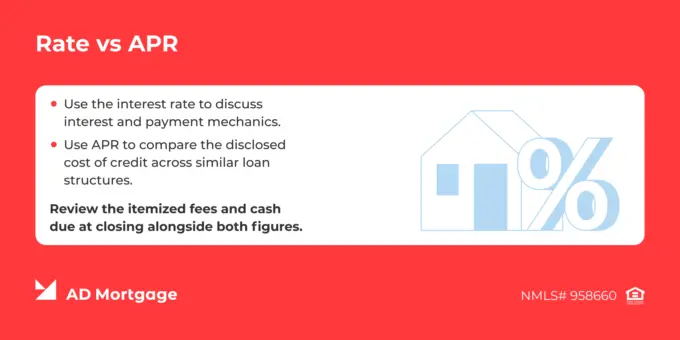
Rate reflects the cost of the money, not the full cost of the transaction. On a closed-end second mortgage, the Annual Percentage Rate (APR) measures the cost of credit as a yearly rate and includes the finance charges attached to the loan.
Open-end plans work differently. For HELOCs, certain fees and charges may be included in the APR calculation, which can make the APR higher than the stated interest rate.
- Home Equity Second Mortgage APR: includes origination fees, points, and most lender charges.
- HELOC APR: index plus margin, with loan fees and points excluded.
APR is most useful for comparing offers with similar types and terms. When comparing a HELOC with a second mortgage, however, APR alone may not capture all of the costs you should consider.
Holding period matters too, since APR spreads fees across the full term and an early payoff absorbs them over fewer years. Read our article on second mortgage rates where we explore this topic in detail.
Are ‘No Closing Cost’ Second Mortgages Free?
No. The costs are recovered rather than removed. Lenders do this in one of two ways – a higher note rate, or a clause recapturing the waived costs if the loan pays off within a set period.
Which structure costs less depends on how long the borrower keeps the loan. A short hold can favor the no-closing-cost option, while holding until term generally does not.
Divide the difference in upfront fees by the difference in monthly payment to find the breakeven, then compare it against the expected holding period.
Broker Checklist for the Cost Conversation
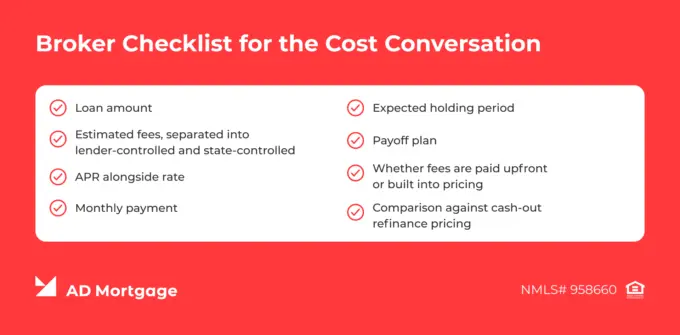
- Loan amount
- Estimated fees, separated into lender-controlled and state-controlled
- APR alongside rate
- Monthly payment
- Expected holding period
- Payoff plan
- Whether fees are paid upfront or built into pricing
- Comparison against cash-out refinance pricing
Conclusion
Second mortgage closing costs should be evaluated alongside rate, APR, monthly payment, and the borrower’s goals rather than in isolation.
Run the scenario through the Quick Pricer or submit a scenario for figures specific to the transaction.
Second Mortgage Closing Costs FAQ
Do Second Mortgages Have Closing Costs?
Yes, in most cases. When a second mortgage has no upfront costs, those costs are typically recovered through a higher interest rate, other loan terms, or an early payoff clause.
What Fees are Included in Second Mortgage Closing Costs?
Fees related to origination, valuation, title and settlement, recording, credit report, and flood certification are included where applicable.
Are Second Mortgage Closing Costs Lower than Refinance Costs?
Usually, because cash-out refinance closing costs are based on the entire new loan amount, not just the cash taken out.
Do HELOCs Have Closing Costs?
Many have little due at opening. HELOC closing costs shift into annual fees, draw fees, and early termination charges.
Can Closing Costs be Rolled into a Second Mortgage?
Often yes, subject to CLTV limits. Rolling them in preserves cash but increases the balance and total interest paid.
What Does APR Mean on a Second Mortgage?
APR expresses the yearly cost of credit including certain finance charges, not just the interest rate. On a closed-end second mortgage it reflects origination fees and points.
Are No-Closing-Cost Second Mortgages Really Free?
No. The cost moves into the rate or into an early termination clause.
How Should Brokers Explain Second Mortgage Fees?
Give a range, identify the drivers behind it, and separate lender-controlled fees from state-controlled ones. Then move to APR, payment, and breakeven.