Best Places to Buy a Home in South Carolina in 2026
The question ‘Where to live in South Carolina?’ does not have one simple answer. A Charleston buyer, a family looking around Greenville, and someone searching for a low-cost home in Allendale are dealing with very different markets.
A coastal buyer may be willing to pay more for access to beaches and waterfront communities. An Upstate buyer may care more about jobs, commuting, and access to the mountains, while someone shopping in rural South Carolina may be focused first on keeping the monthly payment manageable.
That variety is one of the defining features of the state’s housing market. According to Zillow, prices range from around $610,000 in Charleston County to less than $76,000 in Allendale County, creating opportunities for buyers with very different budgets and priorities. AD Mortgage reviewed the numbers behind these markets to identify the South Carolina locations that deserve a closer look in 2026.
AD Mortgage is a wholesale mortgage lender with over 20 years of experience providing mortgage solutions, technology, and support for broker partners. Become a Partner to work with a lender focused on helping you close.
South Carolina Real Estate Market Overview
South Carolina’s housing market can look very different depending on where a buyer searches. For this guide, we considered several factors that help illustrate both the initial cost of purchasing a home and the longer-term cost of owning one.
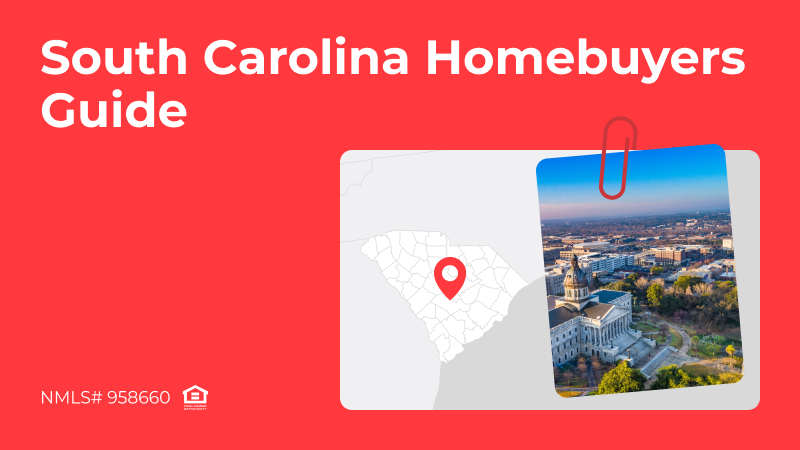
Full research is available in the downloadable South Carolina Homebuyers Guide PDF. The analysis considers:
- Median Home Prices
- Homebuying Entry Costs
- Taxes and Insurance
- Median Incomes
- Cost of Living
- Location
- Down Payment Assistance (DPA) Programs
Our research covers major employment centers, established coastal destinations, growing upstate communities, and smaller markets where lower home values can make homeownership more attainable. Charleston and Beaufort represent the higher-priced coastal end of the market, while Greenville, Spartanburg, and Rock Hill offer different combinations of employment access and affordability. Smaller counties such as Marlboro, Allendale, and Williamsburg sit at the more accessible end of the price spectrum.
The goal is not to declare one location as the best place to buy in South Carolina. Instead, the numbers provide a starting point for comparing what buyers can expect to pay, how long saving for a down payment may take, and what ongoing ownership costs can look like.

The housing and income comparisons in this guide use the data provided in the research. Down payment assistance information should be treated as subject to current funding, eligibility requirements, lender requirements, and program changes.
The sections below look more closely at the cost of getting into a home, the cost of keeping it, and the locations that stand out when those factors are considered together.
The Price of Buying and Owning a Home in South Carolina
For many buyers, the biggest challenge comes before the mortgage payment ever begins: saving enough money to purchase the home.
The table below groups South Carolina counties into three entry-cost categories. Estimated down payments are shown at both 3% and 5% of the typical home value, giving buyers a quick way to compare the amount they may need to bring toward a purchase.
Price to Enter: Cost of Buying a Home in South Carolina
Higher Entry Cost Markets
These counties illustrate how quickly the upfront cost can rise in some of South Carolina’s most sought-after areas. A 5% down payment on a typical Charleston County home is more than $30,000, while the same percentage in Jasper County is closer to $20,000.
| County | Typical Home Value | Est. DP 3% | Est. DP 5% | What This Market Feels Like |
|---|---|---|---|---|
| Charleston | $619,614 | $18,588 | $30,981 | Historic coastal market with strong demand and premium pricing |
| Beaufort | $558,125 | $16,744 | $27,906 | Scenic Lowcountry market known for waterfront living and higher-end home values |
| Jasper | $400,100 | $12,003 | $20,005 | Fast-growing market benefiting from expansion near the Savannah metro area |
Moderate Entry Markets
The middle tier creates a different starting point. Buyers can still find markets where a 3% down payment falls below $10,000, while gaining access to communities with coastal, lake, or upstate appeal.
| County | Typical Home Value | Est. DP 3% | Est. DP 5% | What This Market Feels Like |
|---|---|---|---|---|
| McCormick | $325,203 | $9,756 | $16,260 | Small-town market offering affordable lake-area living and a relaxed pace |
| Horry | $320,250 | $9,608 | $16,013 | Coastal market combining year-round demand with a range of homeownership options |
| Pickens | $310,116 | $9,303 | $15,506 | Growing Upstate market with mountain access and strong commuter appeal |
More Accessible Entry Markets
At this end of the market, the difference is substantial. A 5% estimated down payment on a typical Allendale County home is less than $4,000, compared with nearly $31,000 in Charleston County.
| County | Typical Home Value | Est. DP 3% | Est. DP 5% | What This Market Feels Like |
|---|---|---|---|---|
| Bamberg | $124,675 | $3,740 | $6,234 | Rural market offering affordable homeownership in a close-knit community |
| Williamsburg | $123,559 | $3,707 | $6,178 | Budget-friendly market with lower home prices and small-town character |
| Marlboro | $94,562 | $2,837 | $4,728 | Value-oriented market providing affordable opportunities for first-time buyers |
| Allendale | $74,333 | $2,230 | $3,717 | One of the state's most affordable markets for entry-level homeownership |
Cost to Hold: Ongoing Ownership Costs by County
The purchase price is only the first part of the affordability equation. Once a buyer owns the home, property taxes and homeowners insurance become part of the recurring expense. Those costs can vary considerably across South Carolina, which means a lower purchase price does not necessarily tell the whole affordability story.
We have analyzed monthly costs, including property taxes and insurance, and the percentage of home value they represent, then divided counties into three affordability tiers. You can find the comparison tables in the Guide.
Lancaster, York, and McCormick fall into the lowest ongoing-cost group in the research. Their estimated annual ownership costs range from about $3,040 to $3,452, resulting in less than 1% of the cost per value.
Need help finding the right mortgage solution for your client? AD Mortgage offers a full range of loan programs, with experts available to help match borrower scenarios with appropriate financing options.
Location Still Matters
A home is more than a number on a listing page. Where buyers live affects their commute, access to services, daily routines, and the type of community they experience.
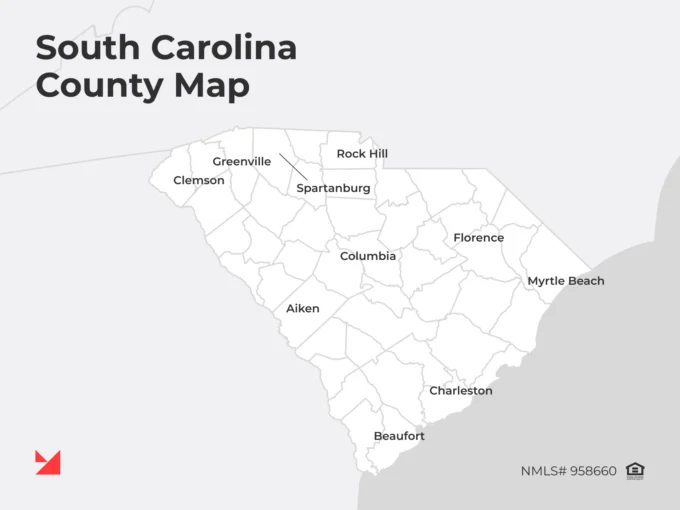
South Carolina gives buyers plenty of different settings to choose from. Coastal markets such as Charleston, Beaufort, and Myrtle Beach offer a very different lifestyle from Upstate communities such as Greenville and Clemson or smaller inland markets such as Florence and Aiken.
Location also affects affordability in ways that are not always visible in the purchase price. A buyer may accept a higher home value in exchange for stronger employment access, while another buyer may prefer a smaller market where the initial cost is lower.
For that reason, the city comparison below considers home values, household incomes, and estimated savings timelines alongside the broader characteristics of each market.
Initial Results
The county-level figures above show how broad South Carolina’s housing market can be.
Lower-priced homes are often found in rural and inland areas, while coastal markets and larger metro areas typically cost more. Keep in mind that insurance, taxes, and other ongoing expenses can make a lower-priced home more costly to own over time.
Down payment assistance adds another dimension to affordability. South Carolina offers statewide, regional, and local programs, though eligibility and availability depend on the buyer, property, loan type, location, funding, and current program requirements.
With these factors in mind, we identified places that offer a strong balance of home prices, ongoing ownership costs, employment access, and available assistance.
Columbia
Columbia is South Carolina’s practical center: a capital city with the energy of a university town, the stability of a government hub, and enough surrounding neighborhoods to suit buyers looking for either downtown convenience or a quieter suburban routine.
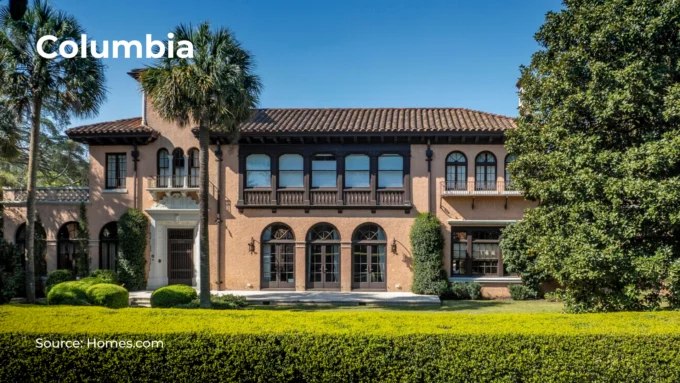
The University of South Carolina gives the city much of its character, particularly around downtown and the Five Points district, while state government, healthcare, Fort Jackson, and regional employers provide a broad economic foundation. Buyers can spend a Saturday around the Vista’s restaurants and galleries, follow the Congaree River through the city, or head toward Lake Murray for a change of pace.
Columbia may not carry the coastal appeal of Charleston or the mountain-adjacent draw of the Upstate, but that is part of its advantage. It is a city for buyers who want access to jobs, culture, schools, and everyday amenities without making tourism or resort living the center of the decision.
Charleston
Charleston sells a version of South Carolina that few other cities can match: pastel row houses, church steeples, waterfront views, centuries of history, and a dining scene that has become a draw in its own right. The peninsula is the obvious centerpiece, but the broader market stretches across established neighborhoods, barrier-island communities, and fast-growing suburban areas.
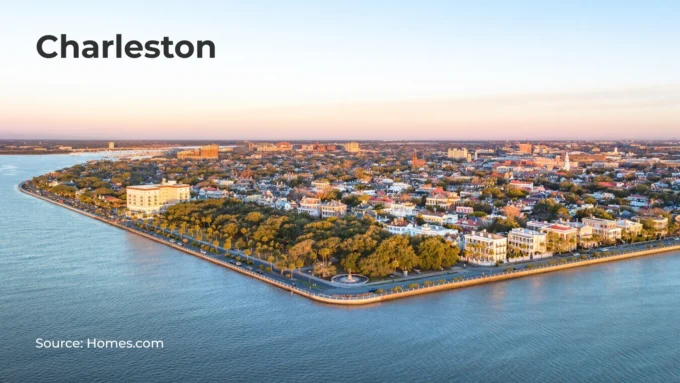
Charleston fits buyers who want history and water to shape daily life and who are comfortable navigating a market where location can matter as much as the home itself. Eligible buyers may also want to investigate statewide assistance programs such as Palmetto Home Advantage, Palmetto Heroes, and SC Housing Homebuyer, subject to current program requirements.
Greenville
Greenville has spent years turning its downtown into the kind of place residents actually use: Main Street restaurants, Falls Park on the Reedy, trails, events, and a compact core that can feel more walkable than much of the surrounding Upstate. It is a city that gives buyers both an active downtown and easy access to the Blue Ridge foothills.
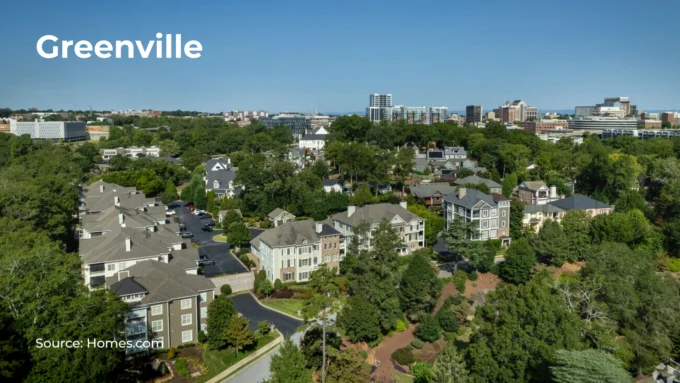
That balance helps explain Greenville’s broad appeal. It works for professionals drawn by a growing business environment, families looking for suburban choices beyond downtown, and buyers who want outdoor recreation close at hand without giving up city amenities. Greenville feels polished and energetic, but still small enough that the center of town remains part of everyday life.
Eligible buyers purchasing within Greenville County may also investigate the Greenville County Homebuyer Assistance Program, which offers up to $20,000 for qualifying low- to moderate-income first-time homebuyers.
Spartanburg
Spartanburg is less interested in playing the role of a picture-perfect resort town and more focused on being a working, growing Upstate city. Its identity is tied to manufacturing, international investment, healthcare, education, and a long-running push to build on its industrial base rather than move away from it.
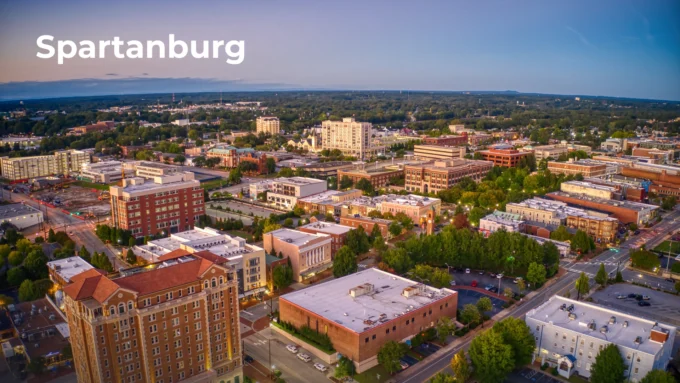
Spartanburg offers a more practical, grounded setting with a growing downtown, a strong connection to the regional economy, and room for people who value access to employment and community over a highly curated urban experience. It is a city with momentum, but one that still wears its blue-collar roots openly.
For qualifying buyers, the City of Spartanburg Homebuyer Assistance Program offers up to $20,000 in assistance. Eligibility and current funding requirements apply.
Rock Hill
Rock Hill sits in South Carolina but operates partly in Charlotte’s orbit. For many residents, the city offers a way to stay connected to one of the Southeast’s largest job markets while living in a place with its own downtown, parks, greenways, schools, and a more distinctly small-city rhythm.
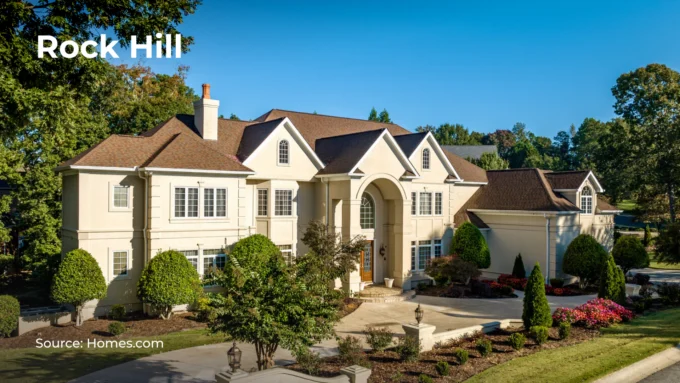
The result is a market that often appeals to commuters, growing families, and buyers watching Charlotte’s expansion move south across the state line. Rock Hill is not merely a bedroom community, though: its local economy, education options, and outdoor amenities give it an independent base. The key question for buyers is whether they want Charlotte nearby rather than at their doorstep.
The city also has its own homebuyer assistance option. Eligible buyers may receive up to $5,000 through the City of Rock Hill Homebuyer Assistance Program, structured as a second mortgage that is forgiven over a 5- to 20-year period, subject to program requirements.
Myrtle Beach
Myrtle Beach is built around the shore: long stretches of sand, golf courses, resort towers, entertainment venues, and an economy that moves with visitors as much as with permanent residents. For buyers, the appeal is straightforward – beach access can be part of an ordinary week, not something reserved for vacation.
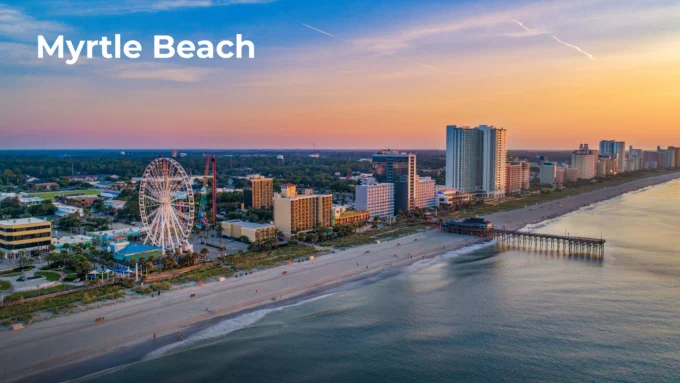
The city is not a single lifestyle, however. Beyond the oceanfront tourist corridor are year-round residential areas, retail centers, healthcare services, and communities shaped by retirees, remote workers, hospitality employees, and small-business owners. Myrtle Beach best suits buyers who welcome an active, seasonal environment and see coastal recreation as a central part of where they live.
The market combines year-round demand with a coastal lifestyle and a broad range of housing options. For buyers drawn to the area, the higher savings timeline is an important part of the affordability calculation.
Florence
Florence is the Pee Dee region’s dependable hub: less flashy than South Carolina’s coast or Upstate cities, but important because it concentrates healthcare, retail, education, and services for a wide area of northeastern South Carolina. It is a place built for daily convenience rather than destination appeal.
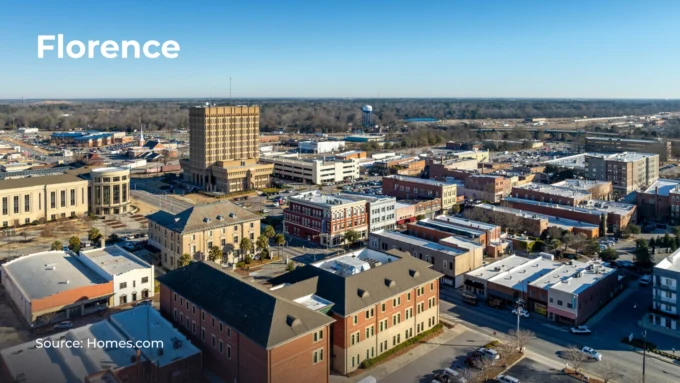
Its location also matters. Florence gives residents access to major highways and sits within reach of the coast, while maintaining a more traditional inland-city pace. Buyers who prioritize regional employment, established neighborhoods, and a practical home base may find Florence more compelling than the state’s better-known lifestyle markets.
The result makes Florence worth considering for buyers whose priority is getting from saving to homeownership without taking on the higher entry costs found in Charleston or Beaufort.
Aiken
Aiken moves at its own pace. Horse country, tree-lined streets, historic homes, and an old-fashioned downtown give the city a character that feels more settled than fast-growing. Equestrian culture is woven into local life, from training facilities and polo traditions to the broader sense that outdoor space and preservation matter here.
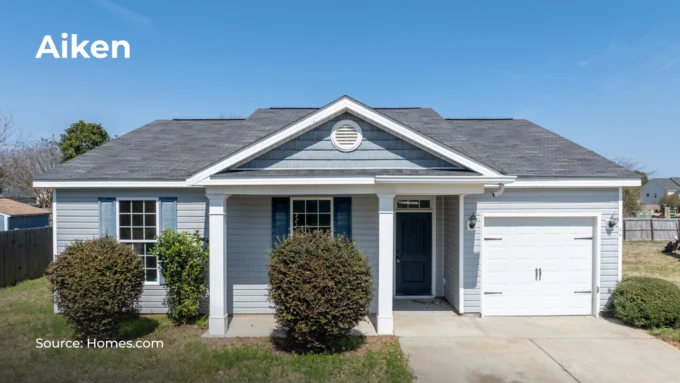
The city also benefits from its connection to the Augusta-area economy and the Savannah River Site, but its strongest selling point is atmosphere. Aiken is for buyers who prefer front porches, local shops, gardens, and a quieter social rhythm to big-city density. It offers South Carolina charm without needing the coast to make its case.
Aiken may therefore appeal to buyers looking for a smaller-market setting without moving all the way toward the state’s lowest-cost rural counties.
Clemson
Clemson is a college town in the fullest sense: the university shapes the calendar, the local economy, the social scene, and the city’s identity. Football weekends bring the energy, but the everyday appeal lies in the mix of campus life, nearby lakes, foothill scenery, and a community that is accustomed to people arriving from elsewhere.

Buyers should expect a market influenced by the academic cycle and by demand from faculty, staff, alumni, students’ families, and investors. Clemson is best suited to people who want a smaller setting with built-in activity, access to outdoor recreation, and the particular sense of belonging that comes with living near a major university.
The numbers do not make Clemson an automatic choice for every buyer, but they highlight the importance of understanding the relationship between local incomes and home prices before entering a higher-cost market.
Beaufort
Beaufort is Lowcountry at a quieter volume. Its historic waterfront, moss-draped live oaks, marsh views, and preserved downtown create a setting that feels more reflective than Charleston and less resort-driven than Myrtle Beach. More than 50 architecturally significant structures contribute to a downtown designated as a National Historic Landmark.
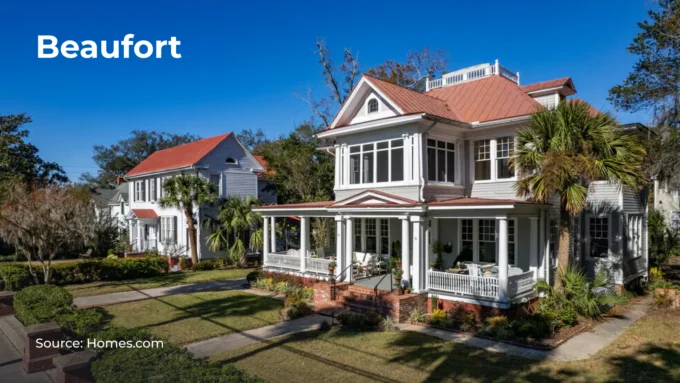
The city attracts buyers who want the coast without the pace of a major tourism market. Water, boating, beaches, golf, and outdoor life are central, but so are historic preservation and a close-knit community feel. Beaufort is a strong fit for retirees, military-connected households, and buyers who see scenery and slower rhythms as part of the value of homeownership.
Beaufort combines coastal appeal with one of the longer savings timelines in the research. Buyers attracted to the Lowcountry should therefore account carefully for both the initial purchase price and the time needed to build the required savings.
Finding Your Place in South Carolina
The South Carolina housing market is like a patchwork blanket, combining diverse higher-cost coastal destinations such as Charleston and Beaufort with growing Upstate cities and more affordable inland communities.
There is no single best place to buy. Lower home prices do not always mean lower long-term costs, so buyers should consider taxes, insurance, income, savings needs, and lifestyle alongside the purchase price. The right market depends on what matters most to each buyer – whether that is job access, coastal living, a shorter path to homeownership, or a lower monthly payment.
For detailed market data, affordability comparisons, down payment assistance programs, and city-by-city figures, download the South Carolina Homebuyers Guide.