

The short answer is – yes, you can refinance second mortgage. Generally, these loans function is the same way as first mortgages, differing only in the order of priority for repayment in case of foreclosure. In this article, we address common questions about second mortgage refinancing, helping you better serve your clients.
Key Takeaways
- Borrowers can refinance a second mortgage to achieve better conditions, consolidate debts, or access equity. While refinancing a second mortgage does not change lien priority, refinancing the first mortgage while keeping the second mortgage in place will require a subordination agreement.
- Brokers should keep in mind common problems that delay approval – including subordination review timelines, title issues, and high CLTV or HCLTV.
- AD Mortgage offers closed-end Second Mortgage loans with loan amounts up to $500,000, as well as various refinancing options. Submit a scenario, and our experts will match your client’s case with the best-fit mortgage solution.
Can You Refinance If You Have a Second Mortgage?
Refinancing a second mortgage is possible – the same way you can refinance a first mortgage. However, this decision should be justified by financial benefits, such as lower interest rates, a more predictable payment structure, lower monthly payments, or access to additional home equity.
Lien priority is an important consideration when it comes to second mortgages. In most cases, refinancing only a second mortgage does not change the priority order and, therefore, the process is generally not more complicated than a standard loan closing.
Why a Second Mortgage Matters in a Refinance
Second mortgage refinancing has several features that brokers and their clients should keep in mind:
- Lien priority determines the order in which loans are repaid in the event of foreclosure. This priority directly influences the lender’s financial risks and, therefore, the loan terms. Second mortgages are subordinated to first mortgages, and refinancing a second mortgage typically does not change this order.
- Title review is a crucial part of the process, as it identifies all existing liens that can affect the deal.
- The key first mortgage lender requirement when refinancing a second mortgage is that its lien remains in first position. Because lien priority typically does not change during this type of refinancing, the first lender is usually not directly involved in the transaction.
Overall, refinancing a second mortgage does not influence the lien priority – it simply replaces an existing second mortgage with a new one on different terms.
Three Second Mortgage Refinancing Strategies: Which Option is Right for Your Client?
Your clients with a second mortgage might wonder whether they should refinance the first mortgage, the second mortgage, or both. Below, we compare three common refinancing options, helping you match the right solution to each client’s situation.
AD Mortgage serves brokers with complex or out-of-the-box borrower scenarios. If you don’t know what mortgage solution will work best for your client, submit a Scenario Request and our experts will contact you within 30 minutes with a tailored solution.
Option 1: Keep the Second Mortgage and Resubordinate It
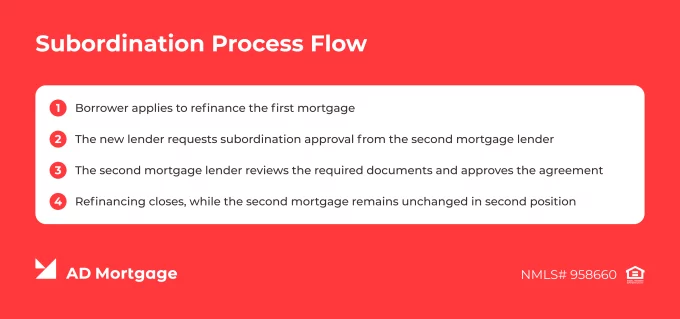
The borrower might want to keep the second lien and refinance the first mortgage. This is possible but requires a subordination agreement in the majority of cases.
A subordination agreement is a legal document that confirms the refinanced first mortgage will remain in first lien position, while the existing second mortgage stays in second position. Without a subordination agreement, the second mortgage could move into first position, which most new first mortgage lenders will not accept.
The second mortgage lender approves the subordination request, which extends the refinancing timelines. Usually, the required documents include:
- Subordination request form
- Title report or title commitment
- Copy of the new first mortgage information
- Appraisal if required
Option 2: Pay Off the Second Mortgage During the Refinance
Some borrowers may choose to pay off the second mortgage when refinancing the first mortgage, consolidating their debt into a single loan.
The second mortgage lender provides a payoff statement showing the exact amount needed to satisfy the loan, including interest and any applicable fees. Once the loan is paid in full, the lender issues a lien release, which is recorded to remove the lien from the property’s title.
Depending on whether the second mortgage is a purchase-money loan or a non-purchase-money loan – such as a HELOC – paying it off may affect whether the refinance qualifies as a rate-and-term or cash-out transaction. For this reason, mortgage brokers should correctly classify the refinance, as it can impact loan eligibility, documentation requirements, and lender guidelines.
Option 3: Refinance the Second Mortgage Only
If the borrower is satisfied with the terms of the first mortgage but wants to lower monthly payments or gain payment stability, refinancing a second mortgage is the working approach.
This option is especially relevant for borrowers with a HELOC. As HELOC borrowing continues to grow, more homeowners may find themselves evaluating whether their existing loan structure still meets their financial goals. According to the Federal Reserve Bank of New York, outstanding HELOC balances reached $446 billion in Q1 2026, reflecting the sixteenth consecutive quarterly increase.
Because the first mortgage remains untouched, this approach is often simpler than refinancing both loans and typically does not require a subordination agreement.
| Option | Best For | Key Consideration |
|---|---|---|
| Keep the Second Mortgage and Resubordinate It | Borrowers who want to refinance the first mortgage while keeping the existing second mortgage | Requires a subordination agreement from the second mortgage lender, which may delay closing |
| Pay Off the Second Mortgage During the Refinance | Borrowers who want to consolidate debt into a single mortgage | Requires payoff documentation and lien release. May affect refinance classification and loan requirements |
| Refinance the Second Mortgage Only | Borrowers who want to keep a favorable first mortgage while improving the terms of the second mortgage | Can replace variable-rate debt with a fixed-rate loan and typically does not require subordination |
CLTV and HCLTV: The Numbers Brokers Need to Check
When exploring refinancing options, it is important to evaluate all current liens – including the first mortgage balance, second mortgage balance, and the HELOC credit line – together with the property’s current appraised value.
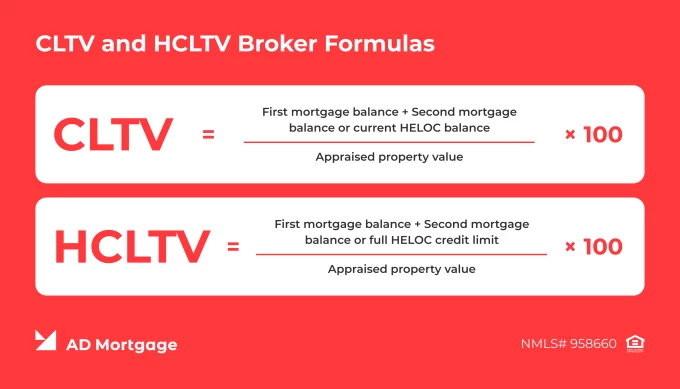
These parameters are used to calculate CLTV and HCLTV, two key metrics lenders use to determine a borrower’s eligibility.
CLTV (Combined Loan-to-Value) measures the total outstanding balances of all mortgage liens compared with the home’s appraised value. If the borrower has a HELOC, only the amount currently borrowed is included in the calculation.
HCLTV (Home Equity Combined Loan-to-Value) uses the same calculation, but if there is a HELOC, it replaces the current balance with the entire approved credit limit. This means the unused portion of the credit line is also included, even if the borrower has not drawn those funds.
Because a borrower can still access the unused portion of a HELOC, lenders often include the full credit line when calculating HCLTV. As a result, HCLTV is often higher than CLTV and may result in stricter lending limits. See the Fannie Mae Eligibility Matrix for applicable CLTV and HCLTV limits.
Common Issues That Can Block or Delay the Refinance
Some issues may interrupt the refinancing process, causing delays and affecting approval. Here are key problems that brokers should watch out for:
- Subordination Delays. Reviewing the subordination request takes time, extending the overall refinancing timeline. Brokers should keep that in mind and ensure they provide complete and up-to-date documentation to avoid back-and-forth communication with the lender.
- High CLTV or HCLTV. If the borrower has insufficient home equity, the combined loan-to-value ratio may exceed the lender limit, potentially delaying or preventing the refinance.
- Title Issues. Unexpected liens, judgments, or ownership discrepancies might be discovered during the title search. Generally, these must be resolved before closing.
- Borrower Qualification Changes. Changes in income, employment, credit score, or debt-to-income ratio can affect loan approval, even if the borrower qualified previously.
Broker Checklist Before Starting the Refinance
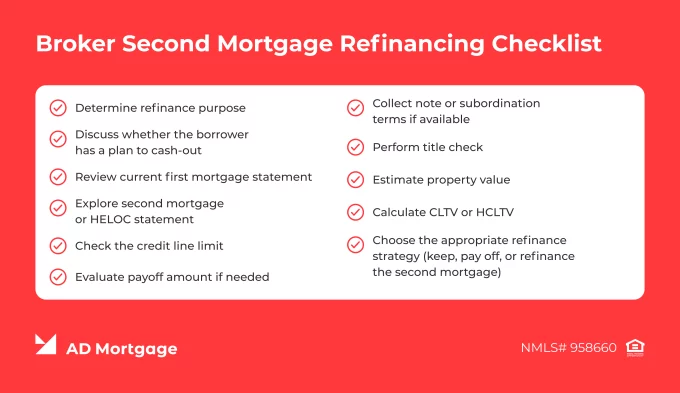
How can brokers approach the refinancing of a second loan process? We have prepared a checklist that will help mortgage originators keep track of every step:
- Determine refinance purpose
- Discuss whether the borrower has a plan to cash-out
- Review current first mortgage statement
- Explore second mortgage or HELOC statement
- Check the credit line limit
- Evaluate payoff amount if needed
- Collect note or subordination terms if available
- Perform title check
- Estimate property value
- Calculate CLTV or HCLTV
- Choose the appropriate refinance strategy (keep, pay off, or refinance the second mortgage)
Example Scenarios
We describe three situations to illustrate how brokers can match their clients to the mortgage solution. Note that these examples are for educational purposes only.
AD Mortgage helps brokers win more business through award-winning technology and lending solutions. If you need any help choosing the right program for your client’s case, submit a scenario request and receive a tailored solution within 30 minutes.
Example 1. Second Mortgage Paid Off During Refinance
Borrower Situation: A borrower has both a first and second mortgage and wants to simplify their debt.
Solution: Paying off the second mortgage during refinancing will combine both obligations into a single loan. As the second mortgage is repaid in full, a subordination agreement will not be required. However, the second mortgage lender will need to provide a payoff statement, and a lien release will be recorded after the payoff is completed.
Example 2. HELOC Left Open and Resubordinated
Borrower Situation: A borrower wants to complete a cash-out refinance but also has a HELOC with favorable terms they do not want to pay off.
Solution: Refinancing the first mortgage allows the borrower to obtain new loan terms while keeping the existing HELOC unchanged. To complete the refinance, the HELOC lender must approve a subordination agreement confirming that the HELOC will remain in second lien position.
Example 3. Replacing a HELOC with a Fixed Second Mortgage
Borrower Situation: A borrower wants predictability in payments and no longer needs a revolving credit line – they look for an option to replace their HELOC with a more predictable mortgage product.
Solution: Refinancing the HELOC into a fixed-rate second mortgage will help the borrower to achieve predictable monthly payments and avoid the risk of future interest rate increases. The first mortgage will stay in place with the terms unchanged.
Conclusion
Refinancing a second mortgage is possible – but might require additional documentation, such as payoff or subordination agreements, in some cases. However, different borrower situations require different approaches.
AD Mortgage helps brokers offer more financing options to borrowers and choose the right mortgage solution for each case. Become a Partner to work with a trusted lender and serve your clients with a wide range of mortgage products.
FAQ: Second Mortgage Refinance
Can You Refinance a First Mortgage if You Have a Second Mortgage?
Yes, you can refinance a first mortgage if you have a second mortgage. In most cases, this requires the second mortgage lender to approve a subordination agreement, confirming that the second lien remains in a subordinate position.
What is Resubordination?
Subordination (or resubordination) is the process by which a second mortgage lender confirms that its lien will remain in second position after the borrower refinances the first mortgage. If approved, the lender signs a subordination agreement (also called a resubordination agreement).
Does a HELOC Affect Refinancing?
Yes. An existing HELOC generally makes refinancing a first mortgage more complicated. The borrower might be required to pay off the HELOC or obtain a subordination agreement from the HELOC lender, which may extend the refinancing timeline. Additionally, having a HELOC affects the CLTV and HCLTV, which may make qualifying for the refinance more challenging.
Do You Have to Pay Off a Second Mortgage to Refinance?
It depends. Some lenders require borrowers to pay off a second mortgage during a first mortgage refinance.
Can You Refinance Only the Second Mortgage?
Yes. This is usually a simpler process because the first mortgage remains unchanged, and lien priority stays the same.
Does a Second Mortgage Count in CLTV?
Yes. CLTV measures the total amount borrowed relative to property value.
Does the Full HELOC Line Count in HCLTV?
Yes. HCLTV includes a full HELOC credit limit – unlike CLTV, which calculates only the drawn amount.
Can Paying Off a Second Mortgage Make the Refinance Cash-Out?
Paying off a second mortgage may be considered a rate-and-term or cash-out refinance, depending on how the second lien originated and how its proceeds were used. Purchase-money second mortgages may qualify for rate-and-term treatment, while non-purchase-money liens such as HELOCs or home equity loans may require cash-out classification depending on lender guidelines.
How Long Does Subordination Take?
The subordination timeline varies by lender, but the process generally takes anywhere from a week to several months. Providing a complete documentation package upfront and responding promptly to lender requests can help brokers keep the process moving smoothly.
What Documents are Needed to Refinance with a Second Mortgage?
Depending on the lender requirements, the required documents vary but typically include mortgage statements, income and asset documentation, a title report, and a property appraisal. For refinancing a first mortgage while keeping the second one, a subordination request and related documents may also be needed.