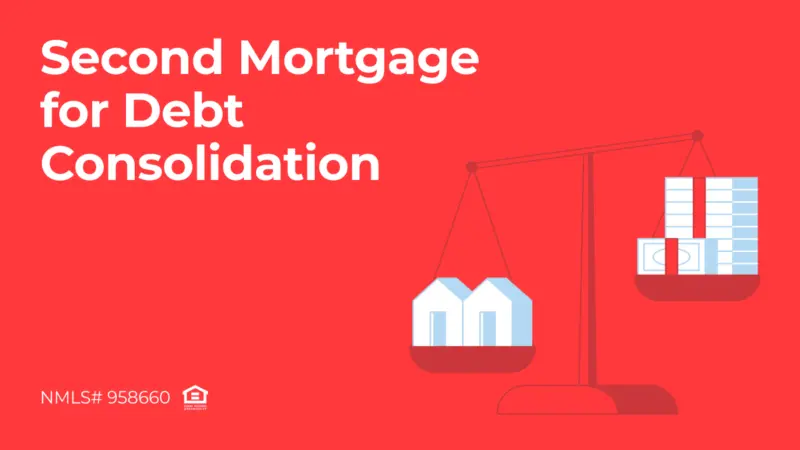
According to the MBA Home Equity Lending Study, 39% of second mortgages are used for debt consolidation. To help brokers better understand how to structure loans for this common purpose, we have prepared this guide. Further, we explain when a second mortgage debt consolidation may make more sense and when other solutions might be preferable.
Key Takeaways
- Second mortgages can be used for debt consolidation and help replace higher-interest personal debts with more affordable loan payments.
- A home serves as collateral for a second mortgage, and therefore there is a risk of foreclosure. Additionally, potentially longer repayment periods can increase the overall cost of borrowing.
- In some cases, other options, such as cash-out refinancing or a personal loan, might be more beneficial. The broker must carefully evaluate the borrower’s situation to match them with the right solution.
- AD Mortgage offers closed-end Second Mortgage loans with loan amounts up to $500,000, CLTVs up to 90%, and DTIs up to 50% that may be used for debt consolidation.
Can You Use a Second Mortgage for Debt Consolidation?
The short answer is – yes, a second mortgage can be used for debt consolidation. An eligible borrower can take out a second mortgage, using the home as collateral. The funds may be used to pay off other obligations – such as credit cards or personal loans – by consolidating existing debts into one mortgage.
However, taking out a second mortgage still requires repayment discipline. Failing to make payments on time can put the borrower at risk of foreclosure.

When Debt Consolidation with a Second Mortgage May Make Sense
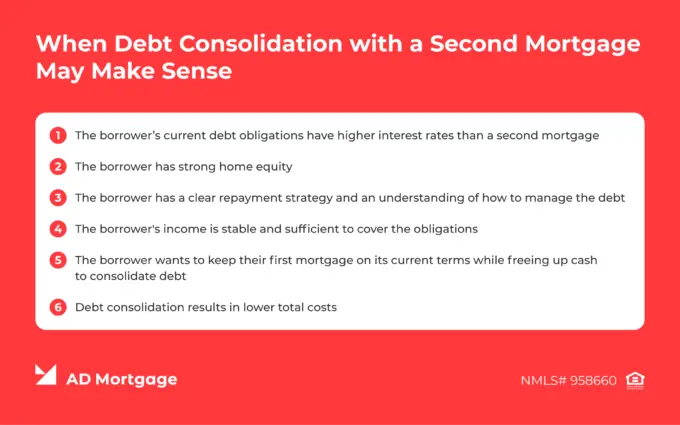
Debt consolidation with a second mortgage can be beneficial, but this solution must be aligned with the borrower’s goals and current financial situation. Here are cases where a second mortgage for debt consolidation might be the right solution:
- High-Interest Debt. If the borrower’s current debt obligations have higher interest rates than a second mortgage, consolidating them can result in lower costs over time.
- Strong Home Equity. To qualify for a second mortgage on better terms, the borrower must have sufficient home equity. In our article on second mortgage borrowing limits, we explain how to calculate the maximum loan amount step by step.
- Payoff Plan. A second mortgage is an option for those who are committed to paying off balances, not accumulating more debts. The higher risks of foreclosure require a clear repayment strategy and an understanding of how the borrower will manage the debt.
- Stable Income. A key factor in making on-time payments is having a consistent income that is sufficient to cover the borrower’s obligations.
- Keeping a Low-Rate First Mortgage. If the first loan has favorable terms, it might not be worth refinancing it to access equity. A second mortgage allows borrowers to keep their first mortgage on its current terms while freeing up cash to consolidate debt.
- Lower Total Costs. When comparing different scenarios, the broker should consider both monthly payments and the overall cost of borrowing. Focusing only on reducing monthly payments may result in choosing an option that costs more in the long run.
AD Mortgage serves mortgage loan officers from coast to coast, helping brokers offer their clients right-fit solutions. Become a Partner today to focus on your customers while we take care of the hassle for you.
Key Risks Brokers Must Explain
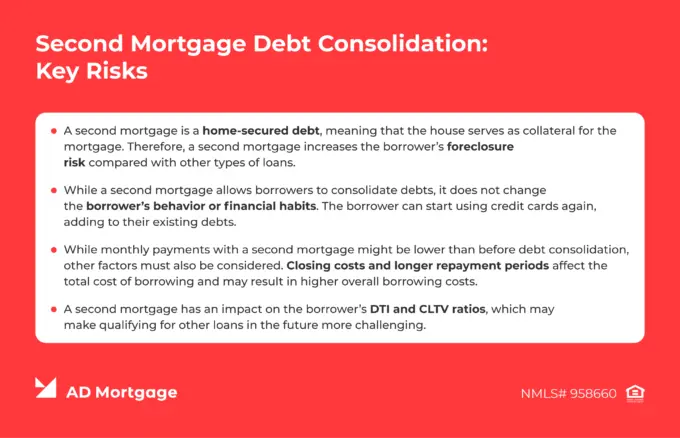
Second mortgages come with trade-offs that are important to keep in mind when choosing a mortgage solution:
- A second mortgage is a home-secured debt, meaning that the house serves as collateral for the mortgage. Therefore, a second mortgage increases the borrower’s foreclosure risk compared with other types of loans.
- While a second mortgage allows borrowers to consolidate debts, it does not change the borrower’s behavior or financial habits. The borrower can start using credit cards or high-interest loans again, adding to their existing debts.
- While monthly payments with a second mortgage might be lower than before debt consolidation, other factors must also be considered. Closing costs and longer repayment periods affect the total cost of borrowing and may result in higher overall borrowing costs.
- A second mortgage has an impact on the borrower’s DTI and CLTV ratios, which may make qualifying for other loans in the future more challenging.
Second Mortgage vs Cash-Out Refinance for Debt Consolidation
Borrowers seeking debt consolidation often compare two close options – a second mortgage and a cash-out refinancing. While a second mortgage is a separate loan that does not affect the terms of the first mortgage, a cash-out refinance replaces the first mortgage with a new loan under new terms. Therefore, the choice between the two options largely depends on whether the borrower wants to keep the first mortgage on its current terms.
Comparison Second Mortgage Cash-Out Refinance First Mortgage Terms do not change Replaced with a new mortgage Interest Rate New rate applies only to the second mortgage New rate applies to the entire mortgage balance Payment Structure Two separate monthly mortgage payments One monthly mortgage payment Closing Costs Typically lower Typically higher Best Borrower Fit Borrowers who want to keep a low-rate first mortgage Borrowers who may benefit from refinancing the entire mortgage Risk Home secures a second loan – foreclosure risk if payments are missed Home secures a new, larger mortgage – foreclosure risk if payments are missed
Read our article Second Mortgage vs HELOC vs Cash-Out Refinance for a detailed comparison of the options.
Second Mortgage vs HELOC vs Personal Loan
If the borrower wants to consolidate debt without refinancing their first mortgage, a home equity second mortgage is not the only option. They can also use a HELOC – a revolving line of credit – or a personal loan, which is not secured by the borrower’s home. In the table below, we compare the three solutions.
Comparison Home Equity Second Mortgage HELOC Personal Loan Collateral Home Home Unsecured Interest Rate Typically fixed Typically variable Typically fixed Payment Stability Stable, predictable monthly payments Payments may vary based on the interest rate and outstanding balance Stable, predictable monthly payments Access to Funds One lump sum Line of credit, allowing to draw funds as needed One lump sum Borrower Discipline Requires a defined payoff plan Requires discipline to avoid repeated borrowing Requires a defined payoff plan Best Use Case Large, one-time debt consolidation Ongoing or flexible borrowing needs Smaller debt consolidation without using home equity
AD Mortgage helps brokers offer more financing options to borrowers and match their clients with the right mortgage product. Submit a Scenario Request, and our experts will respond with a tailored solution in 30 minutes.
Which Requirements Matter Most?
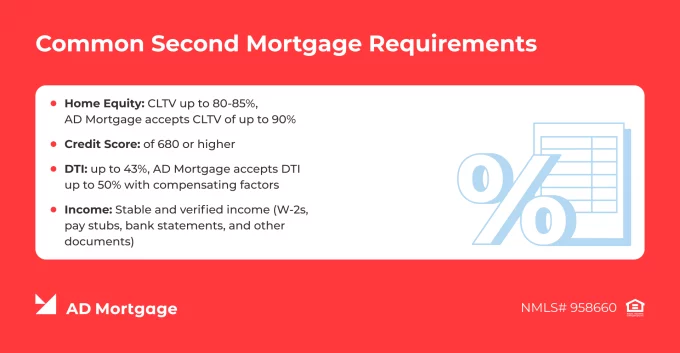
Borrower eligibility for a second mortgage depends on various factors, including the borrower’s financial profile and the secured property. A broker should evaluate the borrower’s situation as a whole to realistically assess their ability to maintain the mortgage. The most common lender requirements include:
- Sufficient home equity is required to qualify for a second mortgage because the lien is secured by the property. Lenders use CLTV or HCLTV ratios to evaluate the amount of debt the borrower can access, considering all existing liens and the property value.
- Credit profile, including a credit score and payment history, reflects the borrower’s creditworthiness and the ability to maintain the mortgage. A strong mortgage history increases the chances of qualifying for a loan on good terms.
- Stable and sufficient income must be verified with income documentation. Borrowers with non-standard income – such as self-employed individuals, gig workers, or real estate investors – might be required to provide additional documentation. Lenders evaluate the DTI ratio after debt consolidation to ensure that borrowers’ income is enough to cover their monthly obligations.
- Property type plays an important role in whether the borrower qualifies and the terms they may receive. Lenders review the property’s condition, its occupancy type, unit count, and other factors to check whether the property can serve as collateral.
Payment Comparison Example
If your client is considering consolidating debt through a second mortgage, you need to educate them on why the total cost of borrowing must be considered and why simply comparing monthly payments is insufficient.
To illustrate this concept, here is an example scenario. It is important to note that it is provided for educational purposes only and is not financial advice.
Borrower Situation: A homeowner has $35,000 in personal loan debt at an interest rate of 15%, with 7 years of repayment remaining. They consider taking out a second mortgage to consolidate the debt into a 7-year loan at 9% interest.
Option Comparison: If the borrower keeps the personal loan, their monthly payment will be around $700, resulting in a total repayment of around $58,800 over the next 7 years. The total interest paid will be approximately $23,800.
If the borrower takes out a second mortgage and consolidates the debt, their monthly payment will be around $560 for the next 7 years. This results in total payments of approximately $47,300 and total interest of around $12,300.
Solution: A second mortgage would be a more favorable choice in this situation, especially because the repayment timeline remains unchanged. However, closing costs will increase the total amount paid, and they should also be considered when structuring the loan.
AD Mortgage offers a full range of loan programs, helping you match your clients with the right mortgage solution.
Broker Talking Points
- ‘Second mortgages can be used for debt consolidation. Let’s take a closer look at your obligations to choose the best solution.’
- ‘Sometimes a cash-out refinance or a HELOC might be a better option than a home equity loan. We will explore these options and consider both monthly payments and total costs before making a decision.’
- ‘Keep in mind that a second mortgage comes with a higher risk of foreclosure because your home serves as collateral.’
When a Second Mortgage May Not be the Right Fit
For some borrowers, a second mortgage for debt consolidation might not be the right choice:
- Unstable income can make it difficult to manage monthly payments, and the higher risk of foreclosure can add significant stress.
- Borrowers with limited equity may qualify for a second mortgage on less favorable terms.
- Unclear repayment behavior and the lack of a repayment strategy can result in new debt accumulation, making debt consolidation less effective.
- If the borrower is facing a short-term cash-flow issue, such as a job change or medical leave, a long-term second mortgage might be a less suitable solution than other short-term financing options.
- Due to closing costs, a second mortgage might not make sense for borrowers who plan to sell or refinance their home soon.
Conclusion
Using a second mortgage for debt consolidation can be a practical solution – especially in the current market, where cash-out refinancing has become less common because of higher interest rates.
AD Mortgage has 20 years of experience in the mortgage industry and offers a wide range of mortgage programs to help our partners serve their clients better.
Yes. Second mortgages can be used for debt consolidation. Unlike cash-out refinancing, second mortgages do not change the terms of the first mortgage, allowing borrowers to pay off existing debts while keeping the first mortgage rate and terms. It might be. A second mortgage may help reduce the cost of high-interest credit card debt, but the broker should compare the total costs of both options before recommending a solution. Home equity loans are not inherently risky, but because the home serves as collateral, missed payments increase the risk of foreclosure. Borrowers should have a clear second mortgage repayment plan to reduce that risk. Depending on the borrower’s financial profile and current situation, a second mortgage or cash-out refinance may be the better option. A home equity loan is typically preferred when a borrower wants to access equity without changing the terms of the first mortgage. A cash-out refinance, on the other hand, replaces the first mortgage with a larger loan and provides the borrower with the difference in cash. Not necessarily. A home equity loan for debt consolidation offers a lump sum at closing, allowing the borrower to pay off existing debts at once. A HELOC provides a revolving line of credit, so the borrower can withdraw funds as needed, making it generally less suitable for one-time debt consolidation. If a second mortgage reduces monthly payments – for example, by extending the repayment term – the borrower’s DTI ratio may decrease. However, the broker should calculate the borrower’s DTI after consolidation to determine the actual impact. Debt consolidation can improve a borrower’s credit score over time if they make timely payments, reduce outstanding revolving debt, and maintain a positive payment history. Before consolidating debt, brokers should compare the client’s current monthly payments and total borrowing costs with the expected payments and costs of the new solution.
FAQ: Second Mortgage Debt Consolidation
Can You Use a Second Mortgage to Consolidate Debt?
Is a Second Mortgage Good for Credit Card Debt?
Is Debt Consolidation with a Home Equity Loan Risky?
Is a Second Mortgage Better Than a Cash-Out Refinance for Debt Consolidation?
Is a HELOC Better Than a Second Mortgage for Debt Consolidation?
Does Debt Consolidation Lower DTI?
Can Debt Consolidation Improve Credit?
What Should Borrowers Compare before Consolidating Debt?